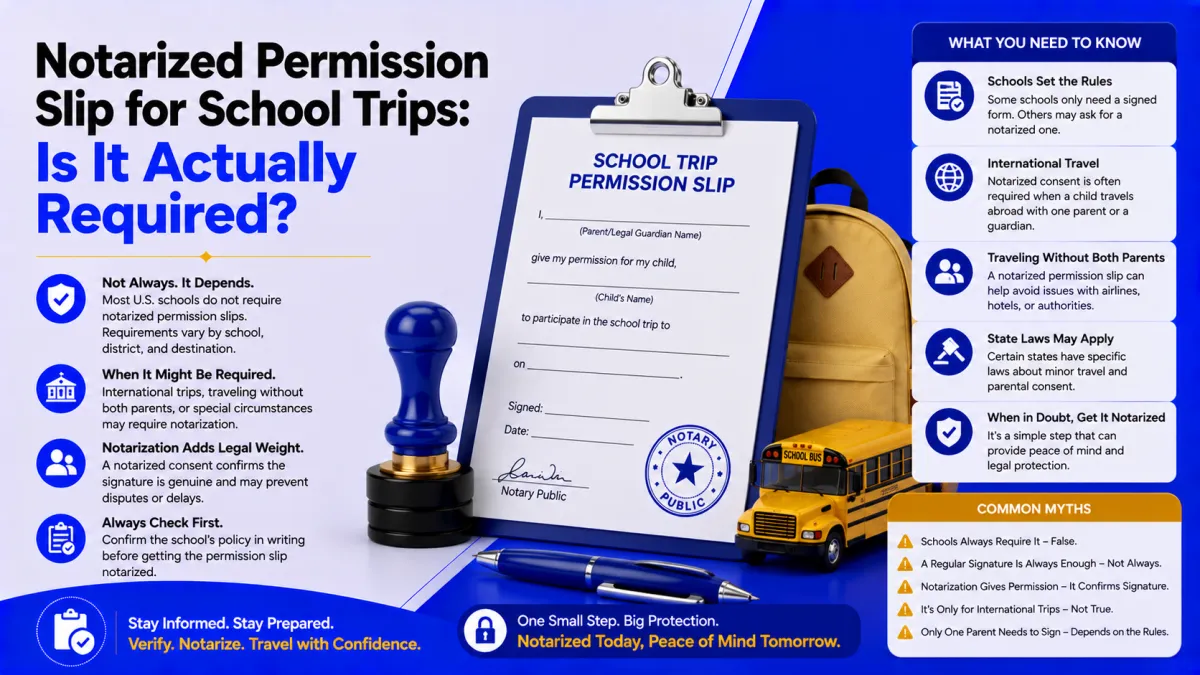

Quick answer: For a standard school field trip, a notarized permission slip is not required, a parent or guardian’s signature is enough. Notarization becomes necessary in specific situations: international travel, a minor flying unaccompanied, or a child traveling with a non-parent chaperone without both parents. In those cases, a notarized parental consent letter is often required by airlines or destination countries, even though no U.S. federal law mandates it. Always check what your school, airline, or destination actually asks for.
The permission slip comes home in a backpack, and somewhere on it, or in a parent group chat, the word “notarized” appears, and now you’re wondering whether a quick signature is really enough. For the everyday field trip, it is. A notarized permission slip for school is rarely required; a parent or guardian’s signature does the job. The exceptions are specific and worth knowing, because that’s where an unnotarized form can derail a trip at the airport.
This guide answers the literal question, maps the situations that genuinely need notarization, and clears up a distinction parents often miss — travel permission is not the same as medical permission.
What a notarized permission slip actually is
A notarized permission slip is a parental consent form whose signature has been verified by a notary public, the notary confirms the signing parent’s identity and that they signed willingly, then adds a seal. Notarization doesn’t change what the form says or grant any new authority; it simply makes the signature harder to dispute. For the underlying mechanics, see BlueNotary’s guide to notary certification.
That’s the key to the whole question: notarization is about proving the signature, so it only matters when someone down the line an airline, a border officer, a foreign country, needs that extra proof.
Do standard field trips need a notarized permission slip? No
For an ordinary school field trip, the museum, the zoo, a local day trip, a parent’s or guardian’s signature on the permission slip is sufficient. Notarization is not typically required. Schools collect a signed slip to confirm consent and acknowledge the activity, and that signature carries the permission.
Some schools may request notarization in narrower cases, an out-of-state or extended trip, or a liability waiver for a higher-risk activity — because a notarized form is stronger evidence the family was informed. But unless your school’s form explicitly says “must be notarized,” a signature is all you need. When in doubt, ask the teacher or office directly rather than assuming.
When notarization is genuinely required: the exception map
The real need for notarization shows up when a minor travels in a way that takes them outside the simple “school has a signed slip” situation. Here’s how the common scenarios break down:
| Scenario | Notarized consent needed? | Why |
|---|---|---|
| Local/in-state field trip | No | Parent signature is sufficient |
| Out-of-state or overnight school trip | Sometimes | Some schools request it; check the form |
| International school trip or travel | Usually yes | CBP recommends it; countries/airlines often require it |
| Minor flying unaccompanied | Often | Many airlines require a notarized consent letter |
| Travel with a non-parent chaperone without both parents | Usually yes | Borders/airlines expect proof both parents consented |
The thread connecting the “yes” rows: crossing a border or flying without both parents. That’s when a notarized parental consent letter becomes the document that prevents a child from being turned away.
International travel: the most important case
This is where parents get caught off guard. There is no U.S. federal law requiring a notarized travel consent form but U.S. Customs and Border Protection recommends one, and that recommendation has teeth in practice. Many countries, including Mexico, Canada, several EU nations, and much of Latin America, require or expect a notarized consent letter when a minor crosses their border without both parents, per U.S. Department of State guidance on traveling with minors.
So for an international school trip, a study-abroad program, or a child visiting relatives overseas, plan on a notarized consent letter. If the document will be used abroad, it may also need an apostille to be recognized, start with apostille vs. notary public and what an apostille is, and confirm with the destination country’s embassy.
Who has to sign the consent letter?
This trips families up, especially in separated or single-parent households. The general rule:
- Child traveling with one parent: The other parent signs the consent letter.
- Child traveling with a guardian, a chaperone, or alone: Both parents should sign.
The letter should clearly name the child, the accompanying adult (if any), the destination and dates, and a statement like: “I acknowledge that my child is traveling with [name] with my permission.” English is preferred for international use, and the National Notary Association’s sample parental consent letter is a useful reference. The same care that goes into any minor-related notarization applies here, see notarization for a minor.
Travel permission is not medical permission
Here’s the distinction that matters most for safety. A travel consent letter authorizes the trip, it does not give the accompanying adult authority to make medical decisions for the child. Those are two different documents:
- Emergency medical authorization clause:- A line in the consent letter letting the chaperone approve emergency treatment if a parent can’t be reached. Recommended, though not universally required.
- Child medical consent / minor power of attorney:- A separate document used when you want a caregiver (grandparent, relative, or chaperone) to consent to medical treatment for the child. This is the tool for delegating medical authority.
If your child is traveling on a longer program or staying with another adult, consider both the travel consent and a medical consent. A notarized affidavit format is often used for these sworn parental statements.
How to get a permission slip or consent letter notarized
If your situation does call for notarization, the process is quick:
- Use the correct document:- A simple signed slip for a local trip; a detailed consent letter (child, adult, destination, dates, signatures) for travel.
- Don’t sign in advance:- The notary must witness the signing.
- Bring valid photo ID:- For each signing parent.
- Choose how to notarize:- A bank, shipping store, or mobile notary works, see places to find a notary near you — or use remote online notarization to do it from home, which is handy when both parents aren’t in the same place.
- Confirm acceptance first:- Ask the school, airline, and (for international trips) the destination’s embassy what they require, so you notarize the right document once.
A real example: the Ramirez family sent their 15-year-old on a school trip to Spain with a teacher chaperone. The domestic permission slip needed only signatures, but the airline and Spanish entry rules called for a notarized consent letter signed by both parents, plus an emergency medical authorization. They handled it online the week before and the trip went off without a hitch at the border.
The bottom line
A notarized permission slip for school is the exception, not the rule. For a regular field trip, your signature is enough. Save the notarization for the situations that actually demand it, international travel, unaccompanied minors, and trips with a non-parent chaperone without both parents and remember that a travel consent letter doesn’t cover medical decisions. Check with the school, airline, and destination first, sign in front of the notary, and you’ll have exactly the document the trip requires. When you need a consent letter notarized quickly, even with parents in different places, BlueNotary can connect you with an online notary in minutes.
Need a child travel consent letter notarized before a trip? Start a session on BlueNotary to verify ID, sign on camera, and download a notarized consent letter the same day convenient when both parents aren’t together. First, confirm what your airline and destination require, then read how to use an online notary service to know what to have ready.
Frequently Asked Questions
Does a school permission slip need to be notarized?
For a standard field trip, no. A parent or guardian’s signature is sufficient. Some schools may request notarization for out-of-state, extended, or higher-risk trips, but unless the form specifically says so, a signature is enough.
When does a minor’s travel consent need to be notarized?
Mainly for international travel, when a minor flies unaccompanied, or when they travel with a non-parent adult without both parents. No U.S. federal law requires it, but CBP recommends a notarized consent letter for international minor travel, and many countries and airlines require one.
Does a field trip permission slip need a notary?
Usually not. A signed permission slip covers most field trips. Notarization is reserved for special cases like international or extended trips, or when a school specifically requests it on the form.
Do airlines require a notarized consent letter for a child?
Some do, particularly for unaccompanied minors or a child traveling with a non-parent adult. Airlines may also require an unaccompanied-minor service form and a fee. Check your specific airline’s policy before the travel date.
What should a notarized child travel consent letter include?
The child’s name, the accompanying adult’s name (if any), the destination and travel dates, a statement granting permission, and the parent signatures. English is preferred for international travel, and an emergency medical authorization clause is recommended.
Does a travel consent form allow medical decisions for a child?
No. A travel consent letter authorizes travel only. To let an accompanying adult make medical decisions, you need a separate child medical consent or a minor power of attorney, or at minimum an emergency medical authorization clause.
Who needs to sign a child travel consent letter?
If the child travels with one parent, the other parent should sign. If the child travels with a guardian, a chaperone, or alone, both parents should sign. This shows borders and airlines that both parents consented.
Can you notarize a permission slip online?
Yes. Remote online notarization lets a parent verify their identity and sign before a notary over secure video, which is convenient when parents are in different locations. Bring valid photo ID and don’t sign in advance.