


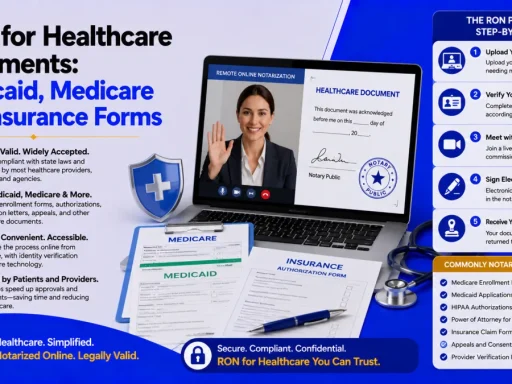
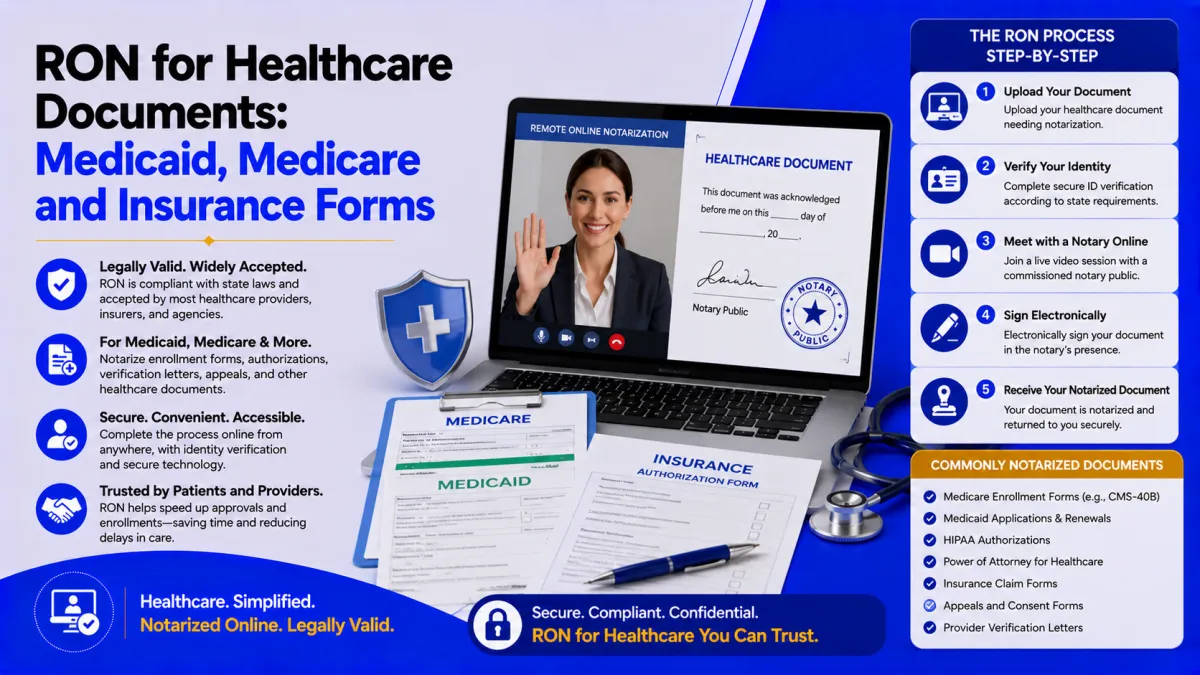

Quick answer: Remote notarization of healthcare documents works for many forms but only some healthcare paperwork needs a notary at all. Most Medicaid, Medicare, and insurance claim forms require only a signature, not notarization. Where notarization is needed, financial powers of attorney, certain insurance affidavits, and some advance directives, remote online notarization (RON) often works. The big exception is advance directives and healthcare powers of attorney, which carry special witness rules that, in some states, limit or block RON. Always confirm your state’s rules and what the receiving agency requires.
A family member is helping an aging parent with Medicaid paperwork, an insurance claim, and an advance directive all at once and the question is whether any of it can be handled by an online notary instead of a trip to an office. The honest answer to remote notarization of healthcare documents is “it depends on the document”: much of this paperwork doesn’t need a notary, some of it does, and a narrow but important slice, advance directives, comes with witness rules that can rule RON out.
This guide sorts the common documents by type, tells you what each actually needs, and flags exactly where remote notarization runs into trouble.
What remote notarization of healthcare documents means
Remote notarization of healthcare documents is the use of remote online notarization (RON), a notary verifying identity and witnessing signatures over live video to notarize health-, insurance-, or care-related paperwork that requires a notary. The key phrase is “that requires a notary,” because notarization is only relevant where a document or institution demands it. For how the technology itself works, see BlueNotary’s remote online notarization explainer.
RON doesn’t change whether a document needs notarizing that’s set by state law and the receiving agency. It only changes how the notarization happens once it’s required.
Most Medicaid, Medicare, and insurance forms don’t need a notary
Start here, because it saves people unnecessary trips. The routine paperwork usually needs a signature, not a notarization:
- Medicare claims and medical documentation require a handwritten or electronic signature from the responsible provider and, per CMS guidance, stamp signatures are not acceptable (with a narrow physical-disability exception). Notarization isn’t part of the standard requirement.
- Medicaid applications require the applicant’s signature to certify the information is accurate. Patient signatures for Medicaid claims are generally obtained by the state agency, not notarized.
- Most insurance enrollment and claim forms need a signature; notarization applies only to specific items (below).
So before booking any notary, check whether the form actually calls for one, many don’t.
Where notarization (and RON) genuinely apply
Notarization shows up around healthcare in specific, predictable places and for most of these, RON is a good fit:
- Financial / durable powers of attorney. When someone manages a loved one’s finances or Medicaid planning, the POA must usually be notarized (most states require it). These are commonly RON-eligible.
- Insurance affidavits and disputes. Proof-of-loss statements, lost-policy affidavits, fraud or identity statements, and some beneficiary-change disputes may require notarization, see BlueNotary’s guide to notarized affidavits and the identity affidavit.
- Beneficiary designations for certain policies or accounts, when the insurer requires a notarized signature.
For these, the witness requirements for online notarization and your state’s RON law govern the process, and a standard online session typically handles them.
The healthcare document matrix, notarize? RON?
Use this as the quick reference. “Varies” means the answer genuinely depends on your state and the receiving institution.
| Document | Notarization needed? | RON usually usable? |
|---|---|---|
| Medicare claim / medical documentation | No (signature only) | n/a |
| Medicaid application | No (certifying signature) | n/a |
| Financial / durable POA (Medicaid planning) | Usually yes | Often yes |
| Insurance affidavit / proof of loss / fraud statement | Often | Often yes |
| Beneficiary designation | Sometimes (per insurer) | Often |
| Healthcare power of attorney | Varies by state | Caution — verify |
| Living will / advance directive | Varies by state | Caution — verify |
| HIPAA authorization | No (signature only) | n/a |
The pattern:financial and insurance documents are RON-friendly; advance-care documents are the ones to verify first.
The caution zone: advance directives and healthcare powers of attorney
This is where remote notarization gets complicated, so it deserves its own section. An advance directive typically combines a living will (your care wishes) and a healthcare power of attorney (the person who decides for you). As the Mayo Clinic explains, these are governed by state-specific formalities and those formalities are exactly what can block RON.
The finalization requirements vary widely, per Nolo:
| State approach | What it requires | RON impact |
|---|---|---|
| Witnesses OR notary | Two qualified witnesses or notarization | RON may work if notarization is the chosen path |
| Witnesses AND notary | Both | Witness rules can complicate a remote session |
| Notary required for electronic versions | e.g., California | Notarization (possibly RON) expected |
| Witnesses in physical/electronic presence | e.g., Maryland allows electronic presence | RON-friendly where electronic presence is allowed |
Two specific traps:
- Witness rules: Many states require witnesses who are not the agent, not the attending physician, and sometimes not employees of the care facility and some require them to be physically present. A remote session may not satisfy a physical-presence witness rule.
- RON exclusions: Some states’ RON statutes exclude certain documents (wills are the classic example, and a few states limit health directives). Because the rules are state-specific and evolving, confirm with an attorney or your state’s authority before relying on RON for an advance directive, the same caution that applies to notarizing a will by state. The nonprofit CaringInfo publishes state advance-directive forms and instructions to check against.
Privacy: healthcare documents and a recorded RON session
Healthcare paperwork contains sensitive personal and medical information, and RON sessions are recorded as part of the audit trail. A reputable platform secures and stores those recordings, and the notary’s role is limited to verifying the signing not reviewing or sharing the document’s contents. Still, it’s reasonable to ask a provider how session recordings and any personal health information are protected before you upload health documents. For the basics of the secure session itself, see how remote notarization works.
How to handle healthcare documents with RON (without missteps)
A practical sequence that avoids the common errors:
- Identify whether the document even needs a notary:- Most Medicaid/Medicare/insurance forms don’t.
- For documents that do, confirm two things:- Your state allows RON for that document type, and the receiving agency, insurer, or facility will accept a remotely notarized version.
- For advance directives, check the witness rules first:- Physical-presence or witness-eligibility rules can override the notary question entirely.
- Make sure the document is complete:- Before the session, no blanks (see common notarization mistakes).
- Choose a compliant platform and have valid photo ID ready:- New to it? Start with how to use an online notary service.
A real example: Renee was helping her father set up Medicaid. His financial power of attorney needed notarization, and her state allowed RON, so they completed it online in one session. His advance directive, however, required two physically present witnesses under their state’s law, so they handled that one in person. Same afternoon, two different paths, decided entirely by the document type.
The bottom line
Remote notarization of healthcare documents isn’t all-or-nothing. Most Medicaid, Medicare, and insurance forms need only a signature; financial powers of attorney and insurance affidavits are usually RON-friendly when notarization applies; and advance directives sit in the caution zone, where state witness rules can complicate or block a remote session. Sort your paperwork by type, confirm both your state’s law and what the receiving institution accepts, and you’ll know exactly which documents you can handle online. When you’re ready to notarize an eligible healthcare document from home, BlueNotary can connect you with a commissioned online notary.
Have a healthcare-related document that needs notarizing, like a financial POA or insurance affidavit? Start a session on BlueNotary to verify ID, sign on camera, and download a notarized document the same day, from anywhere. For advance directives, confirm your state’s witness rules first, then read how to use an online notary service to know what to have ready.
Frequently Asked Questions
Do healthcare documents need to be notarized?
Most don’t. Medicare documentation and Medicaid applications generally need a signature, not notarization, and HIPAA authorizations are signature-only. Notarization typically applies to financial powers of attorney, certain insurance affidavits, and some advance directives, depending on state law.
Can an advance directive be notarized online?
Sometimes, but verify first. Advance directives have state-specific witness and notary rules, some require physically present witnesses, and a few states limit remote notarization for them. Where notarization is the accepted path and your state allows RON, it may work; confirm with an attorney or your state authority.
Do Medicaid or Medicare forms need to be notarized?
Generally no. Medicare requires handwritten or electronic signatures (not stamp signatures, except for physical disability), and Medicaid applications require a certifying signature. Notarization usually isn’t part of these forms, though related documents like a power of attorney may need it.
Can a healthcare power of attorney use remote online notarization?
It depends on your state. A healthcare power of attorney’s finalization rules, witnesses, notary, or both, vary, and witness-presence requirements can complicate a remote session. Confirm your state’s rules before relying on RON for it.
Do insurance forms need notarization?
Most enrollment and claim forms need only a signature. Notarization applies to specific items like proof-of-loss statements, lost-policy or fraud affidavits, and some beneficiary-change disputes. These are often eligible for remote online notarization.
Does a living will need to be witnessed or notarized?
It varies by state. Some states require two qualified witnesses, some require notarization, some accept either, and some require both. A few states have different rules for the living will and the healthcare power of attorney, so check your state’s form and instructions.
Can you notarize healthcare documents online?
Yes, for documents that require notarization and that your state and the receiving institution allow to be notarized remotely, commonly financial powers of attorney and insurance affidavits. Advance directives require extra caution due to witness rules.
Why do some states not allow RON for advance directives?
Because advance directives often require witnesses who must be physically present or meet eligibility limits, and some state RON statutes exclude particular document types. These formalities are designed to protect vulnerable signers, so states apply them strictly.