


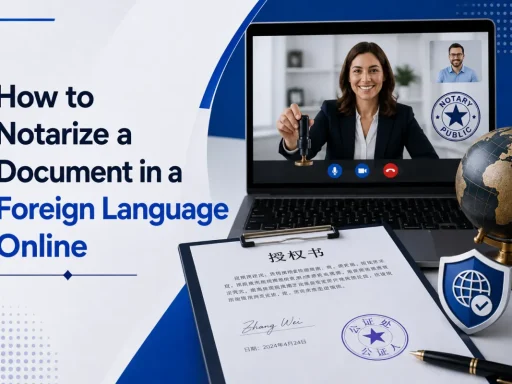


Quick answer: Yes, you can notarize a foreign-language document online. A notary notarizes your signature and identity, not the content, so the text can be in any language. Two rules decide it: you and the notary must share a spoken language (most states don’t allow an interpreter), and the notarial certificate must be in English (or a language the notary reads).
Can a notary notarize a document in a foreign language?
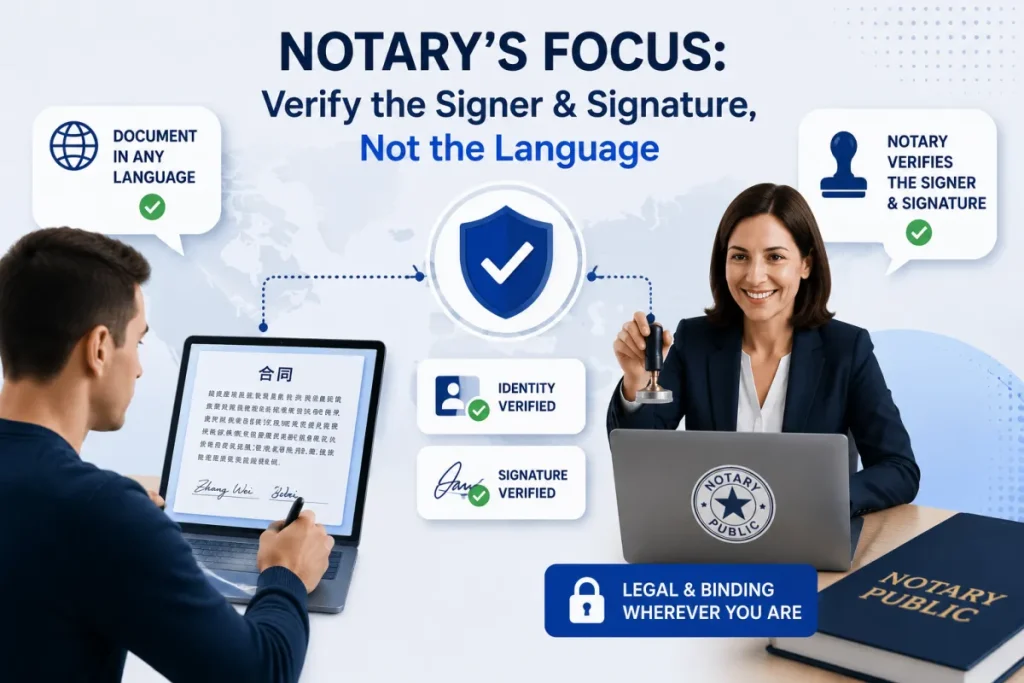
Yes. A notary’s job is to verify the signer’s identity and confirm they’re signing willingly, the notary does not vouch for the document’s contents. Because of that, the language of the document doesn’t have to be one the notary reads. A contract in Spanish, a power of attorney in Mandarin, or a declaration in Arabic can all be notarized.
What the notary does need to understand is the notarial act being performed (an acknowledgment or a jurat) and the certificate wording. And critically, the notary has to be able to communicate with you directly. Those two things, communication and the certificate, are where foreign-language notarizations succeed or fail.
The two rules that decide it
Rule 1: You and the notary must share a spoken language
Every notarial act requires direct verbal communication between the notary and the signer, in a language they both speak. The reason is fraud prevention, if a notary can’t talk to you directly, they can’t confirm you understand what you’re signing or that you’re acting willingly.
That’s why most states do not allow a translator or interpreter to stand between the notary and the signer, the notary would have no way to know the translation is accurate. According to the National Notary Association, only Arizona expressly permits an interpreter for this purpose. So in practice, you need a notary who speaks your language. Online notarization makes this easier, you can search for a notary fluent in your language instead of relying on whoever is nearby.
Rule 2: The notarial certificate must be in English
The document can be in any language, but the notary’s certificate, the acknowledgment or jurat wording the notary completes, usually must be in English or a language the notary can read. California goes further, it requires the exact statutory certificate wording, in English only, even if the notary reads the document’s language. The Oregon Secretary of State’s guidance on non-English notarizations is a good example of how states handle this.
If the document has no certificate the notary can read, the notary attaches a separate loose certificate in English.
Does the notary need to read the whole document?
No, the notary does not have to read or understand the document’s content. But a careful notary will take a few precautions before proceeding, because they can’t be misled about what’s happening:
- Confirm the notarial act you need: You (the signer) can tell the notary whether you need an acknowledgment or a jurat, the notary doesn’t have to read the document to know which act to perform.
- Check the document is complete: No blank spaces, and not already signed (for acts that require signing in front of the notary).
- Identify you with valid ID: A foreign passport is commonly accepted; rules vary by state.
A notary can refuse if they can’t communicate with you, suspect duress, or can’t identify a proper notarial act. That’s normal and protective, not a rejection of your document.
How to notarize a foreign-language document online: step by step
- Find a notary who speaks your language: This is the make-or-break step. Because most states bar interpreters, you need direct communication, choose an online platform that lets you match with a notary fluent in your language.
- Confirm the notarial act and prepare the document, unsigned: Know whether you need an acknowledgment or a jurat. Make sure the document is complete, and don’t sign yet if the act requires signing live.
- Create an account and upload the document as a PDF: Foreign-language text is fine, the platform doesn’t need to read it. See how remote online notarization works if it’s your first time.
- Verify your identity: You’ll present a valid government photo ID (a foreign passport is commonly accepted). Identity-proofing for non-U.S. signers may use alternative checks, since knowledge-based questions rely on U.S. data.
- Communicate directly and sign on the live call: The notary speaks with you in your shared language, confirms you understand and are willing, watches you sign, and completes the act.
- The notary attaches an English certificate and seal: The notarial certificate is completed in English (or a language the notary reads), and the tamper-evident electronic seal is applied.
- Download your notarized document: If an agency also needs it in English, arrange a certified translation separately (next section).
Notarizing vs. translating: don’t confuse them
This trips people up constantly. Notarizing a foreign-language document does not translate it, and it does not certify a translation. The notary only handles your signature and identity.
| Notarization | Certified translation | |
|---|---|---|
| What it does | Verifies the signer’s identity and signature | Provides an accurate English version + translator’s certification |
| Who performs it | A commissioned notary | A qualified translator |
| Covers the content? | No | Yes |
| When you need it | A signature must be officially witnessed | An agency (e.g., USCIS) needs the document in English |
If you’re submitting a foreign document to a U.S. agency, you most likely need a certified translation (not a notarized one), and possibly notarization of a separate affidavit. For documents used abroad, see US document requirements for international use.
Common mistakes to avoid
- Booking a notary who doesn’t speak your language: Most states won’t let an interpreter bridge the gap, direct communication is required.
- Expecting notarization to translate the document: It only handles the signature, translation is separate.
- Assuming the certificate can be non-English: Many states (California strictly) require English certificate wording.
- Pre-signing: For a jurat or many acknowledgments, you sign in front of the notary.
- Using a notarized translation when an agency wants a certified one: Check the requester’s exact wording.
Conclusion
Notarizing a document in a foreign language online is entirely doable, because the notary is verifying you, not reading your document. The whole thing comes down to two rules, find a notary who speaks your language (most states won’t allow an interpreter to stand in), and make sure the notarial certificate is in English or a language the notary reads. Keep in mind that notarization isn’t translation, if an agency needs an English version, that’s a separate certified translation. Get those right and your document holds up wherever you’re sending it.
Need it done now? Connect with a commissioned online notary on BlueNotary in about 15 minutes, 24/7, and choose one who speaks your language so the session is smooth and valid. Not sure your document even needs a notary? Check what documents require notarization first.
Frequently asked questions
Can a notary notarize a document in a foreign language?
Yes. A notary verifies the signer’s identity and signature, not the document’s content, so the text can be in any language, provided the notary can communicate with the signer and complete an English certificate.
Does the notary have to understand the language of the document?
No. The notary doesn’t need to read the document. They do need to understand the notarial act being performed and complete the certificate in a language they can read, usually English.
Can a notary use a translator or interpreter?
In most states, no. Direct communication between the notary and signer in a shared language is required. Arizona is the rare state that expressly allows an interpreter.
Does the notarial certificate have to be in English?
Usually yes. Most states require the certificate wording in English or a language the notary can read. California requires exact statutory wording in English only.
Is notarizing the same as translating a document?
No. Notarizing verifies the signer’s identity and signature; it does not translate the document or certify a translation. A certified translation is a separate service.
Can you notarize a foreign-language document online?
Yes. The same rules apply over a live video session, shared-language communication and an English certificate, and online platforms make it easier to find a notary who speaks your language.