


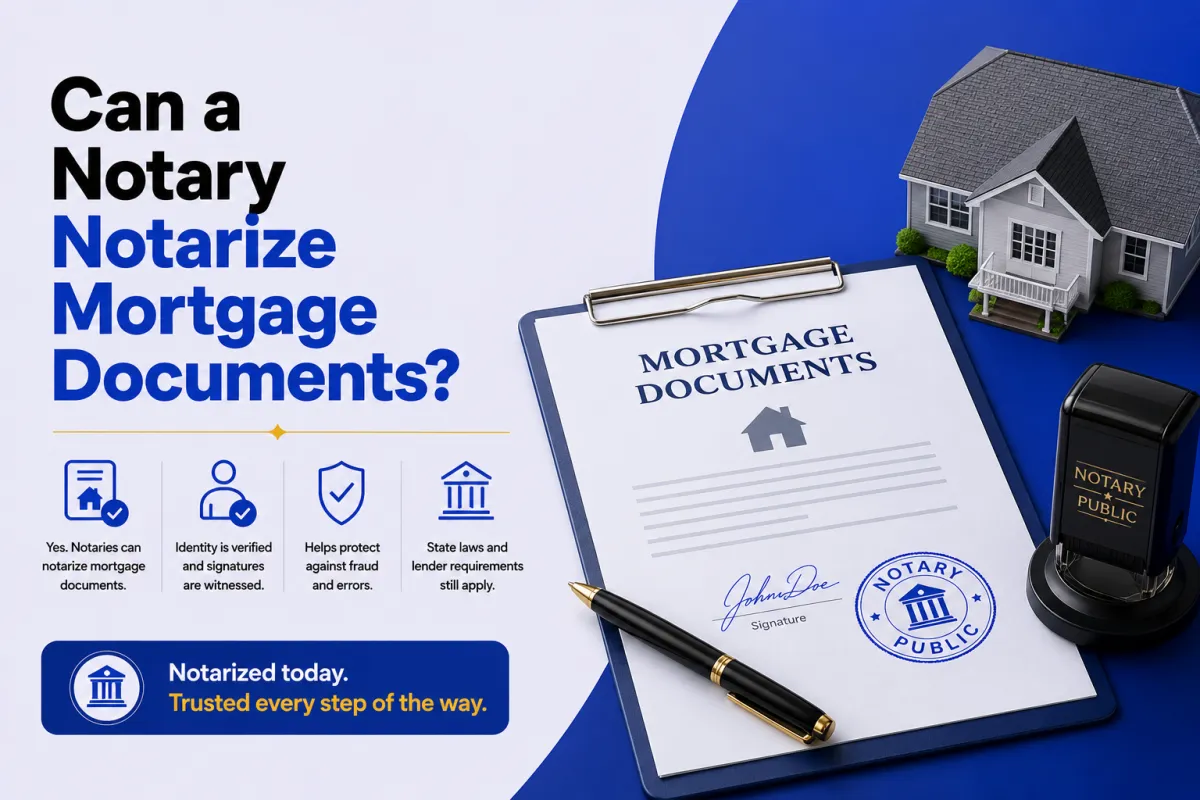

Quick answer: Yes, a notary can notarize mortgage documents. Any commissioned notary can notarize an individual document like a deed of trust. But for a full mortgage loan closing, lenders and title companies usually require a Notary Signing Agent (NSA), a notary with loan-signing training, a background check, and E&O insurance who guides the borrower through the whole package.
Can a notary notarize mortgage documents?
Yes. A commissioned notary public is fully authorized to notarize mortgage documents, the deed of trust or mortgage, related affidavits, and other closing papers that require a notarial act. Notarizing these is a standard part of what notaries do, since real estate documents must be notarized to be recorded and to protect against fraud.
The nuance isn’t whether a notary can notarize a mortgage document, it’s which notary you need for the job. A single document is one thing; a full loan closing is another, and that’s where the Notary Signing Agent comes in. For the document itself, see how a mortgage promissory note is signed and notarized.
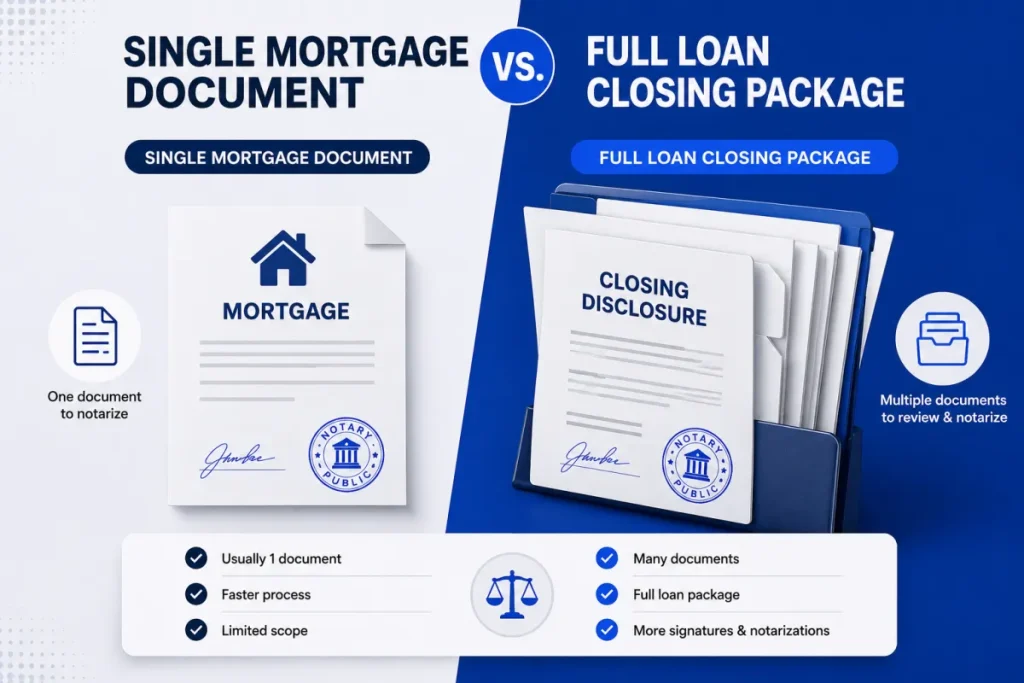
Individual documents vs. a full loan closing
Here’s the distinction that answers most people’s real question:
- A single mortgage-related document: Say, a deed of trust, a subordination agreement, or a power of attorney for a closing, can be notarized by any commissioned notary who verifies your identity and witnesses your signature.
- A complete mortgage loan closing: The full stack of loan documents a borrower signs, is usually handled by a Notary Signing Agent (NSA), because lenders and title companies want a notary trained specifically on loan packages.
So if your task is “get this one document notarized,” a regular notary works. If it’s “close my mortgage,” you’re almost certainly looking at an NSA. The documents involved in a closing are covered in what documents require notarization.
What a Notary Signing Agent (NSA) is, and why lenders require one
A Notary Signing Agent is a notary public with extra qualifications for loan signings. Beyond a standard commission, an NSA typically has:
- Loan-document training: They know the deed of trust, note, closing disclosure, and the rest of the package.
- A background screening: Lenders and title companies require it for trust.
- Errors & omissions (E&O) insurance: Coverage in case of a mistake.
Their job at a closing is to present the documents, ensure every signature, initial, and date is correct, and get the package back on time, not to explain your loan. Lenders prefer (and often require) an NSA because a botched signing can derail a funding. If you’re a notary considering this path, see how to become a loan signing agent.
Can mortgage documents be notarized online?
Yes, increasingly. Mortgage documents can be notarized through remote online notarization (RON) where two things line up: your state authorizes RON for the documents, and your lender and title underwriter accept an online closing. Many now do, which is why online mortgage closings (and refinances) are growing.
The online notary still verifies your identity, witnesses your e-signatures, and applies a tamper-evident seal, see how remote online notarization works. For a mortgage specifically, confirm with your lender that they support RON before scheduling, since acceptance varies by loan and county.
What a notary or NSA does not do
This matters, so it’s worth being clear, a notary or signing agent verifies identity and witnesses signatures, they do not give legal or financial advice. An NSA can point you to where to sign, but they cannot interpret your interest rate, explain whether a loan is a good deal, or advise you to sign.
If you have questions about your loan terms, those go to your lender, loan officer, or an attorney, not the notary. The notary’s role is to make the signing valid, not to counsel you on the deal. Confirm what your state allows in the notarization requirements by state guide.
Conclusion
A notary can notarize mortgage documents, that’s routine. The real question is which notary you need, for a single document, any commissioned notary will do; for a full mortgage loan closing, lenders and title companies almost always require a Notary Signing Agent with loan-document training, a background check, and E&O insurance. More closings now happen online through remote online notarization where the state and lender allow it. Whichever route you take, remember the notary’s job is to verify and witness, not to advise you on your loan.
Closing or refinancing soon? Handle your mortgage notarization online with a commissioned notary on BlueNotary, including full eClosings where your lender supports them. Just have one document to notarize? A standard online notarization covers it in minutes.
Frequently asked questions
Can a notary notarize mortgage documents?
Yes. Any commissioned notary can notarize an individual mortgage document like a deed of trust. A full loan closing, however, usually requires a Notary Signing Agent trained on loan packages.
Do you need a Notary Signing Agent for a mortgage closing?
Usually yes. Lenders and title companies generally require a Notary Signing Agent for full loan closings because they’re trained on the loan package and carry a background check and E&O insurance.
What is a Notary Signing Agent?
A Notary Signing Agent is a notary public with additional loan-signing training, a background screening, and errors & omissions insurance, qualified to guide borrowers through a full mortgage loan package.
Can any notary do a loan signing?
Not typically. Any notary can notarize a single document, but lenders and title companies usually require a certified Notary Signing Agent for a complete loan closing.
Can mortgage documents be notarized online?
Yes, where the state authorizes remote online notarization and the lender and title underwriter accept it. Online mortgage closings are growing, but acceptance varies by loan and county.
Does a notary give advice on loan documents?
No. A notary or signing agent verifies identity and witnesses signatures. They can’t interpret your loan terms or advise you to sign — those questions go to your lender or an attorney.