




A child travel consent form is a surprisingly simple yet powerful legal document. At its core, it’s a formal letter giving a minor permission to travel without both of their parents or legal guardians. Think of it as an official permission slip that proves the child isn’t being taken out of the country or across state lines without authorization, heading off any serious misunderstandings with airlines or border agents.
Why This Form Is a Travel Essential, Not an Option
Picture this: you’ve made it through security, you’re at the gate ready to board, and an airline agent stops you. Your niece, nephew, or even your own child is with you, but the other parent isn’t. The agent asks for proof that you have permission to travel with them, and you have nothing to show. That’s a nightmare scenario that plays out more often than you’d think. This simple form is your key to making sure that travel day goes smoothly.
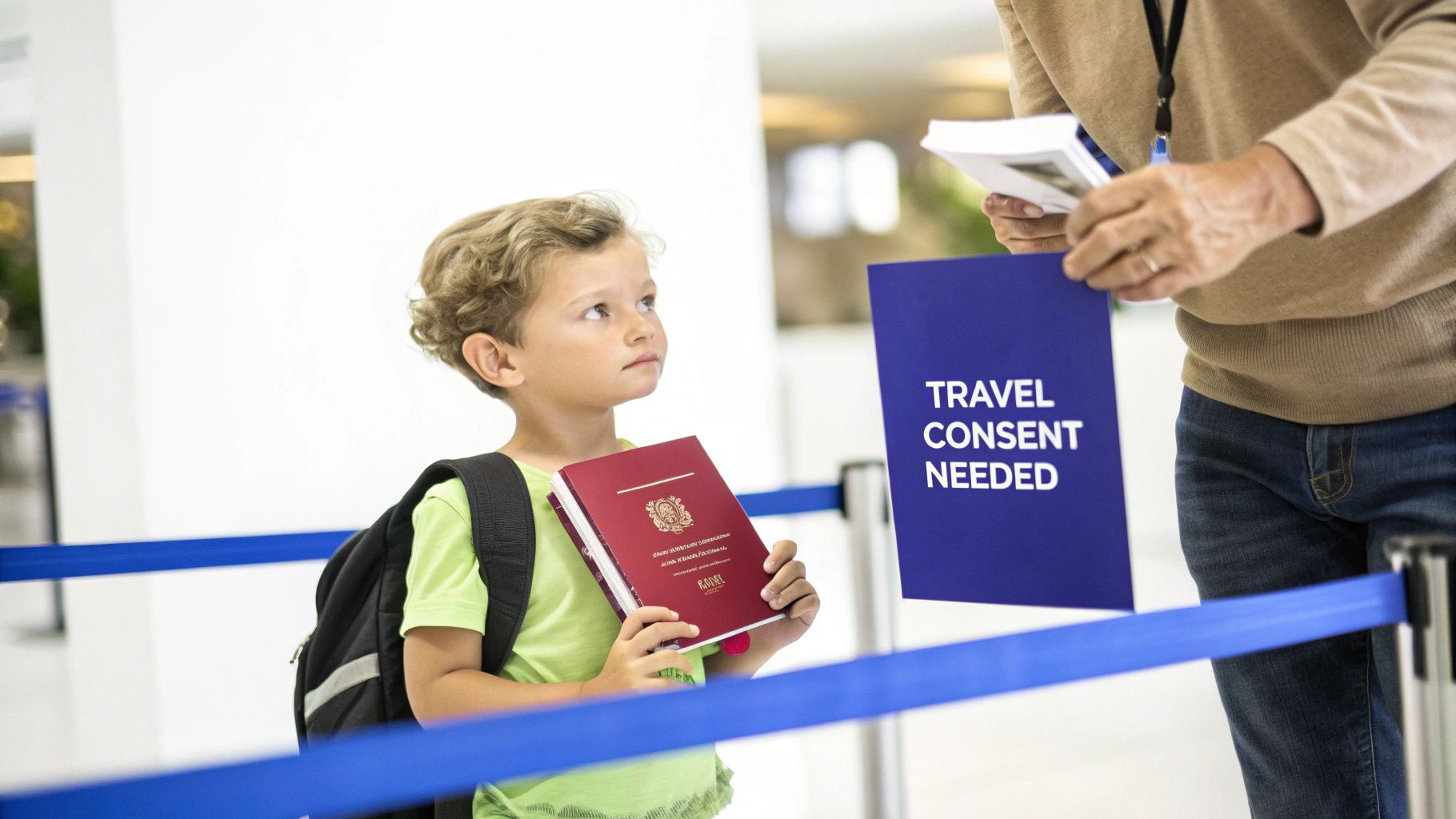
While the U.S. doesn’t have one single federal law that forces you to carry this form for every trip, that doesn’t diminish its importance. The people who do have the power to stop you—like airline staff and border officials—absolutely look for it.
To understand just how critical this document can be, it helps to see who might ask for it and why.
Who Requires a Child Travel Consent Form
This table breaks down the key authorities and situations where a child travel consent form is essential, helping you understand the stakes.
| Authority/Situation | Why They Ask For It | What Happens If You Don’t Have It |
|---|---|---|
| Airlines | To comply with their own internal policies and avoid liability in potential parental kidnapping cases. They want to ensure the travel is authorized. | You could be denied boarding at the gate, even with valid tickets. Your trip ends before it even begins. |
| U.S. Customs & Border Protection (CBP) | To prevent international child abduction, which is a major focus for them. Their primary goal is the child’s safety and welfare. | Lengthy delays, intense questioning, and in some cases, being denied entry or exit from the country until consent is verified. |
| Foreign Immigration Officials | Many countries have strict laws to protect minors. They require proof of consent to ensure the child is not being trafficked or taken illegally. | The child (and the accompanying adult) could be denied entry into the foreign country and sent back on the next flight. |
| Divorced or Separated Parents | To prove the traveling parent isn’t violating a custody order. It provides clear evidence that both parties agreed to the trip. | The non-traveling parent could accuse the other of parental kidnapping, leading to serious legal consequences. |
As you can see, the consequences of not having one are far more inconvenient than the small effort it takes to prepare one.
Border Scrutiny Is on the Rise
In the last few years, international border agencies have become much more vigilant about protecting children. This isn’t just bureaucratic red tape; it’s a direct response to global efforts to combat child trafficking and abduction. The U.S. Department of State now strongly recommends carrying a notarized consent letter anytime a child travels without both parents.
This isn’t an empty warning. CBP has noted that it questions minors traveling with only one parent frequently, and recent 2024 travel advisories suggest that this leads to significant delays in over 15% of these encounters. This is about giving officials undeniable proof that everything is above board. A handwritten note just won’t cut it; they need a properly drafted and, ideally, notarized document to be satisfied.
Navigating Different Family Situations
For families with separated or divorced parents, this form is even more critical. If you have a joint custody agreement, this letter serves as proof that the trip doesn’t violate its terms. It prevents a misunderstanding from escalating into a serious legal accusation and ensures both parents are on the same page.
Ultimately, the question isn’t “Do I really need this?” but rather, “Why would I risk traveling without it?” A child travel consent form is a foundational part of any modern family’s travel checklist. It’s a small bit of preparation that delivers huge peace of mind.
Getting the Right Information on Your Form
When you’re putting together a child travel consent form, getting the details right is everything. A form that’s vague or missing key information can cause the very red flags and delays you’re hoping to avoid. Think of it this way: you’re building a clear, undeniable case that this trip is authorized, and every piece of information is another bit of proof.

This isn’t just about ticking boxes. When you understand why each detail matters, you can create a document that leaves no room for doubt. Let’s walk through exactly what you need to pull together.
The Child’s Core Details
This is the foundational stuff, and it has to be perfect. Every detail here will be checked against the child’s passport or birth certificate, and any little discrepancy can bring the whole process to a screeching halt.
- Full Legal Name: Use the name exactly as it’s printed on their official documents. No nicknames or shortened versions here.
- Date of Birth: This confirms their age and must match their ID.
- Place of Birth: Another key identifier that helps confirm their identity.
- Passport Information: For any international travel, this is a must. Include the passport number, date of issue, and expiration date. This creates a direct, undeniable link between the consent form and the child’s travel ID.
Information for the Parent Giving Consent
The whole point of this form is to document the permission of the non-traveling parent (or parents). Their information needs to be crystal clear so officials can contact them for verification if they feel it’s necessary.
You’ll need their full legal name and up-to-date contact information, including a current address and a reliable phone number. This shows they’re accessible and can vouch for the trip. The identity verification step during notarization also depends on this data being 100% accurate. To get a better sense of how this works, our deep dive into professional https://bluenotaryonline.com/identity-verification/ shows the standards used to confirm someone is exactly who they claim to be.
Details of the Accompanying Adult
Officials need to know precisely who has been entrusted with your child. This person is taking on a huge responsibility, and their identity has to be clearly laid out.
Make sure you include:
- Full Legal Name: The full name of the parent, grandparent, or guardian traveling with the child.
- Relationship to the Child: Be specific. Is this person the “parent,” “grandparent,” “aunt,” or “legal guardian”?
- Passport Information: Just like for the child, the accompanying adult’s passport number is crucial for international trips.
A Clear and Specific Travel Itinerary
“Permission to travel in July” just won’t cut it. That kind of vague language is a major red flag for border agents because it’s too open to interpretation. You need to be specific to show that the consent is for this trip and this trip alone.
A well-defined itinerary is one of the strongest elements of a child travel consent form. It shows that the consenting parent is fully aware of the trip’s scope, from destinations to duration, and has approved those specific plans.
Your itinerary should lock down the details:
- Travel Dates: List a firm start and end date.
- Destination(s): Name the city, state, and country for every planned stop.
- Accommodation Details: Include the name and address of the hotel, resort, or private residence.
- Flight Information (if applicable): Note the airline, flight numbers, and airports. This creates a concrete paper trail for the journey.
Addressing Special Custody Situations
Not every family fits the same mold, and your paperwork has to reflect your legal reality. If you have sole legal custody, you’re not done just by stating it. You absolutely must have a certified copy of the court order proving it. This official document takes the place of the other parent’s signature.
The same logic applies if the other parent is deceased. A copy of the death certificate is the required proof. In these situations, your word isn’t enough—you need the official documentation to back it up. Make gathering these papers a priority as you prepare your complete travel packet.
Navigating International and Airline-Specific Rules
One of the most common and costly mistakes parents make is assuming a single child travel consent form is a one-size-fits-all document. The reality is, the rules can change dramatically the second you cross a border or even walk up to a different airline’s check-in counter. A form that works perfectly for a domestic flight might be completely useless for an international trip.
This lack of a universal standard puts the responsibility squarely on you, the parent or guardian, to do your homework. Sometimes an airline’s internal policy is even tougher than the laws of the country you’re flying to. They have the final say on who gets on their plane, and they will always err on the side of caution to avoid any legal trouble.
Country-Specific Mandates You Can’t Ignore
Different countries have wildly different expectations for a child travel consent form. Some might just recommend you have one, but for others, it’s a strict legal requirement. Showing up without the proper paperwork can mean being denied entry. It’s that simple.
Let’s look at a few real-world examples to see just how much these rules can vary:
- Canada: Our northern neighbor is famously strict about this. The Government of Canada flat-out requires a signed consent letter for any minor traveling abroad alone, with only one parent, or with someone else. This isn’t just a suggestion; it’s a firm rule enforced at every port of entry.
- South Africa: This country has some of the most rigorous rules on the planet. They demand notarized parental consent and certified copies of birth certificates for all minors. This policy, brought in back in 2014 to combat child trafficking, was incredibly effective, cutting unauthorized child exits by 40% by 2025. You can find more details about these diverse requirements for a child travel consent form on fasterdraft.com.
- Mexico: It’s very common for officials here to ask for a notarized consent letter, especially if the child is with an adult who isn’t their parent. I always recommend having a Spanish translation of the form on hand, just to smooth things over with immigration officers and avoid any language barriers.
And that’s just a quick snapshot. Countries in Europe’s Schengen Area, along with many across Latin America and Asia, have their own specific demands. Some might even require the document to be legalized with a special certificate called an apostille. If you’re heading to a member country, it’s a good idea to check our guide on the Hague apostille country list to see if you need this extra layer of authentication.
When Airlines Have Their Own Rulebook
Don’t forget, airlines are private companies, and their number one goal is to avoid risk. To protect themselves from getting tangled in custody disputes or international abduction cases, they often create their own policies for kids traveling.
For example, major carriers like Delta, United, and American Airlines all have detailed rules for minors on international flights. They might require a consent form even when the destination country doesn’t technically demand it. Their gate agents are trained to spot potential red flags, and a child traveling with just one adult—especially one with a different last name—is an immediate reason for a closer look.
Pro Tip: Never assume the airline’s rules are the same as the country’s. Think of the airline as your first checkpoint. If you don’t meet their requirements, you won’t even make it to the border agent.
Your Three-Step Verification Process
To travel with confidence and sidestep any last-minute disasters, you need a solid game plan. Don’t just rely on what a friend told you or what you read on an old travel blog. You need to verify the rules for your specific trip directly from the official sources.
- Check with Your Airline: Your first stop should be the airline’s website. Search for their policy on “minors traveling internationally” or just call their customer service line. Ask them directly what paperwork they require for your exact destination.
- Consult the Destination Country’s Embassy: The absolute best source for a country’s entry requirements is its embassy or consulate in your home country. Their website will have an official list of everything you need, including details on language, notarization, or translation for a child travel consent form.
- Review Your Home Country’s Travel Advisories: Finally, take a look at your own government’s travel advisory board (like the U.S. Department of State). They provide essential advice and often spell out the documentation requirements for popular destinations, giving you a third confirmation of what you’ve learned.
By following these three steps, you create a triangle of verification that ensures you have all your bases covered. This methodical approach turns travel anxiety into genuine preparedness, so you can handle any question that comes your way.
Getting it Signed and Stamped: The Final Legal Hurdles
You’ve carefully filled out the child travel consent form, and now it’s time for the most critical part: making it legally official. This is where signatures and notarization come in. Think of this step as transforming a simple piece of paper into a powerful legal document that border agents and airline staff are trained to recognize and respect.
First things first, you need to figure out exactly who needs to sign. This depends entirely on your specific travel situation, and getting it wrong is a common but easily avoidable mistake.
- One parent traveling with the child? The non-traveling parent is the one who signs. Their signature is the official green light for the trip.
- Child traveling with someone else (like a grandparent or coach)? In this case, both parents (or all legal guardians) must sign the form to grant permission.
- Do you have sole custody? You’ll be the one signing, but you absolutely must attach a copy of the court order that proves it. This document essentially speaks for the other parent.
Here’s a tip I can’t stress enough: Do not sign the form ahead of time! The whole point of notarization is to have a certified official watch you sign it. If you show up with it already signed, the notary will have to reject it, and you’ll be forced to start the process all over again.
Why the Notary’s Seal is So Important
A notary public is an impartial witness commissioned by the state. Their job isn’t to proofread your document or give legal advice; it’s to verify your identity and witness your signature. This simple act is a massive deterrent to fraud.
When a customs officer or airline agent sees that notary seal, it tells them the signatures are authentic and the consent is genuine.
Without that seal, your form is just a letter. With it, it becomes a sworn statement that carries real legal weight. That’s what officials are looking for.
This flowchart gives you a good visual of the different authorities you should be checking with as you prepare for your trip.
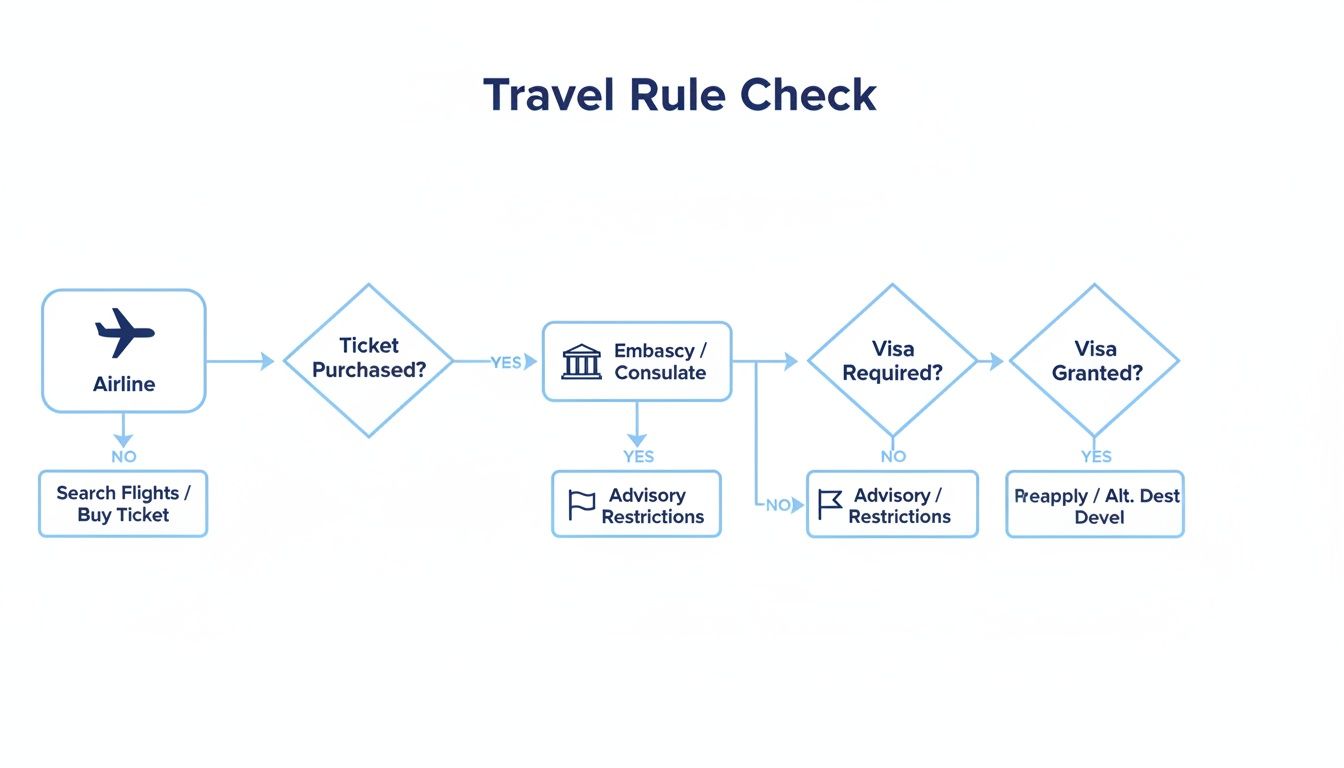
As you can see, a quick check with the airline, the destination country’s embassy, and government travel advisories is the best way to make sure you’ve covered all your bases.
Finding a Notary: In-Person vs. Online
The traditional route involves tracking down a local notary at a bank, law firm, or even a shipping store and making an appointment. This method still works perfectly well.
However, for busy parents, technology now offers a far more convenient path: Remote Online Notarization (RON).
RON platforms connect you with a live, commissioned notary public through a secure video call. You can get the entire thing done from your living room, often in just a few minutes.
The real advantage of RON is that it combines convenience with top-notch security. These platforms use advanced identity verification tech and create a tamper-proof digital record of the signing, making it an incredibly reliable and efficient option.
Services like BlueNotary have this process down to a science, providing a fast, compliant way to get your travel documents ready. The requirements are similar to other official forms; you can even see how the process works for a DS-3053 passport consent form, which is a specific type of travel consent.
No matter which route you take—online or in-person—remember that every single person signing the document will need to show a valid, government-issued photo ID, like a passport or driver’s license. This is a strict requirement. The notary’s main job is to confirm you are who you say you are before they can stamp your form.
Putting Together Your Complete Travel Document Packet
Think of your notarized child travel consent form as the main event, but it definitely shouldn’t show up to the party alone. To save yourself a world of stress and potential headaches at the border, you’ll want to assemble a complete travel document packet. I always tell parents to view this packet as their secret weapon against travel delays—a well-organized folder can answer an official’s questions before they’re even asked.
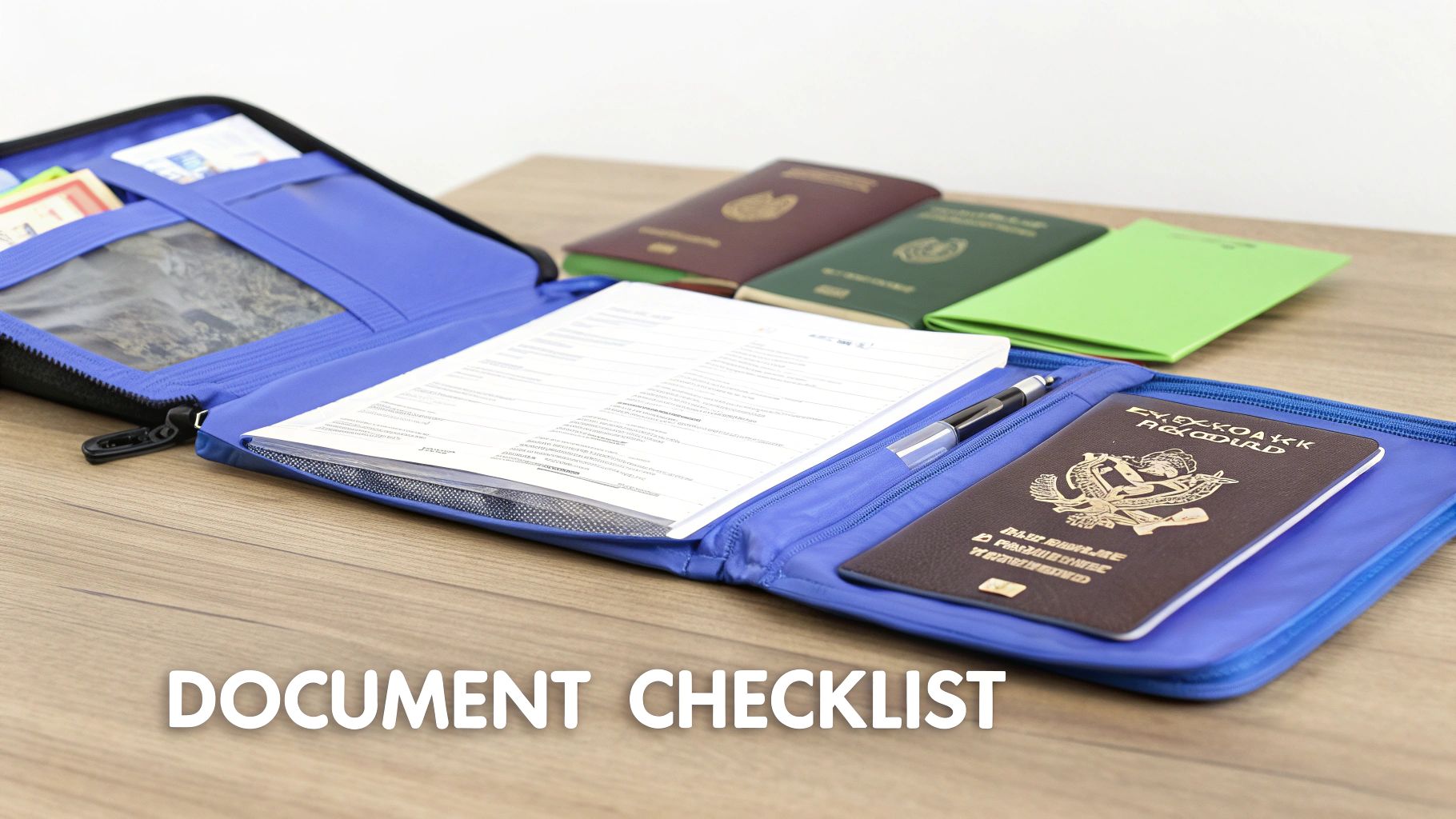
This isn’t about packing a filing cabinet. It’s about being strategic and bringing supporting documents that paint a clear, undeniable picture of a trip that’s been properly planned and fully approved by everyone involved.
Your Supporting Document Checklist
Beyond the consent form, a few key documents provide essential backup. Border agents are trained to verify, and having these papers ready to go shows you’ve done your homework. Always bring physical copies, and keep them organized.
Here’s what I recommend having alongside the consent form:
- Photocopy of the Non-Traveling Parent’s ID: Make a clear copy of the passport or driver’s license that the non-traveling parent signed the consent form with. This allows an official to instantly match the signature on the ID to the one on the notarized document. It’s a simple but powerful step.
- Child’s Birth Certificate: A certified copy is always best. This is your proof of parental relationship, which is critical if the child and the traveling adult have different last names.
- Relevant Court Orders: If you have sole custody or any other specific legal arrangement that affects travel, you must bring a copy of the official court paperwork. This isn’t optional—it’s the document that holds the most weight and overrides everything else.
Pro Tip: I always make digital backups. Scan every single document and save it to a secure cloud service like Google Drive or Dropbox. If your physical folder gets lost or stolen, you can access and print copies from anywhere in the world. It’s a lifesaver.
What About Group Travel?
When a child is traveling with a school group, sports team, or on a mission trip, the documentation gets a bit more involved. The consent form is still the foundation, but the trip organizers will almost certainly need more from you so they can act on your behalf if something goes wrong.
In fact, child travel consent forms are now standard practice for any organization running group trips. For massive youth sporting events like the Little League World Series, these forms are required for all 15,000 international participants. Event reports show this simple step helps prevent border issues in 98% of cases. And when you consider that an estimated 25 million children travel for educational tours each year, it’s no surprise that UNICEF has noted missing forms can lead to entry refusals in up to 10% of those cases. You can see more about how organizations are using these forms in this overview of travel consent forms.
For these kinds of trips, your packet should also include:
- Medical Consent Form: This is crucial. It gives chaperones the authority to get medical care for your child in an emergency.
- Group Itinerary: A detailed schedule of the trip.
- Emergency Contact Sheet: A list of key contacts for the group leaders and other parents.
Smart Organization for a Smooth Trip
Trust me, how you organize these papers really matters. The last thing you want is to be frantically digging through a backpack with a customs official staring you down. A simple, waterproof document folder or a travel wallet with clear sleeves is a small investment that pays off big.
I always keep the child’s passport, the travel consent form, and my own passport clipped together for immediate access. The supporting documents, like the birth certificate and ID photocopies, can go in a separate sleeve right behind them. This system looks professional, projects confidence, and lets you hand over exactly what’s needed without any fumbling.
Common Questions About Child Travel Consent
Even after you’ve dotted every ‘i’ and crossed every ‘t’, a few tricky questions can pop up when you’re getting ready to travel with a child. It’s totally normal. Let’s walk through some of the most common sticking points I’ve seen parents run into.
Does The Form Need to Be in a Specific Language?
This is a fantastic and often overlooked question. For the most part, writing the form in English is the way to go. It’s the standard for aviation and international travel, and it’ll get you through check-in and departure from the U.S. without a hitch.
But here’s where a little extra prep pays off: once you land, you’re on their turf. If you’re heading to a country where English isn’t the primary language—think Japan, Mexico, or France—having a translated version of the form is a brilliant move. It can be the difference between a smooth entry and a frustrating delay with a local immigration official who isn’t fluent in English.
Expert Tip: Before you go, always check the destination country’s embassy website for their specific rules. Some nations are very particular about language, and showing up with a translated form shows you’ve done your homework.
How Long Is a Child Travel Consent Form Valid?
There’s no universal expiration date on these forms. Its validity really comes down to what you write on it.
From my experience, the safest and most universally accepted approach is to create a new form for each specific trip. Clearly state the exact travel dates—the day you leave and the day you return. This leaves zero room for ambiguity and proves consent was given for this particular journey. It can be tempting to create a “blanket” letter for six months or a year if you travel often, but that can invite extra scrutiny from border agents questioning if it’s still relevant.
For maximum peace of mind, just create a new, freshly notarized form for every single international trip.
What if I Cannot Locate the Other Parent for a Signature?
This is one of the toughest situations a parent can face, and it needs to be handled carefully. If you have sole legal custody, the path is clear: you must bring a certified copy of the court order proving it. This official document acts in place of the other parent’s signature, showing you have the exclusive authority to make travel decisions.
Things get much trickier if you share custody but simply can’t find or contact the other parent after making real, documented efforts. Trying to travel without their signature or a court order specifically permitting the trip is incredibly risky and could even lead to accusations of parental kidnapping. You absolutely need to seek legal advice well in advance of your trip to figure out your options. It’s also worth understanding challenges when parental consent is withheld to see just how critical proper legal authorization is in these family law matters.
Is a Consent Form Needed for Domestic US Travel?
Technically, no federal law requires a consent form for flights within the United States. But is it a good idea to have one anyway? Absolutely.
The decision to ask for proof of relationship is often left to the discretion of individual airline staff and TSA agents. Their main job is child safety, and they’re trained to ask questions if a situation doesn’t feel right.
Here’s why having one is just plain smart:
- Different Last Names: If you and the child have different surnames, a form immediately clears up any confusion about your relationship.
- Airline Policies: Some airlines have their own internal rules that are stricter than federal regulations. It never hurts to check with your carrier.
- Peace of Mind: Honestly, this is the biggest reason. A simple signed letter (it doesn’t even need to be notarized for domestic trips) can defuse any potential issue on the spot. It’s a classic “better safe than sorry” move that takes just a few minutes to prepare.
At BlueNotary, we provide a secure and incredibly efficient platform for Remote Online Notarization, helping you get your essential travel documents like the child travel consent form notarized from anywhere, at any time. Ensure your travel plans are protected with a legally sound, professionally notarized document. Learn more and get started at https://bluenotaryonline.com.