






A notarized document isn’t some kind of special paper from a government office. It’s any regular document—a contract, an affidavit, a power of attorney—that has a specific section added to it by a Notary Public. This extra bit is called a notarial certificate, and it’s the official proof that the signer’s identity was checked and they signed the document on purpose.
Think of it as the document’s official, legally-recognized handshake. It transforms a simple signature into a powerful, verifiable act.
The Anatomy of a Notarized Document
At first glance, a notarized document can look deceptively simple. You’ll see the original text of the agreement or statement, but the real action happens in a dedicated space, usually at the end of the document or on a separate, securely attached page. This is where the notary does their job, turning a routine signature into something with real legal weight.
This added section is what notarization is all about. It creates a clear, transparent record of who signed, where they signed, when it happened, and what kind of notarial act was performed. Without this specific information, the notarization is worthless and will likely be rejected by courts, government agencies, or anyone else who needs to rely on it.
Key Visual Elements at a Glance
So, what should you actually be looking for? While the exact layout can differ a bit from state to state, every properly notarized document includes a few core elements. These are the visual cues that work together to create a trustworthy record.
To help you spot these components quickly, here’s a quick rundown of the essential visual elements you can expect to find on any properly notarized document.
| Element | What It Is | Why It’s Important |
|---|---|---|
| Notarial Certificate | The specific block of text that describes the notarial act (e.g., an acknowledgment or a jurat). | It contains legally required wording that outlines what the notary is certifying. |
| Notary’s Signature | The handwritten or electronic signature of the Notary Public. | This is the notary’s personal confirmation that they performed the act correctly. |
| Notary’s Seal/Stamp | The official ink stamp, embosser, or secure digital seal. | This is the notary’s mark of office, proving their authority to act. |
Each piece plays a crucial role. The certificate provides the context, the signature provides the personal attestation, and the seal provides the official authority.
The Unmistakable Stamp of Authority
A standard notarized document in the U.S. will always feature a specific block of text, a clear description of the notarial act, the notary’s printed name and signature, their commission number, and the date their commission expires. It’s all topped off with that official physical or electronic seal.
These elements are found in over 90% of accepted notarizations because they create a rock-solid foundation for the document’s legal value. The National Notary Association is a great resource for digging into the specifics of these requirements.
A notarized document tells a story. The venue says where it happened, the date tells you when, the signature confirms who, and the seal provides the official verification from a trusted third party. Each piece is a chapter in that story.
Getting familiar with these components is the first step to confidently knowing a valid notarized document when you see one. Now, let’s break down each of these elements in more detail.
Decoding the Notarial Certificate Block
The notarial certificate is the heart and soul of any notarized document. It’s that specific block of text, usually at the end of the document or on its own attached page, that serves as the official record of the whole event. Think of it as the notary’s sworn testimony about what happened.
This section isn’t just a jumble of legalese; it’s a carefully constructed statement. Every word has a legal job to do, telling anyone who looks at the document exactly what the notary did, where they did it, and when. Getting to know its parts is the key to understanding what a notarized document looks like and, more importantly, confirming it’s legitimate.
The Venue: Setting the Stage
Right at the top of the certificate, the first thing you’ll almost always see is the venue. This isn’t where the document is going to be filed or where the signer lives. It’s the precise physical location—state and county—where the notarization actually took place.
It usually looks something like this:
- State of [State Name]
- County of [County Name]
This little detail is a big deal because it establishes the notary’s jurisdiction. A notary can only perform their duties in the state that gave them their commission. The venue proves the act was done legally, within their authorized turf. If a notary from Texas tries to notarize something while they’re on vacation in Florida, that act is invalid, and the venue will show it.
Core Components of the Certificate
Once you move past the venue, you get to the main body of the certificate. This is where the story of the notarial act is told. While the exact wording will change based on whether it’s an Acknowledgment or a Jurat, a few key elements are always there.
These core data points are what give the document its legal weight. A document’s acceptance depends on these details being present and correct. In fact, industry reports show that simple mistakes like a missing seal or a wrong date are some of the biggest reasons documents get rejected, causing headaches and expensive do-overs. For a closer look at the market impact, you can explore data on e-notary software.
Here’s what you should always look for:
- The Date of Notarization: This is the exact date the signer stood (or sat) before the notary. The notary has to fill this in at the moment of signing.
- The Signer’s Name: The certificate will clearly state the name of the person whose signature is being notarized.
- Notary’s Signature: The notary has to sign the certificate, usually with the exact same signature the state has on file.
- Notary’s Printed Name: Below the signature, the notary’s full legal name—as it appears on their commission—must be printed or stamped.
These pieces all work in concert to create a solid chain of evidence, tying the signer, the notary, and the specific time and place together into one verifiable record.
A notarial certificate is like a reporter’s summary of an event. It answers the fundamental questions: Who signed? Where and when did they sign? And who officially witnessed it?
The Notary’s Commission Information
Finally, you’ll find the notary’s official credentials. This information is the ultimate proof of the notary’s authority to act and is absolutely non-negotiable for a valid notarization. It creates a direct trail back to the state that commissioned them, so anyone can double-check that the notary is in good standing.
You should always be able to find:
- The Notary Seal or Stamp: This is the notary’s official mark. It typically includes the notary’s name, their state of commission, and often their commission number and expiration date.
- Commission Number: A unique ID number the state assigned to that specific notary.
- Commission Expiration Date: The date the notary’s permission to act expires. A notarization performed even one day after this date is invalid.
This final layer provides security and transparency. For a deeper dive into the specific language and layouts you might see, our guide on what exactly is a notarial certificate provides more detailed examples. By understanding each part of this certificate block, you can confidently spot a properly notarized document from a mile away.
How to Tell Different Notarizations Apart
When you see a notarized document, that block of text the notary adds isn’t just a formality. It’s a specific, legally binding statement that tells you exactly what happened during the signing. Think of it as the document’s official record, explaining who signed, where, and under what circumstances.
Not all notarizations are created equal. Each type serves a unique purpose, and the wording in the notarial certificate is your guide to understanding which act was performed. For anyone dealing with legal, financial, or real estate paperwork, knowing how to spot the differences is absolutely essential.
The Acknowledgment Certificate
The most common type of notarization you’ll encounter is the Acknowledgment. Its job is simple but critical: to confirm that a signer personally appeared before the notary, was properly identified, and then “acknowledged” that they signed the document willingly.
Crucially, the notary isn’t verifying that the information in the document is true. Their focus is solely on the signer’s identity and their voluntary signature. That’s a key distinction.
You’ll find Acknowledgment certificates on documents where the signer’s willing consent is the most important factor.
- Real Estate Deeds: To ensure the person selling the property is doing so of their own free will.
- Powers of Attorney: To verify the person granting authority to someone else understands the gravity of their decision and isn’t being coerced.
- Trusts and Wills: To confirm the creator of the trust or will signed it intentionally.
The key phrase to look for is something like: “…personally appeared [Signer’s Name], who acknowledged that he/she/they executed the same.”
This image breaks down the fundamental components of any notarial certificate, which form the basis for specific acts like Acknowledgments or Jurats.
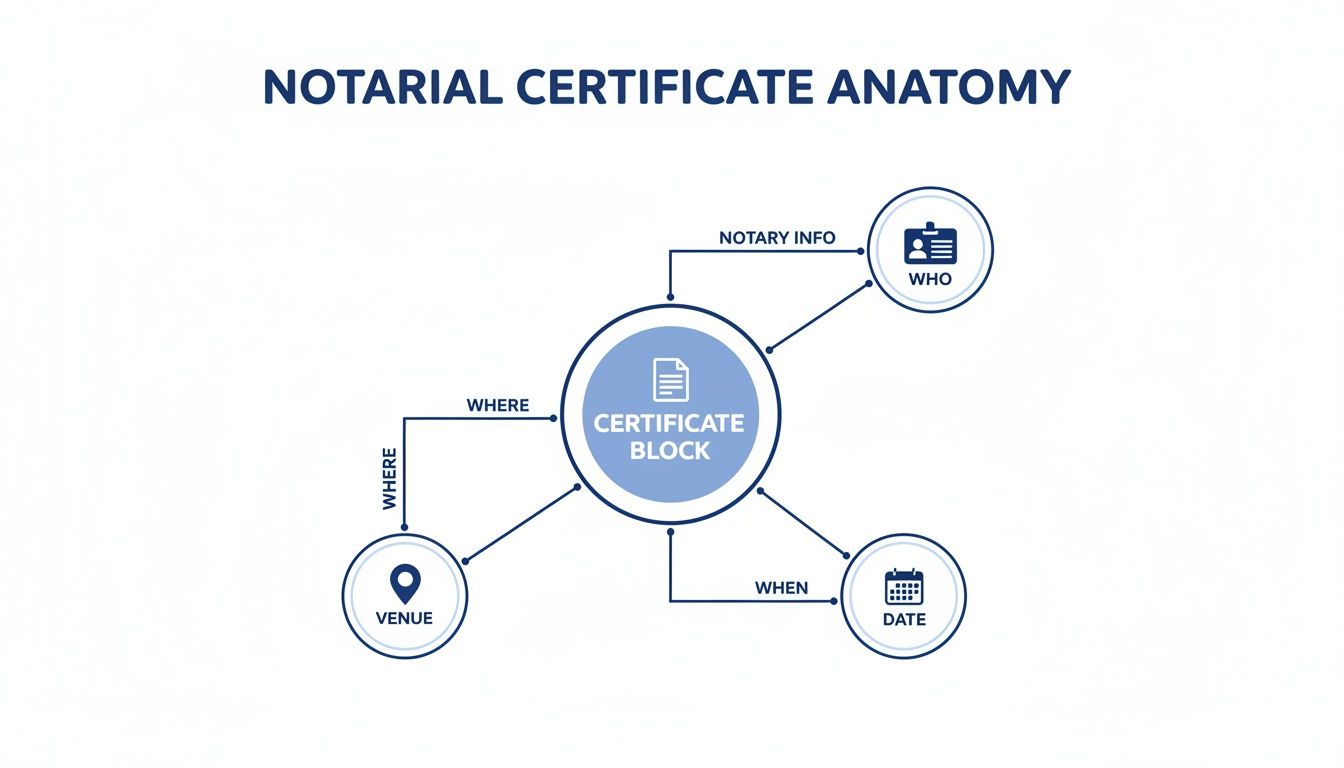
It highlights the core elements—who, where, and when—that create a solid, verifiable record of the notarial event.
The Jurat Certificate
A Jurat takes the notarization a step further. While an Acknowledgment is about the act of signing, a Jurat is all about the truthfulness of the document’s contents.
For a Jurat, the signer must show up, sign the document right there in the notary’s presence, and then swear or affirm—under penalty of perjury—that everything stated in the document is true. This requires the notary to administer a verbal oath or affirmation.
The Bottom Line: An Acknowledgment verifies the signer’s identity and willingness. A Jurat verifies that the signer has been placed under oath regarding the truth of the document’s statements.
Because of this oath, Jurats are mandatory for documents where the signer is making a sworn statement.
- Affidavits: Written statements of fact made under oath, often used in court proceedings.
- Depositions: Sworn testimony from a witness taken outside of court.
- Government Applications: Think passport applications, where making a false statement carries serious penalties.
The tell-tale wording for a Jurat is: “Subscribed and sworn to (or affirmed) before me…” That word, “sworn,” is the dead giveaway. To dig deeper into this specific certificate, you can learn more about what a Jurat is and its legal weight in our detailed guide.
Notarial Certificate Types Compared
To make things even clearer, here’s a quick breakdown of the most common notarial certificates you’ll see.
| Certificate Type | Primary Purpose | Key Wording Example | Common Document |
|---|---|---|---|
| Acknowledgment | Certifies the signer’s identity and voluntary signature. | “…acknowledged that they executed the same.” | Deeds, Powers of Attorney, Trusts |
| Jurat | Certifies the signer was put under oath and attested to the document’s truthfulness. | “Subscribed and sworn to (or affirmed) before me…” | Affidavits, Depositions |
| Signature Witnessing | Certifies that the notary personally watched the signer sign the document. | “…signed in my presence on [Date].” | Contracts, Agreements |
| Copy Certification | Certifies that a photocopy is a true and accurate copy of an original document. | “I certify this is a true and correct copy of the original…” | Diplomas, Driver’s Licenses |
This table helps illustrate how the specific language used by the notary directly reflects the legal function of the notarization.
Signature Witnessing and Copy Certification
Beyond the two main players, notaries perform a few other key acts, each with its own distinct certificate wording.
Signature Witnessing is as straightforward as it sounds. The notary simply certifies that they personally watched the individual sign the document. The certificate wording will state this plainly, with a phrase like “signed in my presence” or “witnessed by me.” This is different from an Acknowledgment, where the document could have been signed before the meeting.
Copy Certification is another specific function. Here, a notary confirms that a photocopy of an original document is a true, complete, and faithful reproduction. The notary must have the original document in hand to make this certification.
The certificate will clearly identify it as a “Certified Copy” and use language like, “I certify that this is a true and correct copy of the original document…” It’s worth noting that not all states allow notaries to certify copies, especially for vital records like birth or death certificates.
Once you learn to spot these key phrases and understand what each notarization is meant to accomplish, you’ll be able to quickly and confidently assess what a notary document really means.
The Notary Seal: From Ink Stamp to Digital Signature

The notary seal is probably the most recognizable part of any notarized document. It’s that official mark that instantly communicates authority and authenticity. For decades, this meant one of two things: a classic ink stamp or a raised metal embosser. Both served the exact same purpose—to leave a verifiable mark from a commissioned public official.
When you see a physical seal on a document, it’s far more than just a decorative stamp. Every state has strict laws dictating what information has to be inside its borders. This ensures that every seal provides a clear, consistent trail right back to the notary who applied it.
Anatomy of a Traditional Notary Seal
A physical notary seal, whether it’s stamped in ink or pressed with an embosser, is designed for immediate recognition. It has to be legible and placed near the notary’s signature without covering up any of the document’s text.
The exact shape—circular or rectangular—can vary by state, but the information it contains is pretty universal:
- The Notary’s Full Name: This must perfectly match the name on their official commission.
- The State of Commission: It clearly shows the jurisdiction where the notary is authorized to work.
- A Commission Number: This is a unique ID assigned by the state.
- The Commission Expiration Date: This date is critical. Any notarization done after this date is invalid.
This collection of information is what elevates a simple piece of paper to a document with real legal weight. The seal is basically the notary’s official badge, confirming they’ve met their state’s requirements to perform the act.
The Shift to Digital Seals and Signatures
As business has moved online, so has the notary seal. In the world of Remote Online Notarization (RON), the very concept of a “seal” gets a major upgrade. It’s no longer just an image of a physical stamp slapped onto a PDF. It’s a sophisticated piece of technology.
A digital notary seal is a cryptographically secure element that is electronically fused to the document. The process uses a digital certificate uniquely tied to the notary’s verified identity. This is leagues more secure than a simple image, which could be copied and forged with minimal effort.
A digital seal isn’t just a picture; it’s an active security feature. It embeds the notary’s identity into the document’s code, creating a lock that shows if anyone has tried to alter the file after notarization.
This evolution brings a whole new level of security and transparency to notarization, making digital documents more trustworthy than ever.
How Digital Notarization Enhances Security
The real magic of a digital seal happens behind the scenes. When a notary applies their seal during a RON session, several things occur automatically to lock down the document’s integrity. Understanding this is key to appreciating how a modern digital notarized document actually works.
Here are the security features that a digital seal brings to the table:
- Tamper-Evident Technology: The cryptographic signature creates a digital “fingerprint” of the document at the exact moment of notarization. If someone changes even a single character later on, the digital seal will show as invalid, immediately flagging the unauthorized alteration.
- Verifiable Audit Trail: Every single action taken during a RON session—from the signer’s identity verification to the final click of the mouse—is recorded in a secure, unchangeable log. This audit trail is attached to the document itself, providing a complete history of the notarization.
- Secure Identity Verification: The digital seal is bound to a rigorous identity verification process the notary had to pass to get their digital certificate in the first place. This ensures the person applying the seal is exactly who they claim to be.
These features make today’s notarized documents far more secure and verifiable than their paper predecessors. You can get a better sense of this technology by learning how platforms facilitate secure eSignature workflows. The seal is no longer just a standalone stamp; it’s part of an integrated system of trust.
Why a Notarized Document Looks Different by Location
If you’ve ever handled legal paperwork from another state, you might have noticed something a little off. The notary seal on a document from Florida is a rectangle, but the one from California is a circle. This isn’t a mistake—it’s a perfect illustration of how geography shapes the look and feel of a notarized document.
The key thing to remember is that notarization in the United States is regulated at the state level, not by the federal government. Each of the 50 states gets to write its own rulebook for notaries public. These laws dictate everything from the shape of the seal to the exact words on the certificate.
State-Specific Notary Rules
Think of it like this: the U.S. isn’t one big notary system, but a collection of 50 smaller ones. While they all share the same basic goal of verifying identity and witnessing signatures, the way they get there can look surprisingly different from one state line to the next.
Here are a few common ways this plays out:
- Seal Shape and Content: Some states are very particular. Texas, for instance, requires a rectangular ink stamp. California, on the other hand, mandates a circular seal. The information required inside that seal—like a commission number, county, or expiration date—also changes depending on local laws.
- Certificate Wording: The actual text a notary uses for an Acknowledgment or a Jurat often comes directly from state-provided templates. A notary in New York might use slightly different phrasing than one in Florida, even when performing the very same notarial act.
- Journal Requirements: In some states, keeping a detailed logbook of every notarization is mandatory. In others, it’s just a recommended best practice. This behind-the-scenes difference can affect the official record-keeping tied to the document you’re holding.
These subtle but critical details are why a document notarized in Arizona will never be a mirror image of one from Maine. The takeaway? What’s “correct” is entirely relative to the state where the notary’s pen hit the paper.
A Tale of Two Legal Systems
The differences get even starker when you zoom out to a global view. Worldwide, notarization is split between two major legal traditions: the common law system (used in the U.S., U.K., and Australia) and the civil law system (found across Europe, Latin America, and parts of Asia).
In the common law world, a notary is first and foremost a witness. Their job is to confirm who someone is and watch them sign. They then attach a simple certificate to a document that someone else—usually an attorney or one of the parties involved—has already prepared.
The role of a civil law notary is much closer to that of a specialized transactional lawyer. They don’t just witness a signature; they are often responsible for drafting the entire legal instrument, providing counsel, and guaranteeing its legal validity.
This fundamental difference in duty creates a massive visual and structural gap. A notarization in France, for example, might be a lengthy, multi-page document drafted from scratch by the notary, who is a public official vouching for the entire transaction. An American notarization, by contrast, is a small, standardized block of text added to a document created by somebody else.
This global context is incredibly important. Around 70% of the world’s population lives under a civil law system, where notarial acts are formal, state-sanctioned instruments drafted by the notary. You can find more insights on these global notarial practices and see how they impact what documents look like. Understanding this divide is the key to making sense of why international paperwork can feel so foreign.
Common Questions About Notarized Documents
Even when you know what to look for, a few common questions always seem to pop up. Let’s clear up some of the most frequent points of confusion you might run into when dealing with notarized documents.
Can the Notary Certificate Be on a Separate Page?
Yes, definitely. This is a very common practice, and the separate page is often called a “loose certificate.”
For it to be valid, the certificate page has to clearly reference the document it belongs to. You’ll typically see details like the document’s title, the date it was signed, and the total number of pages. The notary then staples it securely to the original document.
Does a Notary Stamp Mean the Document Is True or Legal?
This is one of the biggest misconceptions out there. The answer is a firm no.
A notarization does not confirm that the statements in a document are true, accurate, or legally sound. The notary’s job is much more specific: they confirm the signer’s identity, watch them sign, and ensure they are signing willingly. They are an impartial witness to the act of signing, not an auditor of the content.
A great way to think about it is that a notary is like a high-tech security camera for a signature. It captures who signed the document and when, but it offers no opinion on the contract itself. The entire focus is on the signer’s identity and their voluntary act of signing.
What Are the Red Flags of a Fake Notarized Document?
Spotting a forgery often comes down to paying close attention to the details. Keep an eye out for inconsistencies and missing information.
Here are some of the most common red flags:
- The notary seal is missing entirely, or key details like the commission expiration date are gone.
- The seal impression is smudged or unreadable, making it impossible to see the notary’s name or commission number.
- The dates don’t line up. For example, the notarization is dated before the document itself was even created.
- You see obvious signs of alteration, like white-out or scribbled-out information within the notarial certificate.
- For a digital document, the biggest red flag is if it lacks a valid digital signature trail when you inspect it with a PDF reader.
For any business, keeping these important documents organized and secure is a top priority. To better manage, store, and track these records over their lifecycle, many companies look into professional document management services.
Ready to bring your notarizations into the modern era? BlueNotary offers a secure, compliant, and easy-to-use platform for Remote Online Notarization. Simplify your workflows and get tamper-proof, verifiable signatures every time. Visit https://bluenotaryonline.com to get started.