





A remote online notary (RON) service takes the entire, traditional notarization process and moves it online. This means you can get your documents legally notarized from just about anywhere using a computer or smartphone. It swaps the old-school, in-person meeting for a secure, live audio-video session, resulting in a legally binding and tamper-evident digital record.
What Is a Remote Online Notary?
Think about the last time you had to get a document notarized. You probably had to find a notary, drive to their office, show your ID, physically sign a piece of paper, and then watch them apply their stamp and signature.
Now, imagine doing all of that from the comfort of your home office, a coffee shop, or even a hotel room while traveling. That's exactly what remote online notarization does. It's a live video call with a commissioned notary public, but with a whole lot more happening behind the scenes.
This isn't just a simple video chat. It’s a sophisticated, legally sound process that layers multiple technologies to guarantee security and legitimacy. It's the digital equivalent of a firm handshake, witnessed and verified in real-time by a professional, creating an electronic document that's often far more secure than its paper predecessor.
The Technology Behind the Process
A successful RON session relies on a stack of specific technologies that work together. Each piece has a critical job, whether it's confirming someone's identity, locking down the document, or creating an airtight record of the entire event.
Here's what makes it all work:
- Live Audio-Visual Connection: This is the core of the experience—a live, two-way video conference. The signer and the notary have to see and hear each other clearly, which satisfies the legal requirement for "personal appearance" in a digital format.
- Secure Identity Verification: Before the notarization can even start, the system has to prove you are who you say you are. This is done through a multi-step process, often involving scanning a government-issued ID and answering a series of personal questions that only you would know (this is called knowledge-based authentication, or KBA).
- Electronic Signatures (eSignatures): During the live video session, you’ll apply your legally binding signature to the document electronically.
- Digital Notary Seal and Certificate: The notary affixes their own electronic seal and a unique digital certificate. This is the modern version of the ink stamp, and it cryptographically seals the document, making any future changes immediately obvious.
- Comprehensive Audit Trail: Every single step—from the moment you start the ID verification to the final signature—is automatically recorded. This creates a detailed, unchangeable digital log of the entire transaction.
A remote online notarization isn’t just about convenience; it’s about creating a superior evidentiary record. The audio-video recording and detailed digital audit trail provide a level of verification and fraud deterrence that traditional paper-based methods simply cannot match.
To truly grasp the shift, it's helpful to see the two methods side-by-side.
Traditional Notary vs. Remote Online Notary at a Glance
This table breaks down the fundamental differences between the old way and the new way of getting documents notarized.
| Feature | Traditional Notarization | Remote Online Notary (RON) |
|---|---|---|
| Location | Requires in-person physical presence of all parties. | Parties can be anywhere in the world with an internet connection. |
| Scheduling | Limited by office hours and travel time. | Available 24/7/365 from most platforms. |
| Identity Proofing | Visual ID check by the notary. | Multi-factor: ID analysis, KBA, and biometric checks. |
| Document Medium | Physical paper documents. | Secure digital documents (e.g., PDFs). |
| Signatures & Seal | Wet ink signatures and an ink stamp. | Secure eSignatures and a tamper-evident digital seal. |
| Record Keeping | A physical journal entry kept by the notary. | A detailed digital audit trail plus an audio-video recording. |
| Security | Susceptible to forgery and document tampering. | High; encrypted documents and a robust audit trail deter fraud. |
| Turnaround Time | Can take days, depending on coordination. | Often completed in under 15 minutes. |
As you can see, RON doesn't just replicate the traditional process online—it fundamentally improves upon it, especially in areas like security, record-keeping, and speed.
Why This Matters for Your Business
Getting a handle on the mechanics of RON is the first step. The real payoff is understanding how this technology can reshape your day-to-day operations.
It's not just a replacement for an in-person meeting; it's a strategic advantage that drives efficiency, tightens up security, and helps you stay compliant in an increasingly digital world. By breaking down geographical barriers and ditching manual, paper-based steps, RON lets you close deals faster, serve clients better, and cut down on operational headaches. It turns what was once a time-consuming chore into a quick, secure, and straightforward digital transaction.
How a Secure RON Session Actually Works
On the surface, a remote online notary session might look like a simple video call. But under the hood, there’s a sophisticated, multi-layered security process running to protect everyone involved. Think of it less like a casual video chat and more like stepping into a secure digital vault where every single action is verified, recorded, and sealed.
The entire workflow is built not just for convenience, but to make the transaction legally sound and incredibly resistant to fraud. Let's walk through what the user actually experiences, step-by-step, to see how this digital handshake gets done.
Phase 1: The Digital Doorman and Identity Verification
Before you even see the document, the system has to answer one critical question: are you really who you say you are? This is where the first layer of security, multi-factor identity verification, kicks in. It’s a far cry from the quick glance at a driver's license you get in person.
The process usually happens in a few quick stages:
- Government-Issued ID Analysis: First, you’ll snap a picture of the front and back of your ID, like a driver's license or passport. The platform’s tech then runs a forensic analysis on it, checking for things like holograms, microprint, and other security features to confirm it’s the real deal and not a fake.
- Knowledge-Based Authentication (KBA): Next, you’ll face a short quiz. The system generates a few questions based on your personal history, pulling from public and private data records. These "out-of-wallet" questions might be about a previous address or a car you used to own—details a thief with a stolen ID probably wouldn't know.
- Biometric Confirmation: Some platforms add one last checkpoint using facial biometrics. The system compares a live selfie or a short video of your face against the photo on your ID, making sure the person holding the ID is the same one in the picture.
This rigorous, automated gauntlet dramatically cuts down the risk of identity fraud. To get a closer look at the tech behind this, you can dig into the specifics of identity verification for online notarization.
Phase 2: The Live Notarization Session
Once you’ve passed the identity checks, you’re connected to the live, face-to-face meeting with a commissioned remote online notary. This is the modern, digital version of the "personal appearance" requirement that’s always been central to notarization.
During this recorded audio-video session, the notary will visually confirm your identity one more time, make sure you understand the document you’re about to sign, and witness you apply your signature in real time. This direct interaction is key to ensuring you're signing willingly and not under duress.
The visual below breaks down this simple three-step flow.
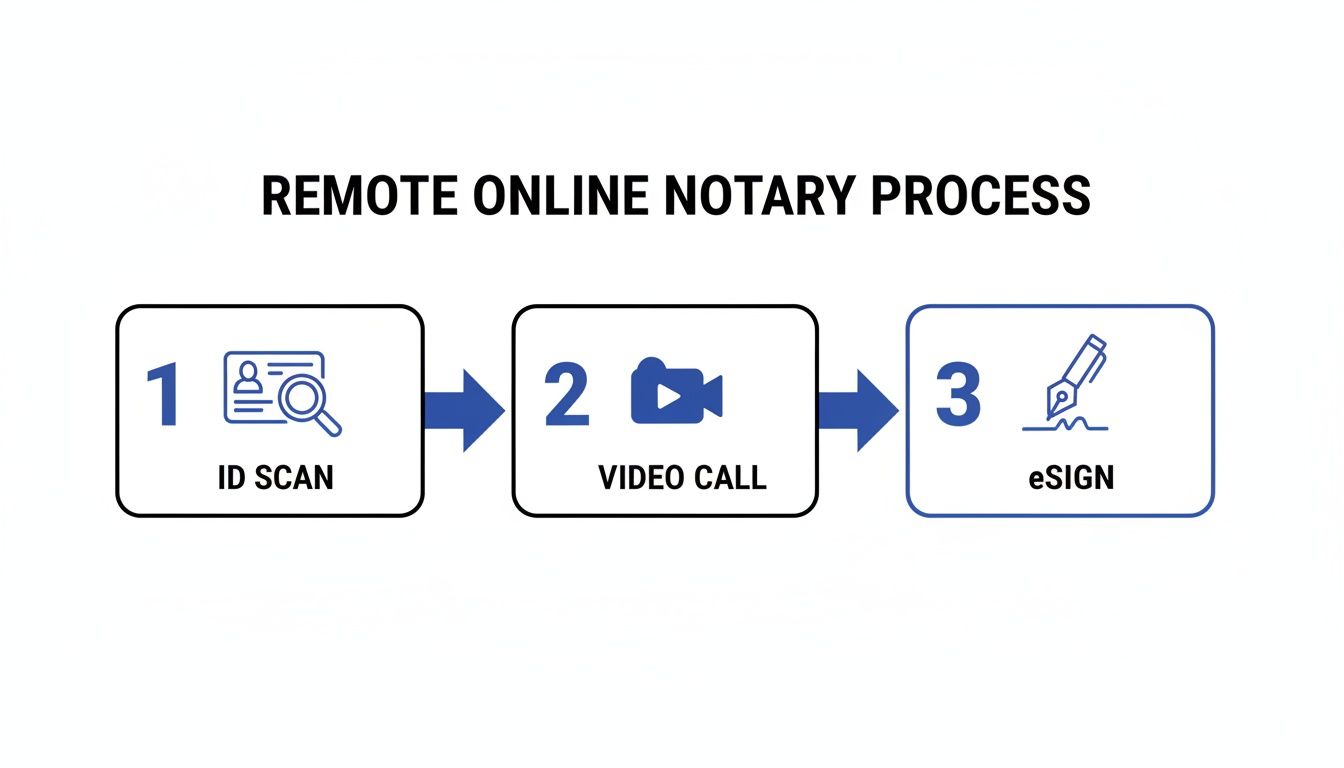
The whole point is to weave identity proofing, live interaction, and document signing into one seamless digital experience.
Phase 3: Signing, Sealing, and Creating the Digital Record
The final phase is where the document is officially executed and secured for the long haul. This involves a lot more than just scribbling a signature with your mouse.
First, you’ll apply your electronic signature in the designated spots. The most common method, used in over 80% of sessions, is as simple as typing your name, which the platform converts into a standard signature font.
Next, the notary applies their own electronic signature and a unique digital seal. This is the most important part. This digital seal isn't just a picture; it’s a cryptographic key tied directly to the notary's digital certificate.
Think of the digital seal like a high-tech wax seal on an ancient scroll. Once it's applied, the document is "locked." If anyone tries to alter anything—even changing a single comma—that digital seal will show as broken, instantly flagging the tampering.
Finally, the platform generates a comprehensive audit trail. This isn't just a quick entry in a logbook. It’s a detailed, tamper-evident record of the entire session, capturing everything from the ID verification results to the precise time each signature was applied. This audit trail, combined with the full audio-video recording, creates a powerful package of evidence that offers a level of proof far beyond what traditional paper notarization ever could.
Understanding the Rules: The Legal Side of RON
For any business, compliance isn't just a box to check—it's the bedrock of trust and legal defensibility. When you bring remote online notary (RON) into your workflow, you need a firm grasp of the rules. While the technology itself feels borderless, the laws have traditionally been a patchwork of state-specific regulations across the U.S.
The good news? It's much simpler than it looks. A couple of powerful legal principles, reinforced by foundational federal laws, work together to make RON a secure and nationally accepted solution, even if your business operates across state lines.
How Interstate Recognition Makes RON Work Everywhere
The first question every business asks is, "If a document is notarized online in one state, is it actually valid in another?" The answer is a clear and confident yes, all thanks to a legal doctrine called interstate recognition.
This principle is built right into the U.S. Constitution and simply means that official acts performed legally in one state are recognized as valid in all the others.
- Here's how it plays out: A notary public commissioned in a RON-approved state (like Florida, Texas, or Virginia) can legally perform a remote notarization for a signer located anywhere in the world.
- The outcome: That notarized document is legally binding and accepted across the country, even in states that haven't passed their own specific RON laws yet.
This is the key that unlocks RON's power for businesses with a national footprint. It’s what allows a mortgage company in California to close a deal for a homebuyer in New York using a notary based in Florida—all without anyone getting on a plane.
The Federal Laws That Paved the Way
The nationwide acceptance of RON doesn't just hang on state-level rules. It's firmly supported by federal laws that established the legality of electronic signatures and records nearly a quarter-century ago.
Two landmark federal acts provide the legal backbone for almost all digital transactions today:
- The ESIGN Act: The Electronic Signatures in Global and National Commerce Act, passed way back in 2000, gives electronic signatures the same legal status as a traditional "wet ink" signature. It states that a contract can't be dismissed just because it's electronic.
- The UETA: The Uniform Electronic Transactions Act is the state-level version of ESIGN and has been adopted by 49 states. It creates a predictable legal framework for using electronic records and signatures, adding another layer of certainty.
Together, these acts ensure that the digital signatures and notary seals used during a RON session are just as enforceable as their old-school paper counterparts.
Why a Compliant Platform Is a Must-Have
Knowing the law is one thing, but making sure every single transaction follows it is another challenge entirely. This is precisely why choosing a compliant RON platform is so critical—it’s how you de-risk your entire operation. A good platform isn't just a piece of software; it's your compliance partner.
A truly compliant remote online notary platform bakes state-specific rules directly into its workflow. This includes managing secure record retention, controlling access to sensitive data, and generating unalterable audit trails that meet stringent legal standards.
What started as a patchwork of emergency orders during the pandemic in 2020 has rapidly evolved into a solid legal framework. In fact, by 2025, it's expected that over 40 U.S. states will have permanent RON laws on the books, a huge jump from just a handful before 2020. This explosive growth is what’s enabling title companies, lenders, and law firms to operate on a national scale like never before. You can read more about the booming remote online notary service market and see just how fast it's expanding.
Ultimately, navigating the legal side of RON means finding a platform that does the heavy lifting for you. It ensures every notarization is not just fast and convenient but also defensible, secure, and legally sound—no matter where you or your clients happen to be.
Real-World Business Applications for RON

The technology behind remote online notarization is impressive, sure, but its real worth shows up when it solves actual business problems. For any company, the question isn’t just "how does this work?" but "what can it do for us?" The ability to create a secure, legally binding document from anywhere is changing the game across a dozen industries.
RON transforms notarization from a logistical headache into a smooth, integrated step in a digital workflow. That shift alone delivers a serious return on investment through faster deals, lower overhead, and a client experience that’s actually pleasant.
From closing a home loan to executing an estate plan, the applications are as diverse as they are powerful. Let's dig into how specific industries are putting RON to work right now.
Real Estate and Title Companies
For decades, the real estate closing was the textbook example of a paper-heavy, in-person ordeal. It meant juggling the schedules of buyers, sellers, agents, and notaries, all leading up to a long meeting where everyone signed a mountain of paperwork. A remote online notary completely upends that model.
Instead of forcing everyone into one room, RON lets people join a secure video session from wherever they are. A buyer in another state can finalize their purchase without booking a flight, and a seller can sign off on the deal from their office between meetings.
The impact on real estate is hard to overstate. A traditional closing can take weeks to line up and get done. With RON, the entire signing can be wrapped up in hours, shrinking settlement times and getting money moving faster for everyone involved.
Enterprise adoption is really what's fueling the Remote Online Notary (RON) market's growth, with real estate and lending leading the charge. Real estate transactions, one of the biggest use cases, benefit enormously. While old-school closings demand multiple in-person meetings, RON provides 24/7 access, which can slash processing times by as much as 80% and seriously cut operational costs. For a deeper look at these trends, check out the full report on the expansion of RON services.
Financial Services and Lending
Banks, credit unions, and mortgage lenders are constantly processing documents that need a notary's seal—from loan agreements to affidavits. Every delay in that chain is a risk and a point of friction for the customer. RON is the answer to both problems.
Think about a customer applying for a home equity line of credit (HELOC). With RON, they can get their loan package notarized from their kitchen table, turning a process that used to take days into something that takes minutes. That kind of speed is a huge competitive advantage.
- Fraud Reduction: The multi-factor identity proofing, which includes ID analysis and KBA questions, is worlds more secure than a quick glance at a driver's license in person. This drastically reduces the risk of identity fraud in lending.
- Enhanced Customer Experience: Offering a convenient digital option is what modern customers expect. It removes the hassle of finding and driving to a notary, creating a far better, smoother interaction with your brand.
- Compliance and Auditability: The complete audio-video recording and tamper-evident audit trail create an ironclad, easily searchable record. This makes satisfying compliance requests and internal audits a breeze.
By putting these tools in place, financial institutions can close loans faster, tighten up security, and give customers the modern experience they're looking for. To see how these features come together, check out the business solutions offered by BlueNotary.
Legal Services and Estate Planning
Law firms and estate planners handle some of the most critical documents in a person's life: wills, trusts, and powers of attorney. A notarized signature is non-negotiable, but getting it done can be a real challenge, especially for clients with mobility issues or those living abroad.
RON solves this problem elegantly, offering a secure and dignified way to execute these essential documents. An elderly client can finalize their estate plan from the comfort of their home, with the notary and witnesses joining via a compliant video session. A busy executive can sign a power of attorney from a hotel room while on a business trip.
This accessibility means crucial legal protections don't get put off because of simple logistics. For law firms, it’s about providing better, more responsive service while upholding the highest standards of legal integrity.
How to Choose the Right RON Platform
Picking a remote online notary (RON) platform isn’t like choosing standard office software. This decision hits at the core of your company's security, compliance, and ability to operate efficiently. A good partner offers far more than a simple video call—they provide a secure, complete environment for your most important transactions.
The market is crowded with dozens of providers, and it's easy to get bogged down in marketing hype and endless feature lists. To cut through the noise, you need to zero in on the fundamentals that make every notarization legally solid, secure against fraud, and a natural fit for your existing business operations.
It really comes down to looking past the sales pitch and asking the hard questions about a vendor's technology, security protocols, and unwavering commitment to compliance.
Evaluate Security and Compliance Standards
First things first: security and compliance are the bedrock of any worthwhile RON platform. This part is absolutely non-negotiable. A single misstep here can expose your entire organization to serious legal and financial risk, so this is where your evaluation must begin.
Start by confirming the platform's compliance with key regulations. You need to see proof of adherence to state-specific RON laws, data privacy standards like SOC 2 Type II, and any industry-specific mandates. For instance, title companies absolutely need their vendors to be approved by major underwriters. BlueNotary, for example, is recognized as a First American-approved RON platform, a vital credential in real estate.
When vetting a platform, treat security certifications not as a feature but as a prerequisite. A platform without verifiable, industry-recognized compliance is a liability waiting to happen.
Scrutinize the Technology Stack
Once you've established a solid baseline of compliance, it's time to get under the hood and inspect the technology that drives the platform. The user experience and the strength of its security depend entirely on the quality of its tech.
Be sure to focus your assessment on these critical components:
- Identity Verification: How seriously do they take identity proofing? Look for a multi-layered approach that includes forensic analysis of government-issued IDs, knowledge-based authentication (KBA), and biometric checks.
- Audio-Video Quality: The platform must deliver a stable, high-quality, and recordable audio-video connection. A choppy or dropped call can invalidate the entire session and leave clients frustrated.
- Audit Trail and Record Storage: Make sure the platform creates a comprehensive, tamper-evident audit trail for every single transaction. You'll also want to ask pointed questions about their record retention policies and long-term storage security, as these are often dictated by state law.
Prioritize Integration and Workflow Capabilities
A powerful RON platform should make your life easier, not add another layer of complexity. That means it has to play nicely with the tools you already rely on, whether it's your CRM, document management system, or case management software.
The key here is to look for a provider with a robust API (Application Programming Interface). A good API allows you to weave the notarization process directly into your existing workflows, creating a seamless experience for your team and your customers. This level of automation is what truly unlocks the efficiency of remote online notary services.
Choosing the right RON platform requires a disciplined approach. The checklist below breaks down the key areas to investigate to ensure you select a partner that meets your needs for security, compliance, and smooth operation.
RON Platform Evaluation Checklist
| Evaluation Category | Key Features to Verify | Why It Matters |
|---|---|---|
| Security & Compliance | SOC 2 Type II, MISMO®, state-specific RON law adherence, underwriter approvals (for real estate). | These certifications are non-negotiable proof that the platform protects sensitive data and meets legal requirements. |
| Identity Proofing | Multi-factor authentication, KBA, credential analysis (ID scanning), and biometric verification. | A weak ID verification process is the #1 vulnerability for fraud. A layered approach is essential for security. |
| User Experience (UX) | Intuitive interface for signers and notaries, stable A/V connection, mobile-friendly design. | A clunky or confusing platform leads to abandoned sessions, frustrated clients, and wasted time. |
| Audit & Record Keeping | Tamper-evident audit trails, secure long-term video/document storage, clear retention policies. | This ensures every step is documented and verifiable, which is critical for legal defensibility and compliance. |
| Integration Capabilities | Robust API documentation, pre-built integrations with major software (e.g., CRMs, DMS). | Seamless integration automates manual tasks, reduces errors, and embeds notarization directly into your workflow. |
| Support & Training | Accessible customer support (phone, chat), comprehensive training resources, dedicated onboarding specialist. | When a live transaction hits a snag, you need immediate, expert help. Good support is a must-have, not a nice-to-have. |
By methodically working through these points, you can move beyond the marketing and make a truly informed decision.
When evaluating potential RON platforms, understanding the broader principles of selecting technology vendors is essential, especially for justice-focused initiatives. For further guidance, explore a guide to technology vendor selection for justice organizations. By asking the right questions about security, technology, and integration, you can confidently choose a platform that aligns perfectly with your business goals.
The Future of Notarization is Already Here
The journey from a paper-stacked desk to a secure, digital closing room isn't just a small step—it's a complete reimagining of how we conduct business. Remote online notarization (RON) has moved far beyond being a niche convenience or a temporary fix. It's now a core, essential part of modern commerce. Think of it less as a trend and more as a strategic move toward making transactions safer, faster, and more accessible for everyone involved.
The market growth tells the same story. The global remote online notary service market is on track to hit $1,836.6 million by 2033, growing at an impressive 18.2% compound annual growth rate. This boom was supercharged by the massive shift to remote work, which itself grew by 500% since 2020 and made reliable digital solutions a must-have. You can dig deeper into the future of the RON market for more insights.
More Than Just Convenience, It’s a Competitive Edge
The real value of bringing a remote online notary platform into your operations goes way beyond just being efficient. It gives you a clear competitive advantage if you care about security, the client experience, and running a tight ship.
When you adopt RON, you’re making a conscious decision to:
- Strengthen Security: You're putting a multi-layered identity verification system in place that is far more rigorous than a quick glance at a driver's license. This dramatically cuts down the risk of fraud.
- Expand Your Reach: Geographical barriers disappear. Suddenly, you can serve clients anywhere in the world with the same confidence and legal backing as if they were in your office.
- Ensure Compliance: Good RON platforms have compliance built right in. They create a tamper-evident audit trail and a complete audio-video recording of the session, giving you an ironclad, legally defensible record of every single transaction.
At its core, RON is about future-proofing your business. It's about committing to a secure, seamless, and superior experience that today’s digital-first clients don't just want—they expect.
What's Your Next Move?
The conversation has shifted. It’s no longer about if you should adopt remote online notarization, but how soon you can get it integrated to start seeing the benefits. Making that move means finding a platform that doesn’t just hand you the tech, but partners with you as you navigate this digital shift.
Bringing RON into your workflow helps you button up your most critical processes, safeguard your organization, and offer a client experience that truly stands out. The future of secure digital transactions has arrived—it's time to make it a central part of how you do business.
Got Questions About RON? We've Got Answers.
When you're thinking about bringing a new technology into your business—especially one that deals with legally binding documents—it's natural to have questions. Getting clear, straightforward answers is non-negotiable.
Let's walk through some of the most common questions we hear from organizations looking to implement a remote online notary service.
Are Documents Notarized Online Legally Binding in Every U.S. State?
Yes, they are, and it comes down to a legal principle called interstate recognition.
Here's how it works: If a document is properly notarized online in a state that has passed permanent RON laws, it's considered legally valid in all other states. This holds true even if some of those states haven't yet passed their own RON legislation. It’s what makes a single platform a workable, nationwide solution for companies with customers or operations all over the country.
How Is RON More Secure Than a Traditional In-Person Notarization?
This is a great question, and the answer lies in the layers of security built into the process. A remote online notarization creates a much more robust and verifiable record than a simple in-person meeting ever could.
Think of it as moving from a handwritten signature in a paper logbook to a full-blown digital evidence package.
- Smarter ID Checks: Instead of just a quick glance, the platform uses forensic technology to scan a government-issued ID, checking for security features the human eye can easily miss.
- Identity Verification: The system often uses Knowledge-Based Authentication (KBA), asking specific questions that only the actual signer should know the answers to.
- A Complete Recording: The entire audio-video session is recorded from start to finish. This unalterable recording is then securely stored as part of the official record.
The result is a comprehensive digital audit trail. This tamper-evident record provides far stronger evidence and fraud protection than a simple signature and stamp in a notary’s journal.
Can We Integrate RON into the Software We Already Use?
Absolutely. Modern RON platforms are built with this exact need in mind. The best providers offer robust APIs (Application Programming Interfaces), which are essential for creating smooth, connected workflows.
An API lets you plug the notarization process directly into your existing CRM, loan origination system, or other core business software. This integration means your team and your clients get a seamless experience without having to jump between different apps, manually re-enter data, or deal with frustrating disconnects.
What Kind of Tech Do My Customers Need for This?
The good news is, the requirements on the client’s end are incredibly simple. The process is designed to be accessible to just about anyone, without needing to download special software or call IT for help.
All a signer needs is:
- A computer or smartphone with a camera and microphone.
- A stable internet connection.
- An up-to-date web browser like Chrome, Safari, or Firefox.
That's it. This simplicity is key—it ensures your clients can get their documents notarized from wherever they are, without any technical headaches.
Ready to see how a secure, compliant, and easy-to-use remote online notary platform can transform your business workflows? BlueNotary provides the complete identity verification and document execution stack you need to operate faster and more securely. Discover the BlueNotary enterprise solution today.