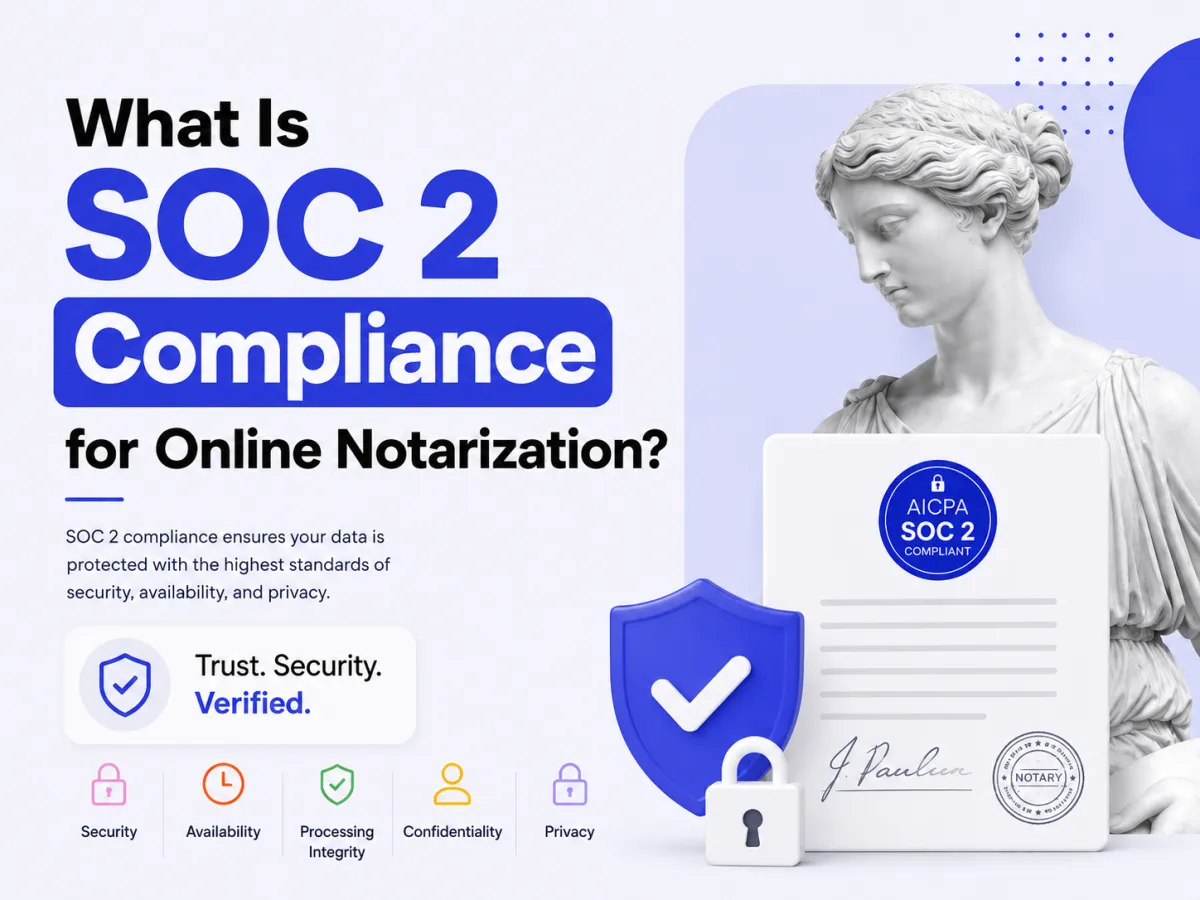

Quick answer: SOC 2 is an independent audit standard (from the AICPA) that verifies how a service provider protects customer data across five criteria: security, availability, processing integrity, confidentiality, and privacy. For online notarization, which handles your ID, KBA data, documents, and session video, SOC 2 (especially Type 2) is a strong signal the platform safeguards your data.
What is SOC 2 compliance?
SOC 2 (Service Organization Control 2) is a compliance framework created by the American Institute of CPAs (AICPA) that evaluates how a technology or service company handles and protects customer data. An independent auditor examines the provider’s controls and issues a report, you can’t self-certify SOC 2; it’s earned through an external audit.
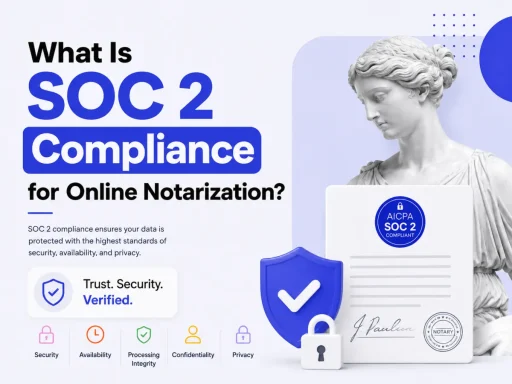
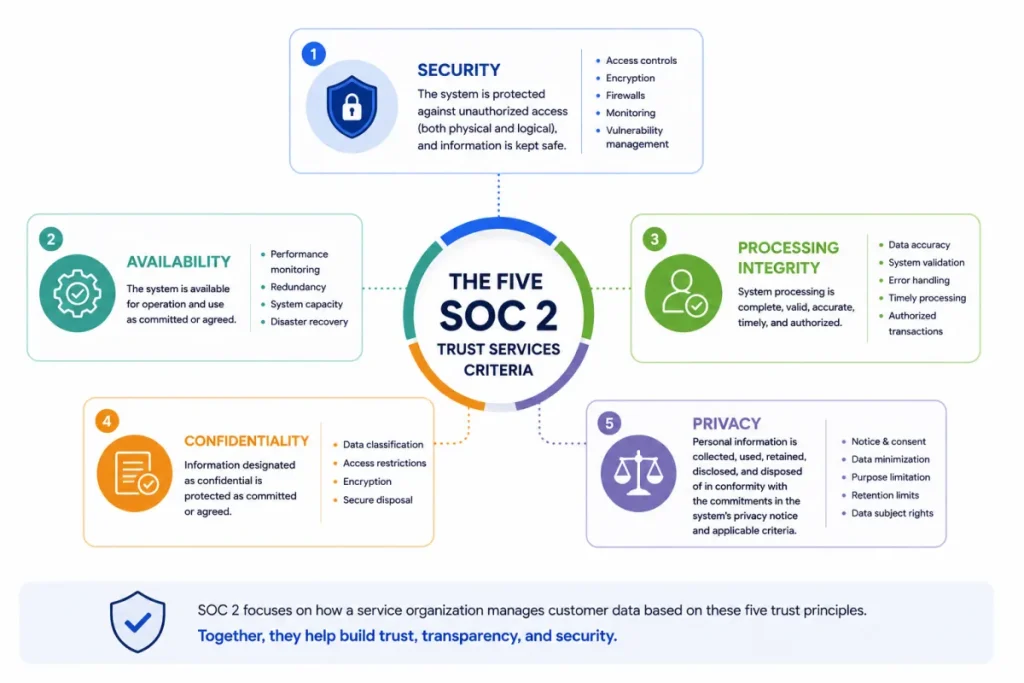
SOC 2 is built around five Trust Services Criteria:
- Security: Protection against unauthorized access.
- Availability: The system is up and usable as promised.
- Processing integrity: Data is processed accurately and completely.
- Confidentiality: Sensitive data is restricted to authorized parties.
- Privacy: Personal information is handled per privacy principles.
For a platform handling your identity and documents, that’s exactly the right checklist, which is why it comes up in online notarization vendor evaluations.
SOC 2 Type 1 vs. Type 2
There are two flavors, and the difference matters:
- SOC 2 Type 1: Assesses whether the right controls are designed and in place at a single point in time. It’s a snapshot.
- SOC 2 Type 2: Assesses whether those controls operated effectively over a period, typically 3 to 12 months. It’s proof the safeguards actually work day to day.
Type 2 is the stronger standard. A platform that’s SOC 2 Type 2 hasn’t just set up controls, it’s demonstrated them consistently over time. When comparing vendors, “Type 2” is the phrase to look for.
Why SOC 2 matters for online notarization
Online notarization runs on sensitive data. In a single session, a platform may handle:
- Your government ID and scan.
- Your knowledge-based authentication (KBA) data.
- The document being notarized (often legal, financial, or personal).
- A recorded audio-video session and audit trail.
A breach or mishandling of that data would be serious. SOC 2 gives independent assurance that the platform encrypts data, controls access, monitors for threats, and responds to incidents, the same protections behind a trustworthy fraud-prevention posture. For businesses, title companies, and lenders, SOC 2 Type 2 is often a procurement requirement before adopting a RON vendor.
SOC 2 vs. HIPAA (and other standards)
People conflate these, so here’s the distinction:
- SOC 2: A voluntary security-controls audit (AICPA) covering data security broadly. Applies to any service handling customer data.
- HIPAA, A federal law protecting health information specifically, relevant when notarizing medical documents.
They’re complementary, not interchangeable. A strong notarization platform may be both SOC 2 Type 2 and HIPAA-aligned, SOC 2 for overall data security, HIPAA for health data. Others you might see include MISMO (mortgage-data standard) and ISO 27001 (international security management).
Is SOC 2 required and how to verify a platform
SOC 2 is not legally required to perform online notarization, state RON laws set the legal rules (identity-proofing, recording, etc.). SOC 2 is a best-practice trust standard on top of that, evidence the platform takes data security seriously.
To verify a vendor:
- Ask for their SOC 2 report (or a summary), request whether it’s Type 1 or Type 2.
- Check the report date, SOC 2 reports cover a period and should be current.
- Confirm which Trust Services Criteria are covered (security is the baseline).
- Look for complementary certs like HIPAA, ISO 27001, MISMO, depending on your use case.
(Disclosure: BlueNotary is SOC 2 Type 2 compliant, alongside HIPAA-aligned and MISMO-certified practices, but always request current reports for your own due diligence.)
Conclusion
SOC 2 is the independent stamp that an online notarization platform actually protects your data, audited by an outside firm against five criteria: security, availability, processing integrity, confidentiality, and privacy. Because notarization handles your ID, KBA data, documents, and recorded session, that assurance matters, and Type 2 (controls proven over months) is stronger than Type 1. It isn’t legally required, state RON laws are but it’s a leading trust signal, especially for businesses vetting a vendor. It complements, rather than replaces, standards like HIPAA.
Choosing a platform you can trust with sensitive documents? BlueNotary is SOC 2 Type 2 compliant and lets you notarize online with encryption and a tamper-evident audit trail, get started, 24/7. Want the legal side too? Check the notarization requirements by state.
Frequently asked questions
What is SOC 2 compliance?
SOC 2 is a data-security audit framework from the AICPA. An independent auditor verifies how a service provider protects customer data across five Trust Services Criteria, security, availability, processing integrity, confidentiality, and privacy.
What’s the difference between SOC 2 Type 1 and Type 2?
Type 1 checks whether controls are properly designed at a single point in time. Type 2 checks whether those controls operated effectively over a period, usually 3 to 12 months. Type 2 is the stronger standard.
Why does SOC 2 matter for online notarization?
Online notarization handles sensitive data, your ID, KBA data, documents, and recorded session. SOC 2 gives independent assurance the platform encrypts, controls access to, and monitors that data.
Is SOC 2 required for online notarization?
No. State RON laws set the legal requirements. SOC 2 is a voluntary best-practice trust standard on top of those rules, and it’s often a procurement requirement for businesses.
What’s the difference between SOC 2 and HIPAA?
SOC 2 is a voluntary security-controls audit covering data security broadly. HIPAA is a federal law protecting health information specifically. They’re complementary; a platform can be both.
How do I check if a notary platform is SOC 2 compliant?
Ask for its SOC 2 report, confirm whether it’s Type 1 or Type 2, check the report date is current, and see which Trust Services Criteria it covers. Look for complementary certs for your use case.