


Think of a notarized affidavit as your personal testimony, put on paper and given the force of law. It’s a written statement of facts you voluntarily sign and swear to be true, all done in the presence of a Notary Public. This simple act transforms your words into a legally powerful document that courts and official bodies trust implicitly.
Understanding the Affidavit and Notary Roles
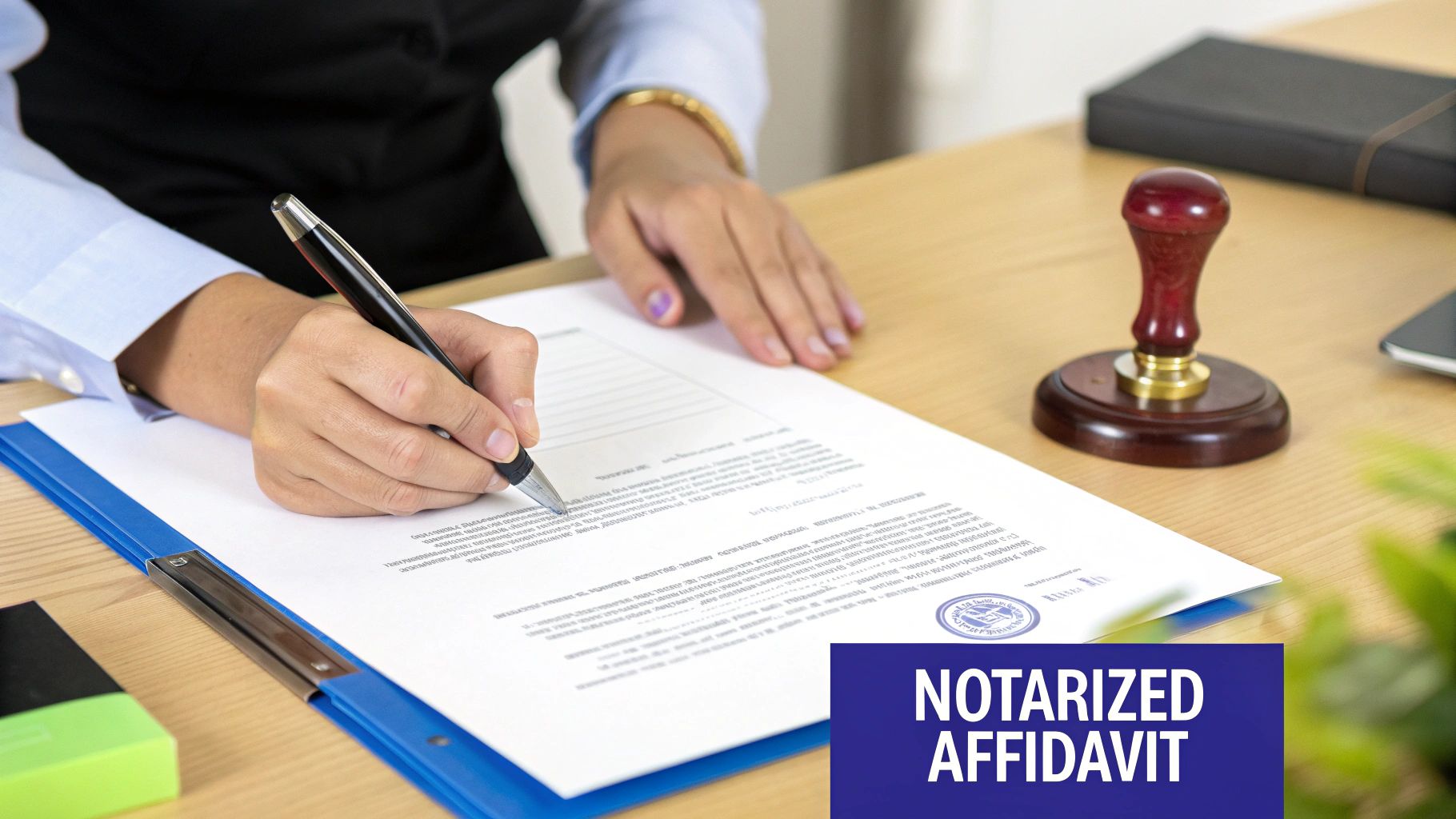
To really get what makes a notarized affidavit work, it helps to see it as a two-part system built on trust and accountability. The affidavit is your sworn testimony in writing. The notarization is the official stamp of authenticity on that testimony. Each part is separate, but they need each other to be effective.
The Affidavit: The Sworn Statement
At its core, an affidavit is a formal document where you—the “affiant”—lay out facts you know to be true. This isn’t the place for opinions, hearsay, or guesswork; it’s a declaration of firsthand knowledge.
For example, in an affidavit of fact, you might state the exact date, time, and details of a car accident you witnessed. The entire point is to present this information in a structured, legally recognized way. You are essentially putting your credibility on the line, backed by the weight of the law.
The Notary: The Identity Verifier
Here’s where a common misconception comes in. The Notary Public is not there to fact-check your statement. That responsibility is 100% on you, the affiant.
Instead, the notary is an impartial, state-commissioned witness. Their job is very specific:
- Confirm Your Identity: They’ll check your government-issued photo ID to make sure you are who you say you are.
- Witness the Signature: You have to sign the document in their presence, whether that’s in-person or virtually.
- Administer an Oath: The notary will have you swear or affirm, under penalty of perjury, that everything in the document is true.
This process is all about preventing fraud. It ensures the signature is legitimate and that you signed it willingly. Think of the notary as a trusted referee in a game—they aren’t playing, but they are there to confirm the player’s identity before they step onto the field.
Once you’ve signed and taken the oath, the notary applies their official stamp or seal and fills out the notarial certificate. This combination of your sworn statement and the notary’s verification is what gives a notarized affidavit its power in legal and financial situations.
To make it even clearer, here’s a quick breakdown of the essential parts you’ll find in a standard affidavit.
Anatomy of a Notarized Affidavit
This table breaks down the essential parts of a notarized affidavit, clarifying the function of each component for quick reference.
| Component | What It Is | Its Purpose in the Document |
|---|---|---|
| Title | The name of the document, like “Affidavit of John Doe.” | Clearly identifies the document and the affiant. |
| Caption/Venue | The court, county, and state where the affidavit is made. | Establishes the legal jurisdiction where the document is valid. |
| Affiant’s Statement | The main body of the document, detailing the facts. | Presents the sworn testimony in a clear, numbered format. |
| Oath/Affirmation | A formal declaration that the statements are true. | Binds the affiant to the truthfulness of the content, under penalty of perjury. |
| Signature Block | The affiant’s signature and the date. | The affiant’s personal endorsement of the statement. |
| Notarial Certificate | The notary’s official statement, seal, and signature. | Verifies the affiant’s identity and the circumstances of the signing. |
Understanding these components helps you see how each piece contributes to creating a document that is both credible and legally sound.
Why a Notarized Affidavit Carries So Much Legal Weight
Ever wonder what makes a simple written statement powerful enough to sway a judge or finalize a major financial deal? It all comes down to three things that give a notarized affidavit its legal muscle: truth, identity, and accountability. Together, these pillars transform a piece of paper into a document that’s tough to challenge and universally trusted.
Think of it like this: an ordinary written statement is like telling a story to a friend. A notarized affidavit, on the other hand, is the equivalent of testifying under oath in a courtroom. The stakes are completely different, which forces everyone to take the words on that page seriously.
The Foundation: A Sworn Oath
The most critical part of an affidavit is the oath. When you sign in front of a notary, you’re not just scribbling your name. You are making a solemn, legally binding promise that everything you’ve written is true to the best of your knowledge. This is no small thing.
That act binds you to your statement under penalty of perjury. Perjury isn’t just a fancy legal term; it’s a serious crime for knowingly lying under oath, and it can land you with hefty fines or even jail time. This very real threat is what gives the document its credibility—it ensures you’ve thought carefully about every word.
Because of this sworn promise, courts and other official bodies treat a notarized affidavit with the same gravity as live testimony. This principle of legal authority isn’t just for affidavits; understanding related documents, like an Authorized Representative and Power of Attorney, also shows how vital that official stamp of approval really is.
The Gatekeeper: Verified Identity
An oath means nothing if you don’t know who made it. This is where the notary public steps in as an impartial, state-commissioned witness. Their main job is simple but crucial: to confirm you are who you say you are.
The identity check is a formal process designed to stop fraud in its tracks. The notary is required to:
- Check Government-Issued ID: They’ll need to see your driver’s license, passport, or another official photo ID to match your face to your name.
- Confirm You’re a Willing Signer: The notary observes your demeanor to make sure you’re signing freely and not being forced into it.
- Assess Your Awareness: They also need to see that you seem to understand what you’re signing and are of sound mind.
This verification gives everyone involved—from judges to bankers—the confidence that the right person signed the document. It effectively shuts the door on forgeries and ensures the individual making the sworn statement is the one who will be held responsible for it.
By verifying the signer’s identity and witnessing the signature, the notary creates an unbroken chain of trust. This authentication is what makes the document reliable for high-stakes transactions where certainty is paramount.
The Record: A Seal of Accountability
The final piece that locks in the affidavit’s legal power is the notary’s official act. After you sign, the notary affixes their seal or stamp and fills out what’s called a notarial certificate. This isn’t just for show; it’s a public official attesting to the event.
Just as importantly, the notary records the entire act in their notary journal. This logbook is a permanent record that includes key details:
- The date and time of the notarization.
- The type of act performed (for an affidavit, it’s usually a jurat).
- Your name and signature.
- How your identity was confirmed (e.g., “Driver’s License”).
This meticulous record-keeping creates a verifiable paper trail. If the affidavit is ever challenged down the road, this journal provides an impartial, official account of the signing. It’s this rock-solid accountability that makes the notarized affidavit a cornerstone of trust in our legal and financial systems.
Where You’ll Actually Need a Notarized Affidavit
The term “sworn statement” might bring to mind tense courtroom dramas, but the truth is, affidavits are a surprisingly common part of everyday life. They pop up in all sorts of legal, financial, and real estate situations as a way to formally state facts and stop potential arguments before they even start.
Knowing when you might need one can save you a ton of time and headache down the road.
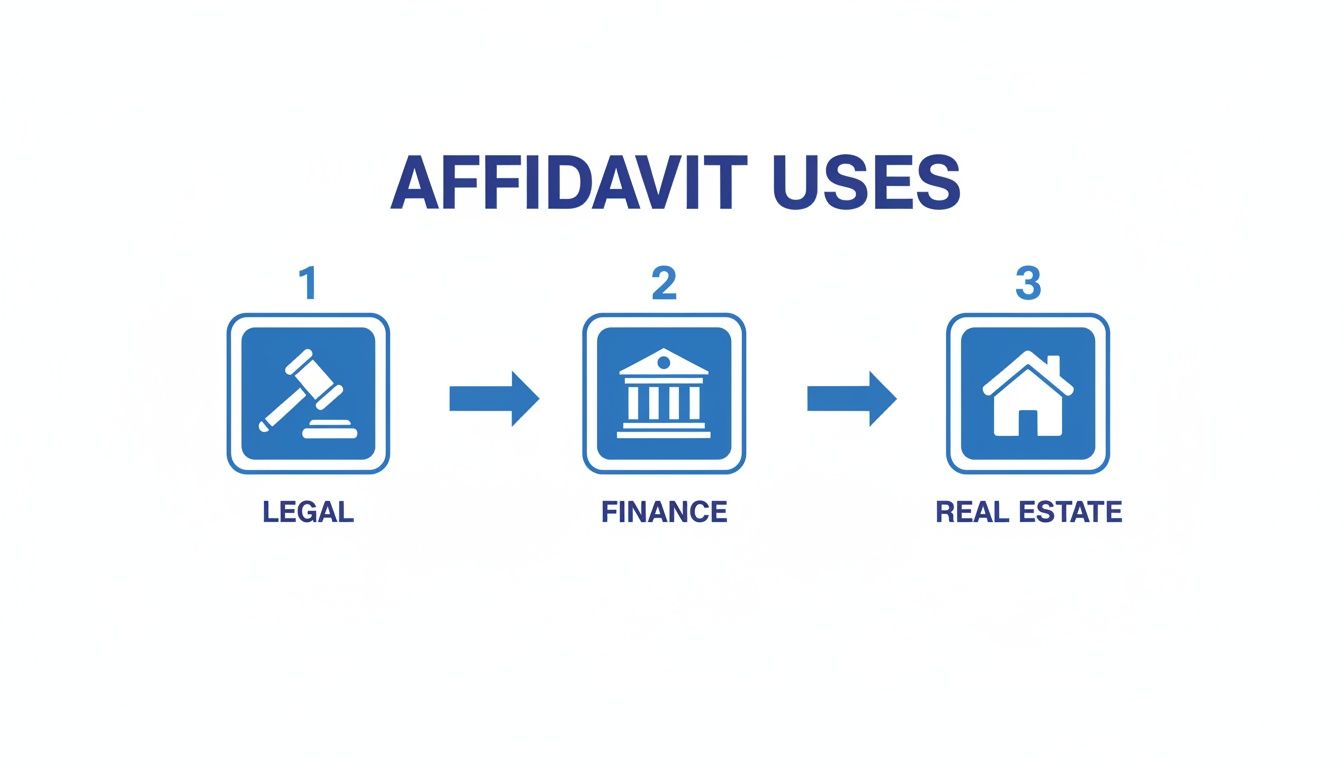
As you can see, affidavits aren’t just for lawyers. They’re a practical tool used to lock down the truth across major parts of our economy.
Legal and Court Proceedings
In the legal arena, affidavits are the bedrock of many cases. They’re used to bring evidence to the table, verify facts, and keep things moving without dragging every single person into court for minor details.
- Family Law: During a divorce or custody battle, an Affidavit of Support can prove that one person has the financial stability to care for a child or ex-spouse. A family friend might also submit an affidavit testifying to a parent’s character.
- Estate Planning: When an estate is small enough to bypass the lengthy probate process, an Affidavit of Heirship or a Small Estate Affidavit is a game-changer. Some states, for instance, allow estates under $75,000 to be transferred this way, saving grieving families a world of stress and money.
- Witness Statements: Instead of calling a witness to testify at a preliminary hearing, an attorney can simply have them sign a notarized affidavit. This locks in their testimony under oath and becomes part of the official court record.
Think of an affidavit as a stand-in for live testimony. When you sign it, you’re legally swearing your statements are true, which gives a judge a reliable foundation for their decisions.
Banking and Financial Transactions
Banks and financial institutions rely on affidavits to manage risk, especially when large sums of money are involved or when mistakes need correcting. These documents create a legal paper trail, protecting both the bank and the customer from fraud or misunderstandings.
A classic example is the Affidavit of Identity. It’s often required when you’ve lost your driver’s license but urgently need to access your account. By signing and swearing to who you are, you take full legal responsibility for the claim.
You might also run into them in other financial situations:
- Lost Stock Certificates: If you misplace a physical stock certificate, you’ll need to sign an affidavit swearing it’s lost and hasn’t been sold or given away.
- Fraudulent Transactions: When you report unauthorized charges on your credit card, the bank will likely ask for a signed affidavit detailing the fraud.
- Correcting Financial Records: An affidavit can fix a simple clerical error on a financial document, like a misspelled name or wrong account number.
Real Estate and Property Matters
In real estate, everything hinges on certainty. Affidavits are used constantly during the buying and selling process to clear up potential issues and ensure the property title is clean. Without these sworn statements, a deal could get tangled up in legal knots or fall apart completely.
The Affidavit of Title is one of the most common documents you’ll see. The seller signs it to swear, under penalty of perjury, that they are the true owner, that there are no hidden debts or claims on the property, and that no one else has a right to it. This gives the buyer and the title company the peace of mind to move forward.
Affidavits also play a role in property management and are often referenced in common rental agreement forms. For example, they can be used to confirm a tenant is following the lease or to document the condition of an apartment at move-out, providing a critical layer of truth in countless personal and professional scenarios.
How to Get Your Affidavit Notarized Today
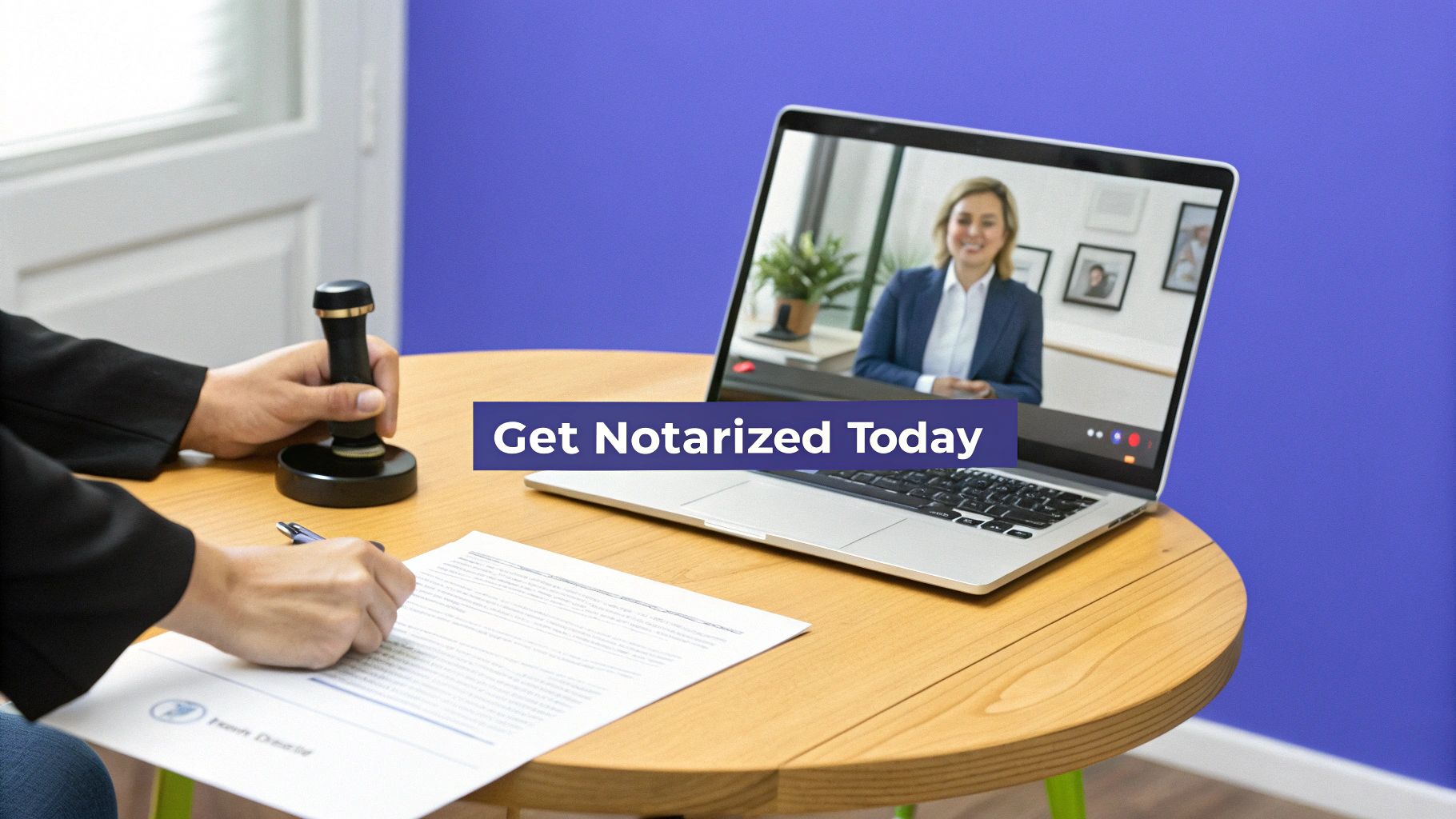
So, you’ve drafted your affidavit. The final, crucial step is getting it notarized. For decades, this process was pretty much set in stone: find a local Notary Public, book a time, and drive over with your ID and paperwork.
That old-school method still works, of course. But today, a much more efficient alternative has changed the game completely. You now have two main options: the traditional in-person route or the modern approach of Remote Online Notarization (RON). Let’s break down the differences so you can pick the best path for your situation.
The Traditional In-Person Method
The classic way involves meeting a notary face-to-face. You might find one at a bank, a local shipping store, a law firm, or even the public library. While it’s a familiar process, it’s often bogged down by real-world friction.
You’re likely to run into a few hurdles:
- Scheduling Conflicts: You have to work around the notary’s 9-to-5 schedule.
- Travel Time: Getting to and from the notary’s office eats into your day.
- Limited Availability: Need a signature after hours or on short notice? Good luck.
Even finding a free option isn’t always straightforward. While some banks help their customers, figuring out where to get notarized for free often takes some digging and may have strings attached. The in-person method is reliable, but it’s built for a world that moves at a much slower pace.
The Rise of Remote Online Notarization (RON)
Remote Online Notarization, or RON, lets you get your affidavit notarized right from your computer or smartphone, no matter where you are. Instead of a physical meeting, you connect with a commissioned notary through a secure audio-visual platform. This digital solution directly tackles the headaches of the traditional method.
The market shows just how big this shift is. The global mobile notary service market, which includes notarized affidavits, was valued at $348.2 million in 2023 and is projected to hit $1.88 billion by 2031. This incredible growth highlights a clear demand for faster, more convenient ways to verify documents. You can learn more about this growing market on amraandelma.com.
RON platforms like BlueNotary are built from the ground up to make this process both seamless and incredibly secure.
With RON, you’re not just swapping a physical meeting for a video call. You’re using a purpose-built system that enhances security with advanced identity verification, tamper-proof digital seals, and a complete, verifiable audit trail.
Here’s how a modern RON platform elevates the entire experience of getting an affidavit notarized:
- Advanced Identity Verification: Before the notarization even starts, the system confirms your identity using sophisticated tools like knowledge-based authentication (KBA) and analyzing your government-issued ID. This is often far more secure than a quick glance at a physical driver’s license.
- Secure E-Signatures: You sign the document electronically with a legally binding digital signature.
- Tamper-Proof Audit Trail: Every single step—from the ID check to the final signature—is recorded. The platform generates a detailed electronic journal and an audio-visual recording of the session, creating a permanent, unchangeable record of the event.
This digital workflow means no more travel, no more scheduling headaches, and several layers of security that simply don’t exist in the traditional paper-and-stamp world.
In-Person Notarization vs Remote Online Notarization
Deciding between in-person and online notarization really comes down to what you value most—convenience, speed, security, or just sticking with what you know. This table breaks down the key differences to help you decide.
| Feature | In-Person Notarization | Remote Online Notarization (RON) |
|---|---|---|
| Convenience | Requires travel and scheduling appointments during business hours. | Available 24/7 from any location with an internet connection. |
| Speed | Can take hours or days depending on availability and travel. | The entire process can be completed in as little as 10-15 minutes. |
| Security | Relies on manual ID checks and physical stamps. | Uses multi-factor authentication, KBA, and creates a secure digital audit trail. |
| Accessibility | Limited to your physical location and local notary availability. | Accessible globally, ideal for signers in different cities or countries. |
For most people and businesses today, RON offers a streamlined, secure, and fully compliant alternative that actually keeps up with the pace of modern life.
The Technology Behind Modern E-Notary Platforms
When you get an affidavit notarized online, what’s happening behind the screen is far more than just a video chat. Remote Online Notarization (RON) platforms are actually complex security ecosystems. They’re engineered from the ground up to create digital trust, often with safeguards that go well beyond what’s possible in a traditional, face-to-face meeting.
This level of security is a huge reason for the industry’s explosive growth. The e-notary software market—the engine driving these services—shot past $261.99 million in 2025 and is projected to hit $655.22 million by 2035. This isn’t just a trend; it’s a fundamental shift powered by serious advancements in digital security and fraud prevention. You can dive deeper and discover insights about the e-notary software market on researchnester.com.
The Core Components of RON Security
So, what makes a platform like BlueNotary so secure? It’s not one single thing but rather several layers of technology working together to verify who you are, protect the document, and create a bulletproof record of the entire event.
Think of it as a digital fortress with multiple walls of defense.
- Multi-Factor Authentication (MFA): This is the first gatekeeper. Before you ever see the notary, the system makes you prove who you are in more than one way—typically with your password and a one-time code sent to your phone.
- Knowledge-Based Authentication (KBA): Next, you might face a short quiz. The platform asks a few multiple-choice questions pulled from your personal history (like a previous street address or car you owned). These are things only the real you would know.
- Credential Analysis: You’ll then scan or take a picture of your government-issued ID. This is where it gets really smart. The platform’s software doesn’t just look at the photo; it analyzes the ID’s security features, like holograms and microprinting, to spot even sophisticated fakes.
This multi-layered approach to identity verification is a key differentiator from traditional methods. Instead of relying solely on a brief, manual inspection of an ID, RON platforms use data-driven checks to build a much higher degree of confidence in the signer’s identity.
Securing the Document and the Session
Once the system confirms your identity, its focus shifts to protecting the document itself and creating a permanent, unalterable record of the notarization. This is where digital tools truly outshine old-school paper and ink. Our guide on digital identity verification goes into even more detail on how these systems work.
The security doesn’t stop once the call starts.
- Encrypted Digital Signatures: Your electronic signature is more than just a digital doodle of your name. It’s a unique, cryptographically secured marker that’s bound to both you and the document. If anyone tries to alter the document after you’ve signed, the signature will show it’s been tampered with.
- Audio-Visual Recording: The entire session—from the moment you greet the notary to the final signature—is recorded and stored securely. This video recording becomes undeniable proof that the notarization took place, capturing your consent and the entire process.
- Comprehensive Audit Trail: Behind the scenes, the platform logs every single action: when you logged in, how your ID was verified, when you signed, and when the notary applied their seal. This detailed digital receipt is permanently attached to the affidavit, creating a complete and verifiable history.
Put together, these technologies ensure that a notarized affidavit created online isn’t just convenient—it’s incredibly secure and legally sound.
Common Mistakes to Avoid When Preparing an Affidavit
Getting an affidavit notarized seems straightforward, but a few simple mistakes can derail the whole process. These aren’t just minor typos; they’re errors that can weaken your statement’s legal standing or get it thrown out entirely.
The most common—and most frustrating—mistake is also the easiest to avoid: signing the document before you meet with the notary. Don’t do it. An affidavit requires a specific notarial act called a jurat, which means the notary must physically or digitally watch you sign.
If you sign ahead of time, you’ll have to do it all over again. The notary’s job is to certify that they saw you sign and administered an oath. If they miss that crucial step, they can’t legally complete their task.
Using Vague Language or Opinions
An affidavit is all about facts. It’s not the place for your feelings, guesses, or assumptions. The power of your statement lies in its clarity and objectivity, based on things you know firsthand.
- Weak Statement (Opinion): “I think the driver was probably distracted.”
- Strong Statement (Fact): “I saw the driver looking down at their phone for approximately ten seconds before the collision.”
Stick to what you personally saw, heard, or experienced. The facts you provide are the evidence; let them build the story on their own.
A strong affidavit presents a clear, factual narrative. Its job is to provide evidence, not interpretation. Vague statements or personal beliefs invite challenges and can damage the document’s credibility in a legal setting.
Including Hearsay or Secondhand Information
Another critical error is putting information into your affidavit that someone else told you. This is hearsay, and it’s a huge red flag in legal contexts. Your affidavit is your sworn testimony, so you can only include what you know directly.
You can’t swear that your coworker, Bob, saw the contract being altered. However, Bob can create his own affidavit detailing exactly what he witnessed. Your document must be limited to your personal knowledge and nothing more.
Common Formatting and Procedural Errors
Beyond the words you write, a few procedural slip-ups can cause major headaches. Keeping these in mind will help ensure a smooth notarization and a solid legal document.
- Leaving Blanks: Never leave empty spaces in the body of the affidavit. If a section doesn’t apply to you, write “N/A” or draw a line through it. This prevents anyone from adding information after the fact.
- Forgetting Your ID: A notary is legally required to verify your identity. Always bring a valid, government-issued photo ID like a driver’s license or passport. No ID, no notarization.
- Not Understanding the Oath: When the notary administers the oath, you are legally swearing that everything in the affidavit is true. This isn’t just a formality—it carries the penalty of perjury. Make sure you’ve read every word and stand by it completely.
By steering clear of these common pitfalls, you can ensure your notarized affidavit is accurate, credible, and ready to serve its legal purpose.
Got More Questions About Affidavits?
Even after you’ve got the basics down, you might still have a few questions. That’s perfectly normal. Let’s tackle some of the most common things people ask after their affidavit is signed, sealed, and delivered.
So, Can a Notarized Affidavit Be Challenged in Court?
You bet it can. Getting a document notarized isn’t like casting a magic spell that makes it untouchable. The notary’s job is to verify your identity and make sure you understand you’re swearing an oath. They aren’t fact-checking the story you’re telling.
The other side in a lawsuit can absolutely question what you’ve written, attack your credibility, or bring in their own evidence to poke holes in your statement. But remember, you signed it under penalty of perjury. That raises the stakes considerably and gives your words serious weight.
What’s the Real Difference Between an Affidavit and a Declaration?
This one trips a lot of people up, but it boils down to one key thing: the oath ceremony. For an affidavit, you have to formally swear that everything in it is true in front of a notary public or another official. That face-to-face (or screen-to-screen) moment is a crucial part of the process.
A declaration, while also signed under penalty of perjury, skips that formal ceremony. Both are serious legal documents, but some situations—think high-stakes court cases, certain government filings, or major financial transactions—specifically require the extra layer of formality that only a notarized affidavit provides.
The core distinction is the presence of an official witness administering an oath. An affidavit involves this formal act, adding a layer of verification that a simple declaration lacks, making it essential for certain high-stakes legal and financial matters.
How Long Is a Notarized Affidavit Good For?
Technically, a notarized affidavit never “expires.” Its power comes from the fact that it’s a snapshot of the truth at the moment you signed it.
But that doesn’t mean it’s useful forever. Think about it: an affidavit from ten years ago confirming your address probably won’t fly with a bank today. The real-world relevance of the document can fade over time. The person or organization you’re giving it to—be it a judge, a loan officer, or a government clerk—gets to decide if it’s still current enough for their needs. Its practical lifespan really depends on the context.
Ready to create a legally sound notarized affidavit without the hassle? With BlueNotary, you can connect with a commissioned notary online in minutes, ensuring your documents are executed securely and efficiently from anywhere. Get your affidavit notarized online today.