


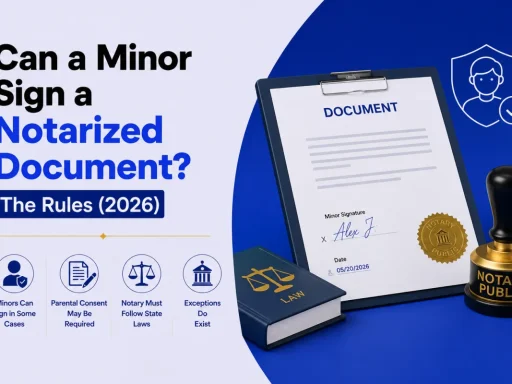

Quick answer: Yes, a minor can sign a notarized document if the notary can verify the minor’s identity and confirm they understand and are signing willingly. The catch is ID, most minors don’t have a government photo ID, so a credible identifying witness may be needed. And notarizing a minor’s signature does not make an otherwise-unenforceable minor contract legally binding.
Can a minor sign a notarized document?
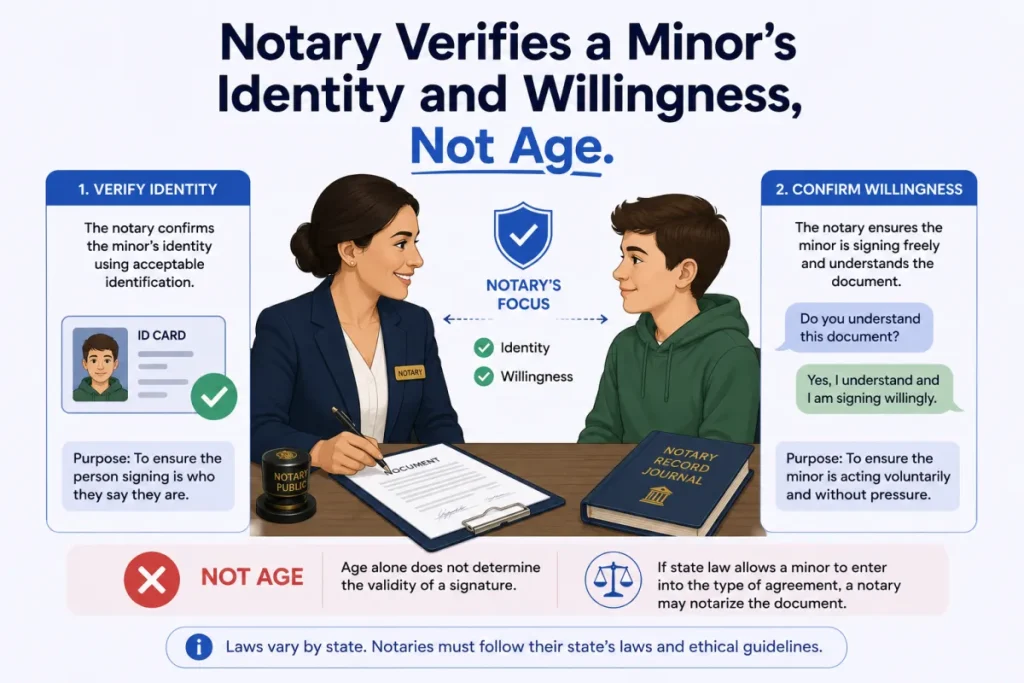
Yes, there’s no minimum age to have a signature notarized. A notary’s role is to verify who is signing, confirm the person understands the act, and witness the signature. If a minor can be properly identified and clearly understands what they’re signing and does so willingly, the notary can notarize their signature.
The complication isn’t the minor’s age, it’s the two things around it, can the notary verify the minor’s identity, and does the signature actually accomplish anything legally once notarized. Both matter, and both are covered below. The identity piece is the same core requirement behind how notarization works.
The ID challenge: verifying a minor’s identity
This is where most minor notarizations stall. A notary must confirm identity, usually through a government-issued photo ID, and most minors don’t have one. A young teen rarely holds a driver’s license or state ID.
You have a few paths:
- The minor has a valid photo ID (a passport, or a state-issued minor ID). Then the notary can verify them directly.
- A credible identifying witness. Where a state allows it, an adult who personally knows the minor (sometimes a parent) can vouch for the minor’s identity under oath, with their own valid ID.
- State-specific rules. Some states have particular procedures for identifying minors, so the acceptable methods vary. Confirm via the notarization requirements by state guide.
Without one of these, a notary can’t verify the minor and must decline.
Can a minor’s document be notarized online?
Often, no. Remote online notarization typically relies on knowledge-based authentication (KBA), questions drawn from adult public and credit records, plus credential analysis of a government ID. A minor usually has neither a photo ID nor a KBA-able record history, so the online identity checks fail.
That means minor signings frequently need to be done in person, where a credible identifying witness can be used. Some online platforms simply don’t support minors for this reason. If the document is actually a parent’s signature (like a child travel consent), that’s different, the parent is the signer and can notarize online normally.
Notarizing a minor’s signature doesn’t make it binding
Here’s the point people miss, notarization verifies identity and signature, it does not grant legal capacity. Minors generally cannot enter enforceable contracts, and having a notary witness the signature doesn’t change that. A notarized contract signed by a minor may still be voidable by the minor under the law.
So a notary can properly notarize a minor’s signature on, say, an affidavit or consent form, but whether that document is legally effective is a separate question that depends on the type of document and state law. For anything with legal or financial stakes, involve an attorney, a notary confirms who signed, not whether it holds up.
What to do: the practical path
If you need a minor’s signature notarized:
- Check whether the minor even needs to sign: Many “minor” documents are actually signed by a parent or guardian — in which case the adult notarizes normally.
- Bring valid ID for the minor if they have one: A passport is the most common option for a minor.
- Line up a credible identifying witness: Where the state allows it, often a parent with their own ID who knows the minor.
- Plan for in person: Because online KBA usually fails for minors, expect to use an in-person notary.
- Confirm the legal effect with an attorney: If the document is a contract or has financial consequences.
Conclusion
A minor can sign a notarized document, there’s no age floor for notarization. What decides it is whether the notary can verify the minor’s identity, which is tricky because most minors lack a photo ID and can’t pass the knowledge-based checks that power online notarization. In practice that often means an in-person signing with a credible identifying witness. And remember the bigger picture: notarizing a minor’s signature confirms who signed, but it does not make a minor’s contract legally binding, capacity is a separate matter for the law and, if it’s important, an attorney.
If the document is actually the parent’s to sign like a consent form, you can notarize it online with a commissioned notary on BlueNotary in about 15 minutes, 24/7. Not sure who needs to sign or what ID is required? Start with what you need to notarize.
Frequently asked questions
Can a minor sign a notarized document?
Yes. There’s no minimum age for notarization. A notary can notarize a minor’s signature if they can verify the minor’s identity and confirm the minor understands and is signing willingly.
What ID does a minor need to get a document notarized?
A valid government photo ID, such as a passport, if the minor has one. Because most minors don’t, a credible identifying witness may be used where the state allows it.
Can a notary notarize a minor’s signature without ID?
Sometimes, using a credible identifying witness, an adult who personally knows the minor and vouches under oath with their own valid ID — where state law permits. Otherwise the notary must decline.
Can a minor’s document be notarized online?
Usually not. Online notarization relies on knowledge-based authentication from adult records and a government photo ID, which minors typically lack, so minor signings often must be done in person.
Does notarizing a minor’s signature make it legally binding?
No. Notarization verifies identity and signature, not legal capacity. Minors generally can’t enter enforceable contracts, so a notarized minor signature may still be voidable.
Can a parent sign for a minor to be notarized?
Often the parent is the actual signer for consent forms and similar documents, and the parent notarizes normally. A parent can also serve as a credible witness for a minor’s own signature where allowed.