




The real difference between an electronic signature and a digital signature boils down to security and verification. Think of an eSignature as a matter of intent—it’s any digital mark, like typing your name or clicking an “I Agree” button, that shows you consent. A digital signature, on the other hand, is a specific, highly secure technology. It uses encrypted “fingerprints” to lock down the document, verify the signer’s identity, and prove the document hasn’t been touched since it was signed.
Comparing eSignatures and Digital Signatures

People often use these terms interchangeably, but for anyone in business or law, knowing the difference is critical. “Electronic signature” is the broad umbrella term for all methods of signing a document online. A digital signature is a specific, technologically advanced type of electronic signature.
This means every digital signature is an electronic signature, but not all electronic signatures are digital signatures. The digital version offers a much higher level of assurance because it’s built on a technical framework called Public Key Infrastructure (PKI).
Core Differentiators
The distinction really comes down to three things: how identity is verified, how document integrity is protected, and the resulting legal weight. A basic eSignature is perfectly fine for low-risk agreements where just showing consent is enough. But for high-value transactions that need undeniable proof of who signed and that the document is authentic, digital signatures are the gold standard.
Here’s a simple way to remember it: An eSignature shows you agreed to something. A digital signature cryptographically proves who you are and guarantees the document is authentic and tamper-proof.
Platforms like BlueNotary are built on this advanced digital signature technology. By integrating powerful identity verification with cryptographic security, they meet the tough compliance standards in fields like real estate, finance, and law, where the integrity of every transaction is absolutely essential. To get a better handle on the basics, you can find out more about what an esignature is on our blog.
For a quick, at-a-glance comparison, this table breaks down the essential differences between the two.
Quick Comparison eSignature vs Digital Signature
| Attribute | Electronic Signature (eSignature) | Digital Signature |
|---|---|---|
| Core Concept | A digital symbol representing the intent to sign. | An encrypted, technology-based signature for security. |
| Security | Relies on basic audit trails (IP address, timestamp). | Uses cryptographic encryption (PKI) for high security. |
| Verification | Often just requires email verification or simple log-in. | Requires identity verification through a Certificate Authority (CA). |
| Tamper Evidence | Limited; alterations may not be easily detectable. | Becomes invalid if the document is altered after signing. |
| Legal Standing | Legally binding under acts like ESIGN & UETA for most contracts. | Offers superior legal weight due to strong proof of identity. |
| Common Use Cases | Internal HR forms, sign-up sheets, service agreements. | Loan documents, real estate closings, legal settlements. |
As you can see, the choice isn’t about which one is “better” but which one is right for the specific situation. The level of risk and legal scrutiny involved in your transaction should guide your decision.
The Cryptographic Backbone of Digital Signatures
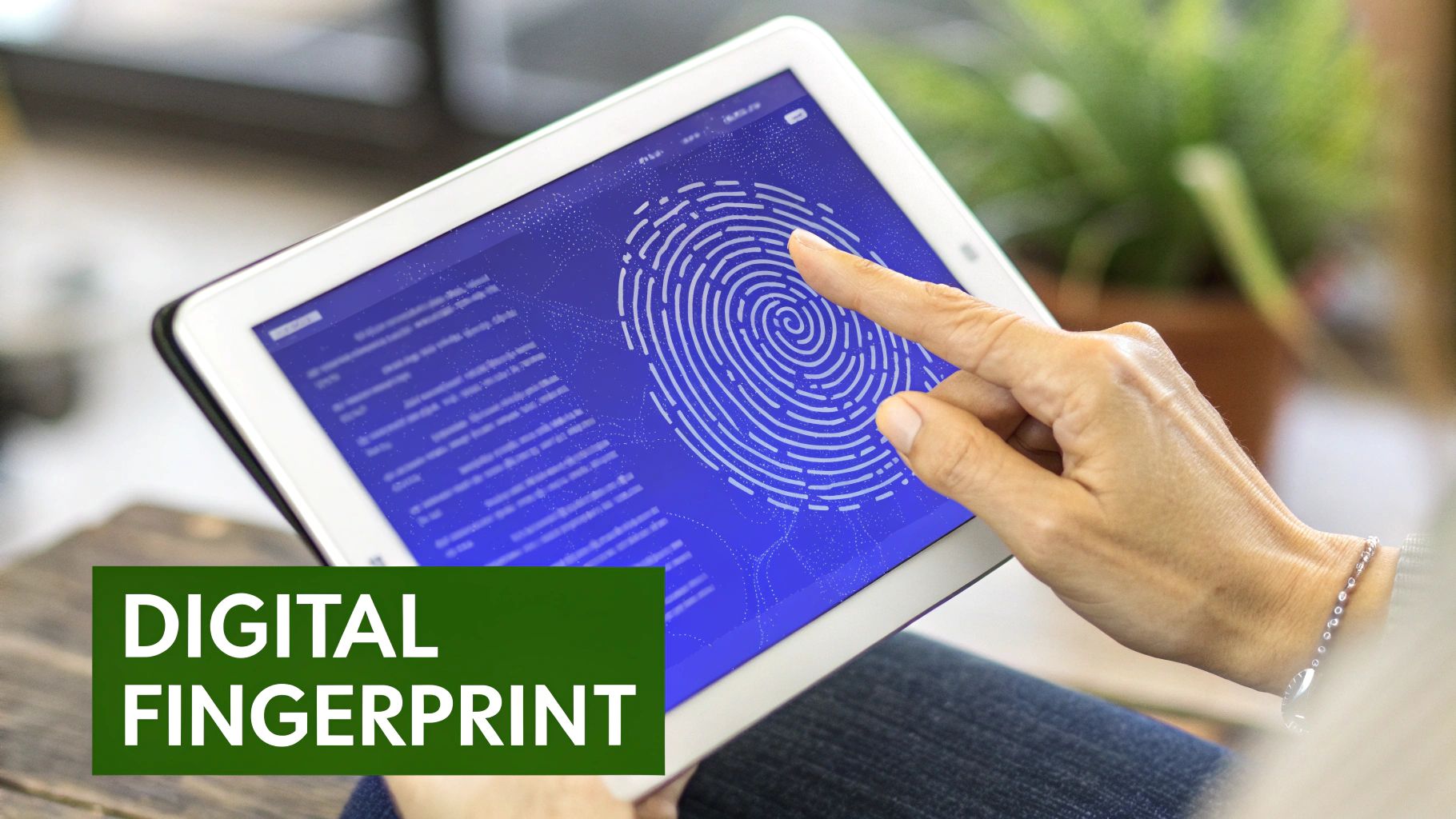
While an e-signature shows intent, a digital signature is built on a sophisticated cryptographic foundation. This is what truly sets them apart. It’s this underlying tech that provides a level of security and irrefutable proof that a simple e-signature just can’t offer. Essentially, it creates a tamper-evident seal and a unique digital “fingerprint” for every document and signer involved.
This entire security system is called Public Key Infrastructure (PKI). It’s a battle-tested method for securing online communications and transactions, and it’s the engine behind every valid digital signature. You can think of PKI as a high-security digital vault for your documents.
How Public Key Infrastructure (PKI) Actually Works
At its heart, PKI uses a matched pair of cryptographic keys for every user: a private key and a public key. These two keys are mathematically tied together but serve very different purposes.
The private key is kept completely secret by the signer—it’s their personal signing tool. The public key, on the other hand, is shared openly so others can verify the signature.
When you apply a digital signature, your private key encrypts it. Anyone who has your public key can then decrypt it. If the decryption works, it confirms two critical things:
- Authentication: It proves the signature could only have been created by the person holding the corresponding private key.
- Integrity: It verifies that the document’s contents haven’t been changed a single bit since the moment it was signed.
This two-key system is the cornerstone of trust, ensuring the signer is who they say they are and the document is exactly as they left it.
The “Digital Fingerprint,” or Hash
Before the private key does its work, the document itself is put through a process called hashing. A special algorithm takes all the data in the document—every word, every space—and condenses it into a short, unique string of text. This string is called a hash.
Think of it like putting your entire document into a super-advanced blender. No matter how large the document is, the blender produces a small, one-of-a-kind digital summary—the hash. If you change so much as a comma in the original document and run it through again, you get a completely different result.
This hash is the document’s unique fingerprint. The digital signature process encrypts this compact hash, not the entire document. It’s incredibly efficient and is what makes the signature tamper-evident.
If someone alters a signed document—even by adding a single space—the new hash won’t match the original one locked inside the signature. That mismatch instantly invalidates the signature, giving you undeniable proof that tampering occurred.
Certificate Authorities: The Guardians of Identity
So, how do you know a public key really belongs to the person it’s associated with? That’s where a Certificate Authority (CA) steps in. A CA is a trusted, independent organization that acts like a digital notary or a passport office for the internet.
Before issuing a digital certificate, a CA performs rigorous checks to verify the identity of the person or organization. Understanding the various methods for identity verification is key to appreciating the security of digital signatures.
Once the identity is confirmed, the CA issues a digital certificate, which is a small electronic file that:
- Binds the signer’s verified identity to their public key.
- Is issued by a trusted CA, giving it third-party credibility.
- Has a set expiration date for ongoing security.
When you open a digitally signed document, your software (like Adobe Acrobat) automatically checks the certificate. It confirms that the certificate is still valid, was issued by a recognized CA, and hasn’t been revoked. This certificate is the final piece of the puzzle, providing independent proof of the signer’s identity and making the digital signature a secure and legally sound choice for high-value transactions.
Digging into the Security and Compliance Gaps
When you get down to brass tacks, the real difference between an eSignature and a digital signature comes alive when you look at their security and compliance muscle. Yes, both are legally binding, but their ability to hold up in court or stop fraud couldn’t be more different. This isn’t just tech jargon—it’s a critical factor in managing risk for any high-stakes agreement.
A standard eSignature’s security often hinges on a simple audit trail. This log usually captures the signer’s IP address, their email, and timestamps for when the document was viewed and signed. It’s better than nothing, but it offers pretty thin proof of who the signer actually is and does little to lock the document down from being altered later.
On the other hand, a digital signature is built on a multi-layered security model designed for integrity and what the legal world calls “non-repudiation.” It’s so much more than a simple log. It embeds a cryptographic seal directly into the document, creating an unbreakable link between a verified identity and the document’s contents at the precise moment it was signed.
The Power of an Immutable Audit Trail
The audit trail for a digital signature is just fundamentally stronger because it’s cryptographically baked in. It isn’t just a separate list of events that happened; it’s a core, tamper-evident part of the signed document itself.
If anyone tries to change even a single character in the document after it’s been digitally signed, that cryptographic seal shatters, instantly voiding the signature. This gives you undeniable proof of tampering and creates a permanent, unchangeable record—exactly what you need for serious legal and regulatory compliance.
A standard eSignature audit trail tells a story of what probably happened. A digital signature’s cryptographic audit trail provides mathematical proof of exactly what happened, who did it, and that the document is untouched.
This distinction is everything in heavily regulated industries. It’s no surprise that 83% of people using electronic signatures say security is the most important feature, a need best met by the cryptographic security of digital signatures. This is precisely why North America, which accounts for 55% of the global e-signature market, sees such strong adoption of digital signatures in finance and healthcare. On top of that, 40% of top providers now use AI to spot fraud, a technology that works best when paired with the rock-solid security of a digital signature. You can explore more e-signature statistics to understand these market trends.
A Closer Look at Identity Verification
One of the biggest security holes with basic eSignatures is identity verification. In many cases, just having access to an email account is treated as good enough proof of identity. That’s a huge risk, especially since email accounts get hacked all the time.
Digital signature platforms like BlueNotary slam that door shut by building tough, multi-factor identity verification (IDV) right into the signing process. The workflow is far more rigorous and requires passing through several layers of authentication before a signature can even be applied.
These layers often include:
- Government ID Verification: The signer has to upload a picture of their government-issued ID, which is then analyzed by sophisticated software to ensure it’s authentic.
- Knowledge-Based Authentication (KBA): The signer is asked a series of personal questions pulled from their credit and public records history—questions that, in theory, only they can answer.
- Biometric Analysis: Facial recognition technology compares a live selfie or video of the signer against the photo on their ID to confirm they are the person holding it.
To properly secure your signing processes, it’s essential to build strong Access Control Policies around your digital signature implementation. By layering these advanced verification techniques, platforms can create a complete and legally defensible record of the entire transaction. This is how you reduce risk for deals in real estate, lending, or estate planning—fields where fraud is incredibly costly and you need absolute certainty about who is signing. It’s a holistic approach that ensures a digital signature is more than just a mark; it’s a verifiable, secure, and compliant act.
Navigating The Legal Frameworks For Each Signature Type
The real worth of any signature boils down to one thing: its legal standing. While both electronic and digital signatures are meant to create binding agreements, they operate under different legal frameworks that give them varying levels of clout in a courtroom. Getting these laws right is absolutely critical for picking the correct signature for your transaction.
In the United States, the legal foundation for electronic signatures rests on two major laws: the Electronic Signatures in Global and National Commerce (ESIGN) Act of 2000 and the Uniform Electronic Transactions Act (UETA). These two acts work together to confirm that an electronic signature is just as legally valid as one signed with a pen.
The laws in the U.S. are intentionally “technology-neutral,” meaning they don’t prescribe a specific technology. They simply care about the signer’s intent. This is why a basic e-signature works perfectly well for many everyday agreements, like new hire paperwork or simple service contracts.
Global Standards and The Rise of eIDAS
Meanwhile, the European Union has its own robust framework called eIDAS (electronic IDentification, Authentication and trust Services). This regulation creates a single, predictable legal structure for electronic signatures across all EU member states, which is a massive help for anyone doing business internationally.
Unlike the broad-stroke approach of the U.S. laws, eIDAS gets much more specific. It lays out three distinct tiers of electronic signatures, with each level adding more security and carrying more legal weight. This tiered system gives businesses a clear guide for matching the signature type to the level of risk involved.
- Simple Electronic Signature (SES): This is the baseline, much like a standard e-signature in the US. It shows intent to sign but doesn’t have stringent identity verification requirements.
- Advanced Electronic Signature (AES): This is a significant step up. An AES has to be uniquely linked to the signer, be able to identify them, and be created using data that only the signer controls. It also must be tied to the document in a way that flags any later changes.
- Qualified Electronic Signature (QES): This is the gold standard. A QES is an advanced signature backed by a qualified digital certificate and created using a secure device. Under eIDAS, a QES is legally equivalent to a handwritten signature and is automatically accepted as valid across the entire EU.
The eIDAS framework really gets to the heart of the e-signature vs. digital signature debate. While all are legally recognized, only the cryptographically secured tiers like AES and QES provide the “non-repudiation” needed for high-value, high-risk agreements.
This clear legal distinction is fueling massive growth in the market. The global digital signature market was valued at USD 5.2 billion in 2024 and is expected to skyrocket to USD 38.16 billion by 2030. It’s no surprise that the QES segment is predicted to grow the fastest as more businesses demand the highest possible level of legal certainty.
Why Evidentiary Weight Matters
So, what’s the crucial difference if a signature is challenged in court? With a simple e-signature, the burden of proof falls on the person trying to enforce the agreement. They have to present the audit trail—IP addresses, timestamps, email chains—to prove who signed and that they intended to do so.
This can be a heavy lift, especially for industries with strict financial services industry regulations. Digital signatures, especially those that meet AES or QES standards, completely flip the script. They arrive with a built-in, tamper-evident package of cryptographic proof.
This superior evidentiary weight is why digital signatures are the go-to for documents where identity and integrity are paramount—think real estate closings, major loan agreements, or complex legal settlements. Platforms built to these standards create an incredibly robust, legally defensible record that holds up under the toughest scrutiny. You can learn more about how BlueNotary ensures compliance by visiting our Trust Center.
Deciding Between an eSignature and a Digital Signature: A Practical Guide
Understanding the tech and the laws behind e-signatures and digital signatures is one thing, but knowing which one to use in the real world is where it really counts. The decision almost always boils down to one simple question: how much risk is involved in this transaction? Your answer will point you to the right tool, balancing both speed and security.
This decision tree breaks down the thought process for picking the right signature based on the stakes of the agreement.

As the visual shows, the line between the two is really about risk. High-value, high-consequence documents demand the robust security that only a digital signature can provide.
When a Simple eSignature is All You Need
For routine, high-volume agreements where the risk is low, a standard eSignature is the way to go. The main goal here is to capture consent quickly and keep things moving without adding unnecessary steps. In these situations, the legal or financial fallout from a disputed signature is usually minimal.
Here are a few common examples where a basic eSignature works perfectly:
- Internal HR Forms: Think onboarding packets, policy acknowledgments, time-off requests, and routine compliance training forms.
- Simple Service Agreements: Contracts for low-cost monthly subscriptions like marketing tools or gym memberships fit this category.
- Permission Slips and Waivers: School field trip forms, photo release consents, or event participation agreements are all great candidates.
In these scenarios, you’re primarily focused on documenting agreement, not building an ironclad case for court. The convenience and speed of a simple eSignature easily win out over the need for heavy-duty cryptographic security.
Key Takeaway: If the document’s value is low and the risk of a legal fight is close to zero, an eSignature is your best bet. It offers a legally recognized way to confirm agreement without overcomplicating the process.
When You Absolutely Must Use a Digital Signature
When the stakes are high, a simple “I agree” just won’t cut it. You need undeniable proof of who signed and a guarantee that the document hasn’t been touched since. This is where digital signatures shine—they’re built for situations where security, compliance, and non-repudiation are paramount.
Certain industries, which are the core focus for platforms like BlueNotary, operate almost exclusively with digital signatures because of the high value and intense regulatory oversight of their work. For example, the Banking, Financial Services, and Insurance (BFSI) sector makes up 26.2% of the entire digital signature market, a testament to its critical need for encrypted authentication. And while sales departments lead in overall digital tool adoption at 62%, finance (53%) and IT (41%) are increasingly turning to digital signatures for their superior audit trails. You can dive deeper into these electronic signature market statistics for more context.
High-stakes scenarios that demand digital signatures include:
- Real Estate Closings: Digital signatures are non-negotiable for executing closing packages, mortgage applications, and property deeds, where the integrity of every document is critical.
- Lending and Financial Services: Loan agreements, promissory notes, and wealth management contracts all require verifiable identities and tamper-evident seals to combat fraud.
- Legal Services: Settlement agreements, wills, trusts, and powers of attorney must have the highest possible evidentiary weight to stand up to scrutiny in court.
The Critical Role of Digital Signatures in Remote Online Notarization (RON)
Nowhere is the power of digital signature technology more obvious than in Remote Online Notarization (RON). A RON session isn’t just about signing a document; it’s a formal, legally recognized notarial act performed entirely online. For it to be legally valid, it must rely on the heavy-duty security of digital signatures.
The process, which is a foundational feature of the BlueNotary platform, weaves several layers of security into one seamless workflow:
- Robust Identity Verification: The signer has to pass multi-factor authentication, which often includes answering knowledge-based questions (KBA) and having their government-issued ID analyzed biometrically.
- Live Audio-Video Session: The entire signing ceremony happens on a live, recorded audio-video call with a commissioned notary public, creating a permanent visual record of the event.
- Digital Signature Application: Finally, the notary applies their own unique digital signature and an electronic seal to the document. This locks it down with a cryptographically secure, tamper-evident layer that proves the notarization is authentic.
This fusion of live interaction, strict identity proofing, and digital signature technology produces a comprehensive, legally defensible notarized document. It represents the gold standard for secure remote transactions, making it indispensable for high-value legal, real estate, and financial agreements that require a notary’s seal.
Frequently Asked Questions About Signatures
When you’re dealing with electronic and digital signatures, a few questions always come up. Getting clear answers is crucial for deciding which technology to trust with your documents, especially when legal validity and security are at stake. Let’s break down the most common queries.
Getting these details right helps you understand the real-world implications of your choice and highlights why the difference between esignature and digital signature is so important for managing risk.
Are eSignatures Legally Binding?
Yes, absolutely. Standard electronic signatures are legally binding for most agreements in many parts of the world, thanks to laws like the ESIGN Act in the U.S. They’re great for showing that someone intended to agree to terms, which is often enough for simple, low-risk contracts.
The catch is that their legal standing can be challenged if there’s any doubt about the signer’s identity or if the document was altered. This is where a digital signature really shines. It provides a much stronger foundation of evidence through its cryptographic security and detailed audit trail, making it the go-to for high-value transactions that could end up in court.
A simple eSignature is legally valid, but a digital signature is legally defensible. The cryptographic proof baked into a digital signature makes it incredibly difficult to dispute, offering far better protection for your most critical agreements.
Can a Digital Signature Be Forged?
With today’s technology, forging a true digital signature is virtually impossible. It’s important to remember this isn’t just a picture of a signature on a page; it’s a complex, encrypted code created using Public Key Infrastructure (PKI). This code uniquely links a verified identity to the document’s exact contents at the precise moment of signing.
If anyone tries to change the document after it’s been digitally signed—even by a single character—it breaks that cryptographic seal and instantly invalidates the signature. This tamper-evident quality is one of its core security strengths. It’s exactly why digital signatures are trusted for sensitive legal and financial documents where authenticity is everything.
How Can I Tell if a Document Uses a Digital Signature?
Most modern PDF viewers, like Adobe Acrobat, make this easy. When you open a digitally signed document, you’ll usually see a prominent blue bar or a special panel at the top. This banner often says something like “Certified” or “Signed and all signatures are valid.”
Clicking on that panel reveals a treasure trove of information confirming its authenticity. You’ll typically find:
- The signer’s verified name.
- The trusted Certificate Authority (CA) that issued the digital certificate.
- A precise timestamp showing exactly when the document was signed.
- Confirmation that the document hasn’t been modified since it was signed.
This built-in verification process lets anyone who receives the file instantly confirm its integrity and the signer’s identity, providing a level of trust a simple e-signature just can’t offer.
Why Choose BlueNotary Over a Simple eSignature Tool?
Basic eSignature tools are fine for low-stakes paperwork—think internal HR forms or simple permission slips. But for businesses in heavily regulated fields like finance, real estate, and law, the standard is much higher. These industries manage high-value assets and face strict compliance rules, so the cost of fraud or a disputed contract can be catastrophic.
BlueNotary is a secure document platform built from the ground up on advanced digital signature technology. We go way beyond simply capturing a signature. Our platform integrates all the pieces you need for a legally sound transaction into a single, seamless process. This includes things like multi-factor identity verification, biometric analysis, tamper-proof audit trails, and the audio-video recording required for Remote Online Notarization (RON). It’s a holistic approach that ensures your most important agreements are secure, compliant, and defensible from start to finish.
For transactions that demand the highest level of security, compliance, and legal defensibility, BlueNotary offers an all-in-one platform built on robust digital signature technology. Secure your most important agreements today.