


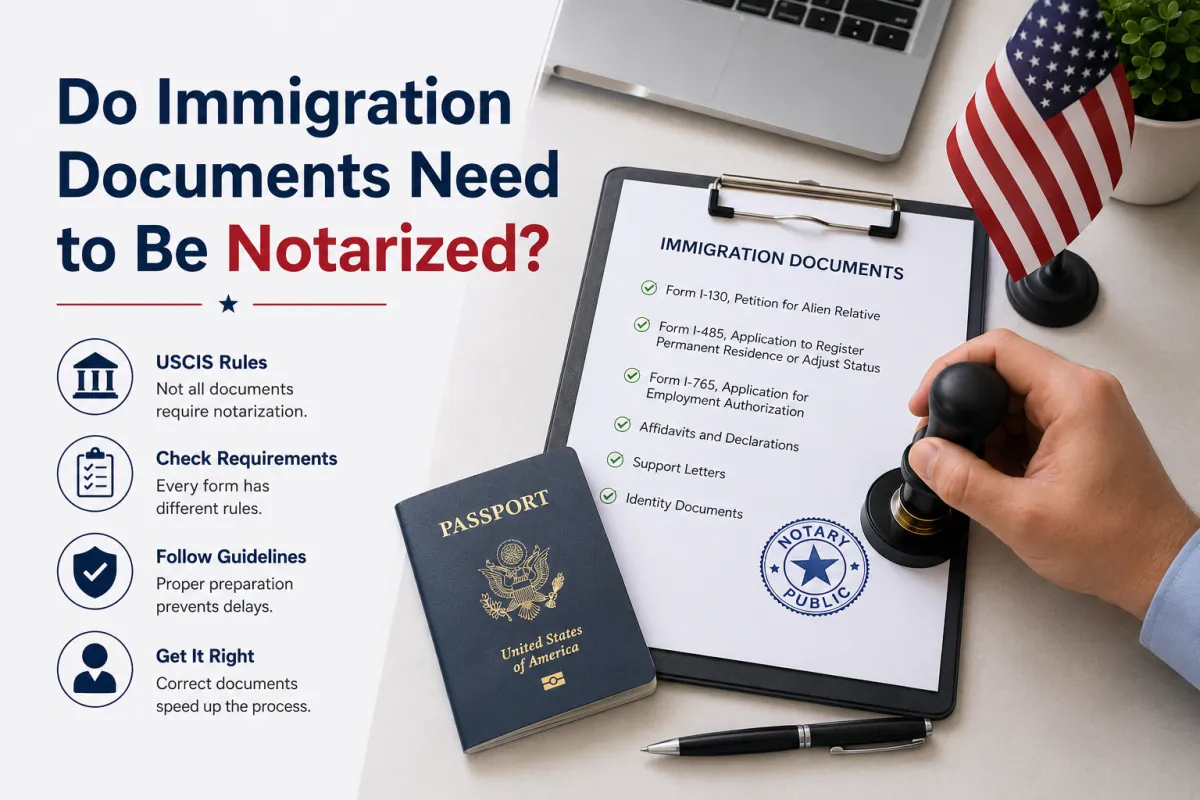

Quick answer: Most immigration documents do not need to be notarized. USCIS forms, including the I-864 Affidavit of Support, are signed under penalty of perjury, so a notary isn’t required. Notarization is mainly needed for certain sworn affidavits or documents used outside USCIS. Foreign-language documents need a certified translation, not a notarized one.
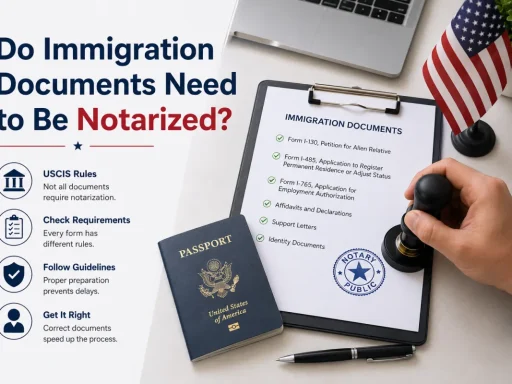
Do immigration documents need to be notarized?
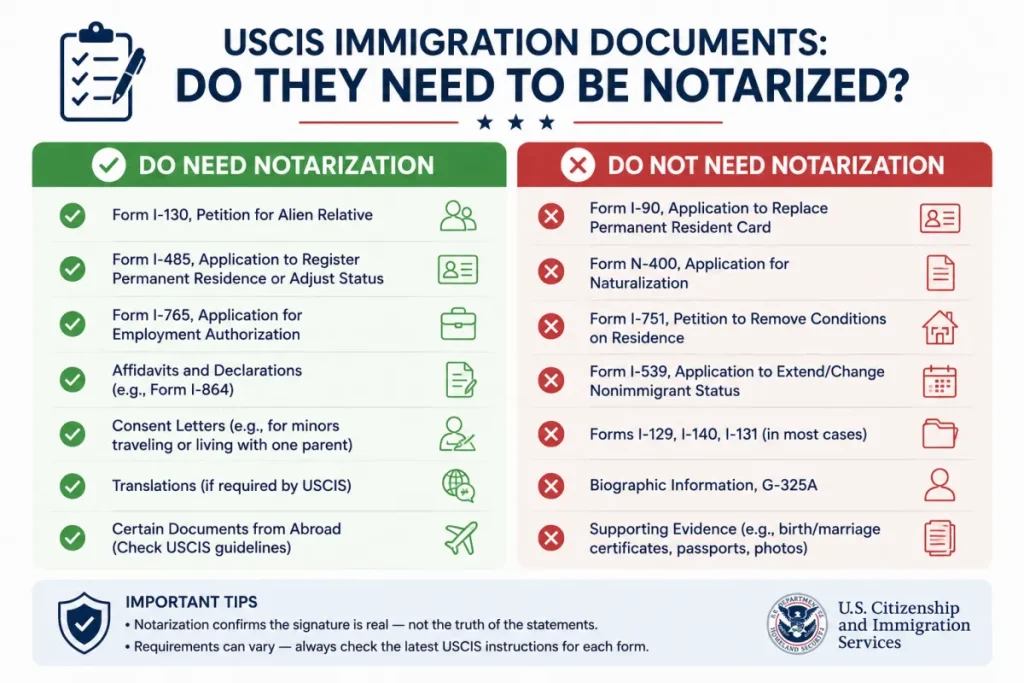
In most cases, no. Immigration documents do not need to be notarized. This surprises many applicants, because notarization feels like the “official” step. But U.S. Citizenship and Immigration Services (USCIS) designs its forms to be signed under penalty of perjury, which means your signature alone carries legal weight. A notary stamp adds nothing USCIS asks for.
That covers the vast majority of immigration paperwork, petitions like the I-130, green card applications like the I-485, naturalization (N-400), work authorization (I-765), and more. You sign them, you don’t notarize them.
Where people go wrong is assuming everything official needs a notary. It doesn’t and over-notarizing can slow you down. The real question is the narrow set of situations where notarization is needed, covered below. When you do need it, you can handle it with remote online notarization.
Why USCIS usually doesn’t require notarization
USCIS relies on the penalty-of-perjury standard. When you sign a USCIS form, you’re legally attesting that the information is true under U.S. law, the same legal exposure a sworn, notarized statement carries. Adding a notary is redundant.
The clearest example is the Form I-864, Affidavit of Support. Even though it’s called an “affidavit,” USCIS does not require it to be notarized. The sponsor signs it under penalty of perjury, and that’s enough. You can confirm this directly in the official USCIS Form I-864 instructions. Notarizing it anyway won’t cause a rejection, but it’s unnecessary effort.
The same logic applies to copies: USCIS generally wants plain photocopies of your original documents, not certified or notarized copies, unless an officer specifically requests an original. Never mail your only original unless USCIS asks.
When immigration documents do need notarization
Notarization still has a place in immigration, just a narrow one. You may need a notary when:
- You’re writing a personal affidavit or sworn statement: When an official record is missing (for example, an affidavit of birth because a birth certificate is unavailable, or an affidavit confirming a relationship), a notarized sworn statement is often expected.
- The document will be used outside USCIS: Papers headed to a foreign government, consulate, or court — common in consular processing or dual-track immigration, frequently require notarization, and sometimes an apostille on top.
- A specific agency or attorney requests it: Occasionally a receiving party asks for a notarized version even when USCIS wouldn’t. Follow the requester’s written instruction.
In these cases, the notary verifies the signer’s identity, not the truth of the contents. For documents crossing borders, you may need authentication beyond a notary, see apostille vs. notary public.
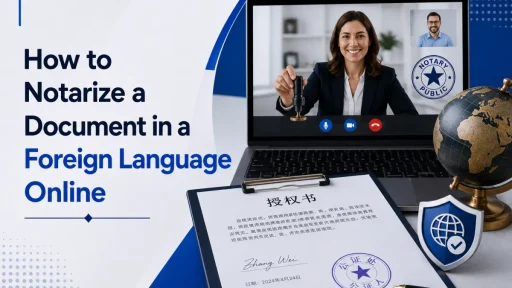
Certified translation vs. notarized translation: the biggest mix-up
This is where most applicants get it wrong. If you submit a foreign-language document to USCIS, it must come with a certified translation, not a notarized one.
Under 8 CFR 103.2(b)(3), USCIS requires the translator to provide a signed statement certifying that the translation is complete and accurate and that they are competent to translate from the foreign language into English. A notary seal is not mentioned in that regulation and is not required.
| Certified translation | Notarized translation | |
|---|---|---|
| What it includes | Translator’s signed certification of accuracy + competency | A notary verifying the translator’s signature |
| What it proves | The translation is complete and accurate | The identity of the person who signed |
| Does USCIS require it? | Yes — required for foreign-language documents | No, not required by USCIS |
| Governing rule | 8 CFR 103.2(b)(3) | N/A for USCIS |
For USCIS, get a certified translation. Paying extra to notarize the translator’s signature doesn’t add anything USCIS needs (though a foreign agency might ask for it).
Notarization vs. apostille for immigration civil documents
For certain immigration paths, your civil documents (birth, marriage) used abroad may need an apostille, a higher level of authentication for countries in the Hague Convention, rather than (or in addition to) notarization. An apostille authenticates the document for international use; a notary only verifies a signature. If a consulate or foreign authority is involved, check whether you need an apostille rather than notarization.
Common mistakes to avoid
- Notarizing USCIS forms that don’t need it: The I-130, I-485, N-400, I-765, and I-864 are signed under penalty of perjury — no notary needed.
- Getting a notarized translation instead of a certified one: USCIS wants the translator’s certification, not a notary seal.
- Sending certified or notarized copies when photocopies are fine: USCIS usually wants plain photocopies unless it requests originals.
- Mailing your only original document: Keep originals unless specifically asked.
- Skipping notarization on a personal affidavit that needs it: When you replace a missing record with a sworn statement, notarization is often expected.
Conclusion
For immigration, less is often more. Most USCIS documents, including the I-864 Affidavit of Support are signed under penalty of perjury and do not need to be notarized. Foreign-language documents need a certified translation, not a notarized one. The genuine exceptions are narrow: personal affidavits that stand in for a missing record, and documents headed to a foreign government, consulate, or court. Before you pay for a notary, confirm what the receiving party actually requires, and when in doubt on a complex case, ask a licensed immigration attorney.
When you do hit one of those exceptions and need a document notarized, you don’t have to find a notary’s office, notarize your affidavit or cross-border document online with a commissioned notary on BlueNotary in about 15 minutes, 24/7. Need to know whether a specific document needs a notary at all? Start with what documents require notarization.
Frequently asked questions
Does the I-864 Affidavit of Support need to be notarized?
No. Despite the name, USCIS does not require the I-864 to be notarized. The sponsor signs it under penalty of perjury, which is legally sufficient.
Does USCIS require notarized documents?
Generally no. USCIS forms are signed under penalty of perjury, so notarization isn’t required. Notarization mainly applies to personal affidavits or documents used outside USCIS.
Do USCIS translations need to be notarized?
No. USCIS requires a certified translation, the translator’s signed statement of accuracy and competency under 8 CFR 103.2(b)(3), not a notarized translation.
Do I need to notarize copies of documents for USCIS?
Usually not. USCIS typically wants plain photocopies of your originals, not certified or notarized copies, unless an officer specifically requests an original.
What immigration documents need to be notarized?
Mainly personal affidavits used when an official record is unavailable, and documents intended for a foreign government, consulate, or court, not standard USCIS forms.
Is a notarized translation the same as a certified translation?
No. A certified translation includes the translator’s accuracy certification; a notarized translation only verifies the signer’s identity. USCIS requires the certified version.
Do I need an apostille or notarization for immigration?
It depends where the document is used. USCIS rarely needs either for its forms, but civil documents used abroad may need an apostille rather than a notarization.