



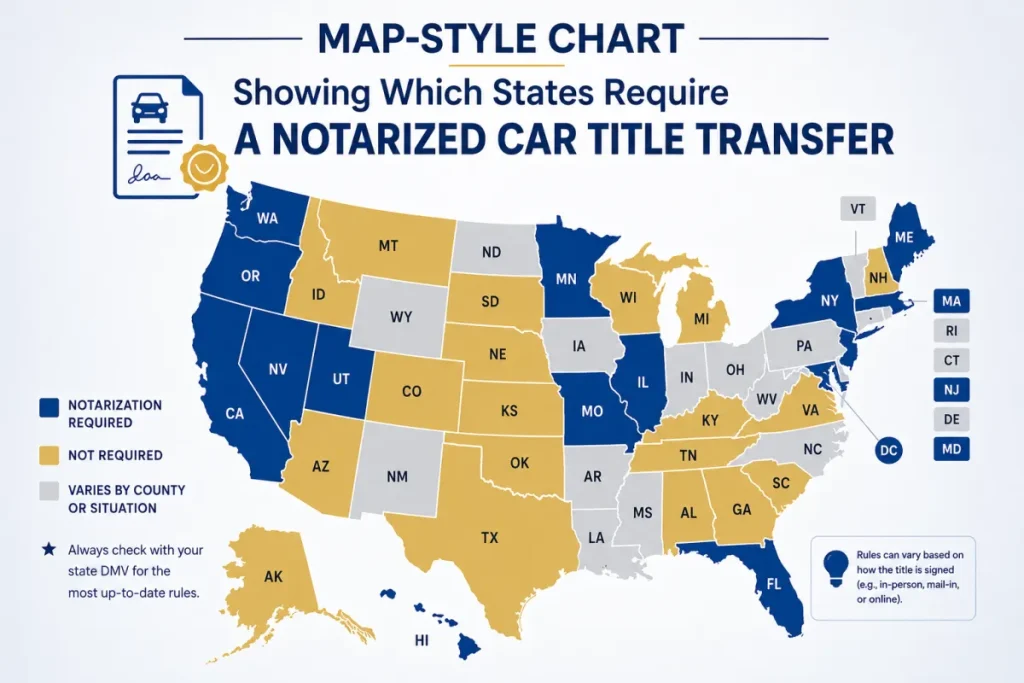
Quick answer: Yes, you can notarize a car title online in most states through remote online notarization (RON). The bigger question is whether your DMV accepts a remotely notarized title, acceptance varies by state. A handful of states (Arizona, Kentucky, Louisiana, Montana, North Carolina, Ohio, Oklahoma, Pennsylvania, Wyoming) require title notarization; most do not.
Does a car title need to be notarized?
A car title (certificate of title) is the legal document proving who owns a vehicle. To sell or transfer it, the owner signs the title over to the buyer, and in some states, that signature must be notarized before the DMV will process the transfer.
Whether you need a notary depends entirely on the state where the title is issued. Most states do not require notarization — California and Florida, for example, simply need a signature. But a specific group of states do require the title signature to be notarized, and skipping it there means the DMV rejects the transfer.
If you’re also creating a bill of sale for the sale, that’s a separate document, and some buyers want it notarized even when the title doesn’t require it.
Can you notarize a car title online?
Yes. You can notarize a car title online through remote online notarization, where a commissioned notary verifies your identity over live video, watches you sign the title, and applies a tamper-evident electronic seal. RON is authorized in nearly every state, so finding a notary isn’t the hard part.
Here’s the caveat that matters most: RON being legal is not the same as your DMV accepting a remotely notarized title. DMVs set their own rules on digital signatures and electronic seals, and some still require a wet-ink, in-person notarization for vehicle titles. Before you book an online session:
- Call or check your state DMV to confirm it accepts remotely (electronically) notarized titles.
- Use a platform your DMV recognizes, so the electronic seal and certificate are accepted.
- Ask whether they need the original paper title with a physical seal, which some title offices still require.
New to the process? Here’s how online notarization works end to end before you start.
Which states require a notarized car title?
If your title was issued in one of these states, the signature generally must be notarized for the transfer to go through. Most other states require no notary at all.
| State | Whose signature is notarized |
|---|---|
| Arizona | Seller |
| Kentucky | Seller |
| Louisiana | All transfers (buyer + seller) |
| Montana | Seller |
| North Carolina | Both buyer and seller |
| Ohio | Seller |
| Oklahoma | Seller |
| Pennsylvania | Most transfers (seller) |
| Wyoming | Seller |
| Most other states (CA, FL, TX, etc.) | No notarization required |
A few states (such as Alabama, Mississippi, and West Virginia) make notarization optional for certain private sales. Because rules change and depend on the title’s issuing state, confirm yours with the state motor vehicle agency, for example, the California DMV title transfer page.
How to notarize a car title online: step by step
- Confirm your state requires notarization, and that your DMV accepts RON: This two-part check is the whole game. If your DMV needs wet ink, an online notary won’t help.
- Have the title ready, but don’t sign it yet: Fill in the sale details (odometer, sale price, names) accurately. The notary must watch you sign. Errors or cross-outs can void a title.
- Create an account and upload the title: A platform like BlueNotary connects you with a commissioned online notary, usually within about 15 minutes, 24/7. Confirm the platform’s seal is DMV-recognized in your state.
- Verify your identity: Complete knowledge-based authentication (KBA) and a government photo ID scan. Your name must match the title exactly.
- Sign the title on the live video call: The notary confirms your identity and willingness, watches you sign, then applies the electronic notary seal and completes the certificate.
- Submit the notarized title to the DMV: Follow your state’s transfer process. Keep the recorded session and electronic certificate as proof in case the title office has questions.
Don’t write on the title before the session. Many DMVs reject titles with corrections, the wrong signature line used, or a date that doesn’t match the notarization.
Notarizing a title without the buyer (or with both parties)
Most states only require the seller’s signature to be notarized, which means you often don’t need the buyer present, the seller can complete the online notarization alone and hand over the signed title.
A few states are stricter. Louisiana notarizes the full transfer, and North Carolina requires both the buyer’s and seller’s signatures to be notarized. When both parties must sign, an online platform is actually convenient, buyer and seller can join the same video session from different locations, or complete separate sessions if your state allows it. Always confirm the order and who must appear before you start.
Common mistakes that get a title rejected
- Assuming every DMV accepts RON: Some require wet-ink notarization for titles, check first.
- Signing before the session: The notary must witness the signature; a pre-signed title is void.
- Wrong signature line or section: Using the buyer’s line as the seller (or vice versa) can ruin the title.
- Odometer or sale-info errors: Mistakes and cross-outs often force a duplicate title.
- Missing the second party: In states like North Carolina, both signatures must be notarized.
Conclusion
Notarizing a car title online is quick and legally valid, but only worth doing if two boxes are checked. Your title’s issuing state actually requires notarization (Arizona, Kentucky, Louisiana, Montana, North Carolina, Ohio, Oklahoma, Pennsylvania, or Wyoming, most states don’t), and your DMV accepts a remotely notarized title. Confirm both, fill the title out accurately, sign live in front of the notary, and keep your electronic certificate. Do that and your transfer clears without a trip to a notary’s office.
Ready to transfer your vehicle? Once you’ve confirmed your DMV accepts RON, upload your title, verify your ID, and connect with a commissioned online notary on BlueNotary in about 15 minutes, 24/7. Buyer and seller can even join from different locations. Need a matching bill of sale template? Grab one before your session so both documents are ready.
Frequently asked questions
Does a car title need to be notarized?
Only in some states. Arizona, Kentucky, Louisiana, Montana, North Carolina, Ohio, Oklahoma, Pennsylvania, and Wyoming require it; most states, including California and Florida, do not.
Can you notarize a car title online?
Yes. You can notarize a title online through remote online notarization, but you must confirm your state DMV accepts a remotely notarized title before relying on it.
Which states require a notarized car title?
Arizona, Kentucky, Louisiana, Montana, North Carolina, Ohio, Oklahoma, Pennsylvania, and Wyoming are the main ones. A few others make it optional for certain private sales.
Will the DMV accept an online-notarized title?
It depends on the state. Many DMVs accept RON, but some still require wet-ink, in-person notarization for titles. Check with your DMV and use a DMV-recognized platform.
Do both buyer and seller need to be present to notarize a title?
Usually only the seller’s signature is notarized. North Carolina requires both signatures, and Louisiana notarizes the full transfer, so both parties must participate.
Can I notarize a title online without the buyer?
In most states, yes. Only the seller’s signature needs notarizing, so the seller can complete the online session alone.
Can I notarize an out-of-state car title online?
Yes. You can connect with a commissioned online notary from anywhere, but follow the rules of the state where the title is issued and where it will be transferred.