


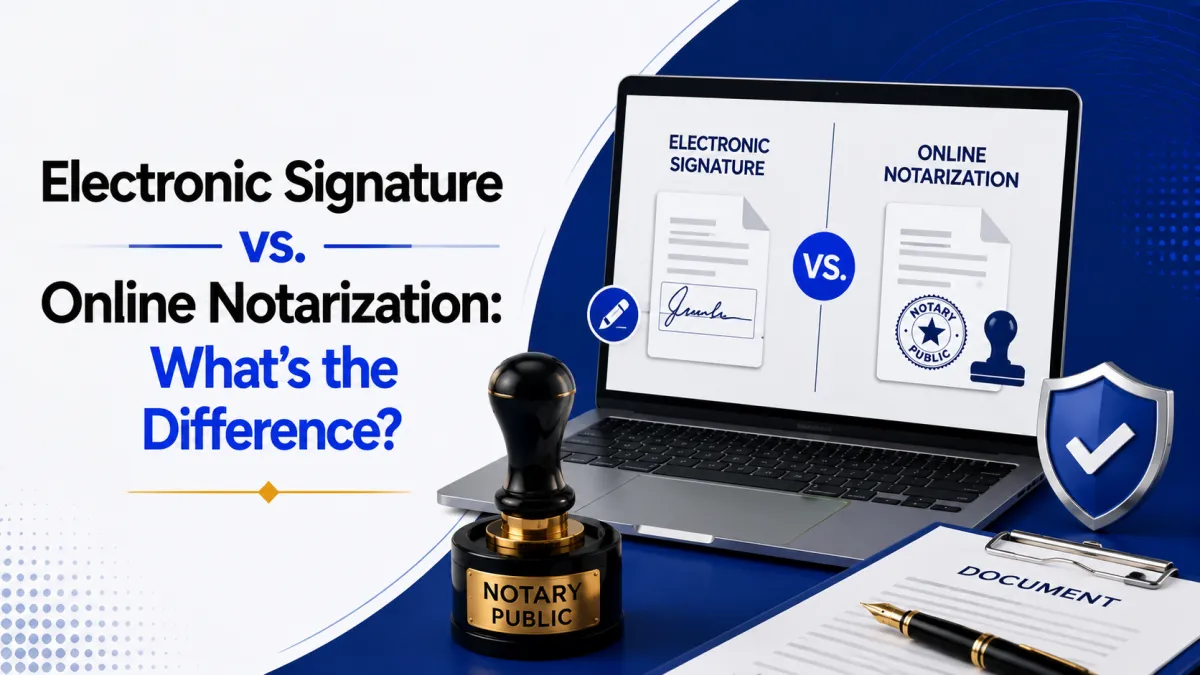

Quick answer: An electronic signature lets you sign a document digitally to show intent and consent, no notary involved. Online notarization (RON) adds a commissioned notary who verifies your identity over live video, witnesses the signing, and applies an official seal. Use an e-signature for everyday contracts; use online notarization when a law or institution requires a notarized document.
What is an electronic signature?
An electronic signature (e-signature) is any electronic mark, a typed name, drawn signature, or click-to-sign, that you apply to a document to show you agree to it and intend to sign. Tools like DocuSign and Adobe Acrobat Sign create e-signatures. There’s no notary, no identity check by a third party, and no official seal.
E-signatures carry full legal force in the United States thanks to two laws: the federal ESIGN Act (2000) and the Uniform Electronic Transactions Act (UETA), adopted by 49 states. Together they say a document can’t be denied legal effect just because it’s signed electronically. For the full legal breakdown, see BlueNotary’s electronic signature legal requirements guide.
You’d use an e-signature for things like employment offers, NDAs, vendor contracts, and online sign-ups — documents where both parties simply need to agree.

What is online notarization?
Online notarization, formally remote online notarization (RON), is when a commissioned notary public verifies your identity and witnesses your signature over a live audio-video call, then attaches a notarial certificate and a tamper-evident electronic seal. It’s the digital version of visiting a notary in person.
The notary does three things an e-signature platform does not: confirms you are who you say you are (through ID checks and knowledge-based authentication), confirms you’re signing willingly, and creates an official, recorded record of the act. That’s why notarization is reserved for higher-stakes documents. Here’s how remote online notarization works step by step.
You’d use online notarization for documents the law or an institution requires to be notarized, like a deed, a power of attorney, or a sworn affidavit.
Electronic signature vs. online notarization: the key differences
The simplest way to see it, an e-signature captures agreement, while online notarization verifies identity and adds legal authority. A notarization actually contains an electronic signature inside it, plus much more.
| Dimension | Electronic Signature | Online Notarization (RON) |
|---|---|---|
| What it proves | You agreed and intended to sign | A notary verified your identity and witnessed the signing |
| Notary involved? | No | Yes — a commissioned notary public |
| Identity verification | None (or basic email/login) | ID check + knowledge-based authentication |
| Witnessing | No | Yes, live over video |
| Official seal | No | Yes — tamper-evident notary seal + certificate |
| Governing law | ESIGN Act + UETA | Your state’s RON law |
| Typical cost | Often free or low subscription | A per-session notary fee |
| Best for | Contracts, NDAs, offer letters, sign-ups | Deeds, powers of attorney, affidavits, titles |
An e-signature is faster and free for everyday agreements, online notarization is what you reach for when a document must be notarized to be accepted.
When do you need an electronic signature vs. online notarization?
The deciding question is simple, does a law, court, or institution require the document to be notarized? If yes, an e-signature alone won’t do, you need notarization.
An electronic signature is usually enough for:
- Business contracts, vendor and service agreements
- Non-disclosure agreements (NDAs)
- Employment offer letters and onboarding forms
- Leases (in many states), waivers, and consent forms
Online notarization is typically required for:
- Real estate deeds and many closing documents
- Powers of attorney
- Affidavits and sworn statements
- Certain vehicle titles, and documents headed for an embassy or apostille
Because requirements vary by state and by the receiving party, confirm before you sign. A quick call to the bank, county recorder, or agency, or a look at the notarization requirements by state, tells you which path you need.
E-notary vs. remote online notary: a common mix-up
People often confuse two digital notary terms, so here’s the clean distinction:
- Electronic notarization (e-notary / IPEN): The notary uses an electronic signature and seal, but you still appear in person before them.
- Remote online notarization (RON): You appear before the notary over live video, no in-person meeting.
Both produce a digitally notarized document; the difference is whether you’re physically present. Secretaries of State draw this line clearly, see, for example, Pennsylvania’s Electronic or Remote Notarization guidance. For more on the seals themselves, BlueNotary compares electronic vs. wet-ink notary stamps.
Are both legally valid?
Yes, both are legally valid when used correctly. Electronic signatures are enforceable nationwide under the ESIGN Act and UETA. Online notarizations carry the same legal weight as in-person notarizations in states that have authorized RON, and notarizations performed in one state are generally recognized in others. The National Association of Secretaries of State (NASS) tracks remote notarization adoption across the country.
The catch is matching the tool to the requirement: an e-signed document is valid as an agreement, but if the law required it to be notarized, an e-signature alone won’t satisfy that, and a court or institution can reject it.
Common mistakes people make
- E-signing a document that legally needs notarization: A signed deed or POA without a notary can be rejected.
- Assuming “electronic notary” means remote: E-notary can still require in-person appearance; RON is the remote one.
- Skipping the institution’s rule: Some banks or agencies have their own format requirements even when the law is satisfied.
- Thinking notarization replaces the signature: Online notarization includes your electronic signature — it doesn’t remove it.
Conclusion
The difference comes down to purpose, an electronic signature captures that you agreed to a document, while online notarization adds a commissioned notary who verifies your identity, witnesses the signing, and seals it with legal authority. For everyday contracts, NDAs, and offer letters, an e-signature is fast, valid, and often free. The moment a law, court, bank, or county requires a notarized document, a deed, power of attorney, or affidavit, you need online notarization, not just a signature. When in doubt, ask the receiving party which one they require, so your document isn’t rejected later.
Need a document actually notarized, not just signed? Connect with a commissioned online notary on BlueNotary in about 15 minutes, 24/7, and get an identity-verified, sealed document that holds up. Just need agreement on a contract? Then an e-signature is all you need, save the notary for when it’s truly required.
Frequently asked questions
Is an electronic signature the same as notarization?
No. An electronic signature only shows you agreed and signed. Notarization adds a commissioned notary who verifies your identity and witnesses the signing, which an e-signature does not do.
Is an e-signature legally binding?
Yes. Electronic signatures are legally binding across the U.S. under the federal ESIGN Act and UETA, as long as both parties intended to sign and consented to transact electronically.
When do I need online notarization instead of an e-signature?
When a law, court, bank, or agency requires the document to be notarized, commonly deeds, powers of attorney, affidavits, and certain titles. An e-signature alone won’t satisfy a notarization requirement.
What’s the difference between an e-notary and a remote online notary?
An e-notary uses an electronic signature and seal but you appear in person. A remote online notary lets you appear over live video, with no in-person meeting required.
Is online notarization legally valid?
Yes. In states that authorize RON, an online notarization carries the same legal weight as an in-person one and is generally recognized across state lines.
Can you notarize an electronically signed document?
Yes. Online notarization actually combines your electronic signature with the notary’s identity verification and seal, the signature and the notarization work together.