





Quick answer: Yes, in most states you can close on a house online using remote online notarization (RON). You sign and notarize your closing documents with a commissioned notary over a live video call. Whether you can depends on your state, lender, and title company, RON closings are now legal in 40+ states.
What is a remote online notarization (RON) real estate closing?
A RON real estate closing is a home closing where you sign and notarize your documents electronically, with a commissioned notary verifying your identity and witnessing your signatures over a live audio-video call instead of across a table. It’s the digital version of the traditional closing, same legal documents, same notarization, done remotely.
These closings run on secure platforms that combine document prep, identity verification, e-signing, and notarization in one recorded session. The notary applies a tamper-evident electronic seal and a journal entry, creating an audit trail that’s often stronger than paper. For the mechanics of the notary side, see how remote online notarization works.
Can you close on a house online?
Yes, you can close on a house online in most of the country. More than 40 states have passed laws authorizing remote online notarization, and states like Florida, Texas, Virginia, and New York were early adopters for real estate. But “can you” depends on more than your state.
Three approvals all have to line up:
- Your state must authorize RON for the closing documents.
- Your lender and title underwriter must accept RON closings, most major underwriters (First American, Old Republic, Fidelity) do.
- The county recorder where the property sits must accept the electronically notarized, e-recorded deed.
If any one of those says no, you may do a hybrid eClosing instead, most documents are e-signed, and only the few that must be wet-ink (often the notarized deed) are signed on paper. Check your state’s position in the notarization requirements by state guide.
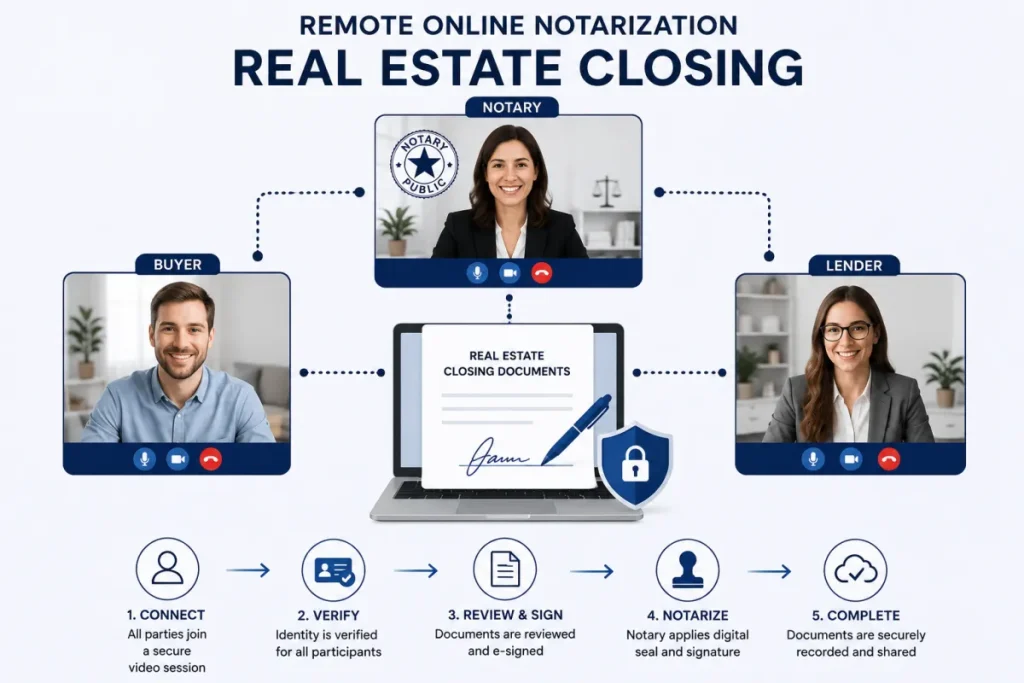
How a RON real estate closing works: step by step
- Your lender or title company prepares the closing package: All documents, the deed, mortgage or deed of trust, and closing disclosure are uploaded to a secure closing platform. You don’t start this yourself; the title company coordinates it.
- You receive and review documents in advance: You get secure access to read everything before the session, including the closing disclosure you’re legally entitled to review.
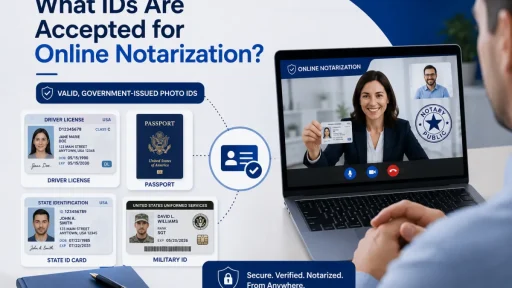
- You verify your identity: At the session you complete multi-factor identity checks, knowledge-based authentication (KBA) and a government photo ID scan.
- You join the live video session with the notary: The notary confirms your identity and willingness, then watches you e-sign each document in a recorded audio-visual session. Multiple parties can join from different states.
- The notary applies the electronic seal and journal entry: Notarized documents like the deed and mortgage, receive a tamper-evident seal, creating an immutable audit trail.
- Documents are e-recorded and funds are wired: The signed deed is e-recorded with the county, and closing funds are wired electronically. The keys are yours.
Hybrid is common. If your county won’t e-record a digital deed, you may sign that one document on paper while everything else stays online.
Which closing documents get notarized online?
Not every page in a closing package needs a notary, but the most important ones do. The documents that always require notarization at a closing are:
- The property deed, must be notarized to be recorded with the county.
- The mortgage or deed of trust, lenders require notarization to protect their lien.
- Closing disclosures and certain agreements, notarized to finalize the transaction.
Other documents (loan applications, disclosures, affidavits) may be e-signed without a notary. For a fuller breakdown, see what documents require notarization and how a mortgage promissory note fits the package.
Online vs. traditional closing: how they compare
| Dimension | Online (RON) closing | Traditional in-person closing |
|---|---|---|
| Where you sign | Anywhere with a camera and internet | At a title/attorney office |
| Multi-state parties | Easy — all join by video | Requires travel or mail-away |
| Identity check | KBA + ID scan, recorded | Visual ID inspection |
| Notarization session | ~15–45 minutes | ~1 hour, plus travel |
| Audit trail | Recorded session + e-journal | Paper notary journal |
| Availability | Where state, lender, and county allow | Nationwide |
An online closing wins on speed and convenience, especially for out-of-state or relocating buyers, while a traditional closing is the fallback when any party in the chain doesn’t yet support RON.
Is an online closing legal and accepted?
Yes. In states that authorize RON, an online closing is fully legal, and the notarized documents carry the same legal weight as in-person ones. Critically for financed purchases, Fannie Mae, Freddie Mac, and the FHA accept RON-notarized documents, and most major title underwriters approve RON closings. Industry adoption is tracked on the Mortgage Bankers Association’s RON resource.
The remaining variable is county e-recording: not every county records electronically yet, which is why hybrid closings still exist. Your title company will know what your county accepts.
What can stop an online closing
- Your county won’t e-record a digital deed → You sign that document on paper (hybrid).
- Your lender or underwriter doesn’t support RON → Traditional closing required.
- Your state hasn’t authorized RON for the document type → In-person notarization needed.
- Identity verification fails → You’ll need to retry or use in-person ID checks.
- All-cash vs. financed → Cash closings are often simpler to do online, financed ones add lender rules.
Conclusion
You can absolutely close on a house online in most states: you sign and notarize your deed, mortgage, and closing disclosure with a commissioned notary over live video, and the documents hold the same legal weight as an in-person closing. The deciding factors aren’t really about you, they’re whether your state allows RON, your lender and title underwriter accept it, and your county will e-record the deed. When all three align, an online closing can shave hours of travel and friction off the process; when one doesn’t, a hybrid closing keeps most of it digital.
Buying or selling soon? Ask your lender or title company whether they support RON eClosings, many already run them on platforms like BlueNotary’s eClosing. If you’re a title or escrow professional who wants to offer remote closings, see how BlueNotary works for title and escrow.
Frequently asked questions
Can you close on a house online?
Yes, in most states. Using remote online notarization, buyers and sellers sign and notarize closing documents over a live video session, as long as the state, lender, and county all allow it.
Is an online real estate closing legal?
Yes. In states that authorize RON, an online closing is legal and the notarized documents carry the same legal weight as in-person ones. Fannie Mae, Freddie Mac, and the FHA accept RON-notarized documents.
Which states allow remote online notarization for closings?
More than 40 states have authorized RON, including early real-estate adopters like Florida, Texas, Virginia, and New York. Acceptance still depends on your lender and county.
Do all lenders accept RON closings?
No. Most major title underwriters and many lenders accept RON, but not all. If yours doesn’t, you may do a hybrid closing where only the notarized documents are signed in person.
How long does an online closing take?
The notarization session usually takes 15 to 45 minutes. Your overall loan timeline still depends on underwriting, but digital closings often move faster than traditional ones.
What documents are notarized at a closing?
Mainly the property deed, the mortgage or deed of trust, and certain closing agreements. Other documents in the package are often e-signed without a notary.
Can you refinance a mortgage online?
Yes. Refinances are frequently done as RON closings, since they involve fewer parties than a purchase, where your state and lender permit it.