


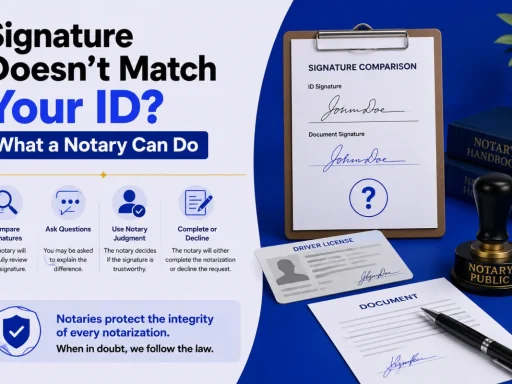
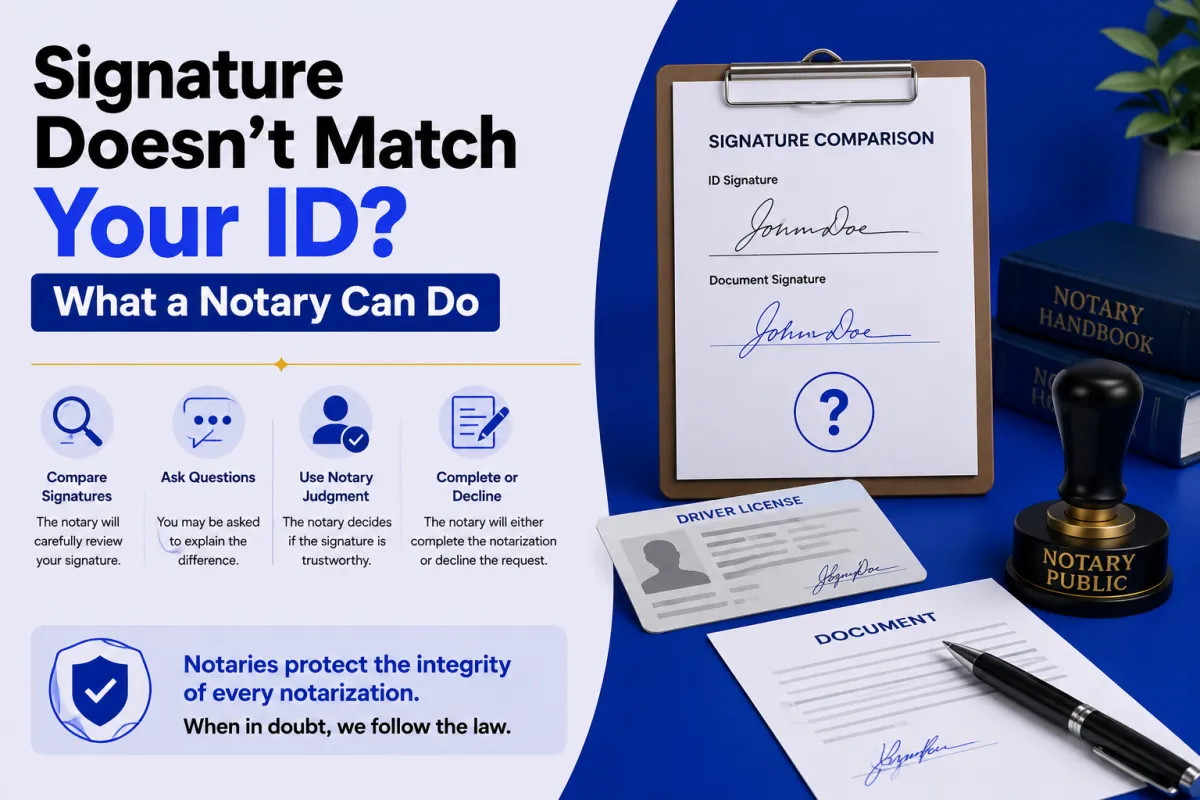

Quick answer: It depends on what doesn’t match. A notary does not compare your signature style to the one on your ID, you can sign in print, cursive, or with a flourish. What matters is the name. The name you sign must be supported by your ID. If the names don’t match, the notary may have to decline until you fix it.
Can a notary notarize if your signature doesn’t match your ID?
Usually yes, if the name checks out. People assume a notary studies your signature and rejects it if it doesn’t look like the one on your driver’s license. That’s not how it works. A notary’s job is to verify your identity using your ID, not to compare handwriting. So the way you sign, cursive, block letters, initials, or a scrawl, generally doesn’t matter.
What the notary does check is that the name connected to your signature is supported by your identification. If you sign a name your ID can reasonably confirm, you’re fine. If you sign a name your ID can’t support, that’s where a notarization can stall. The identity check is the heart of it, see how remote online notarization verifies you.
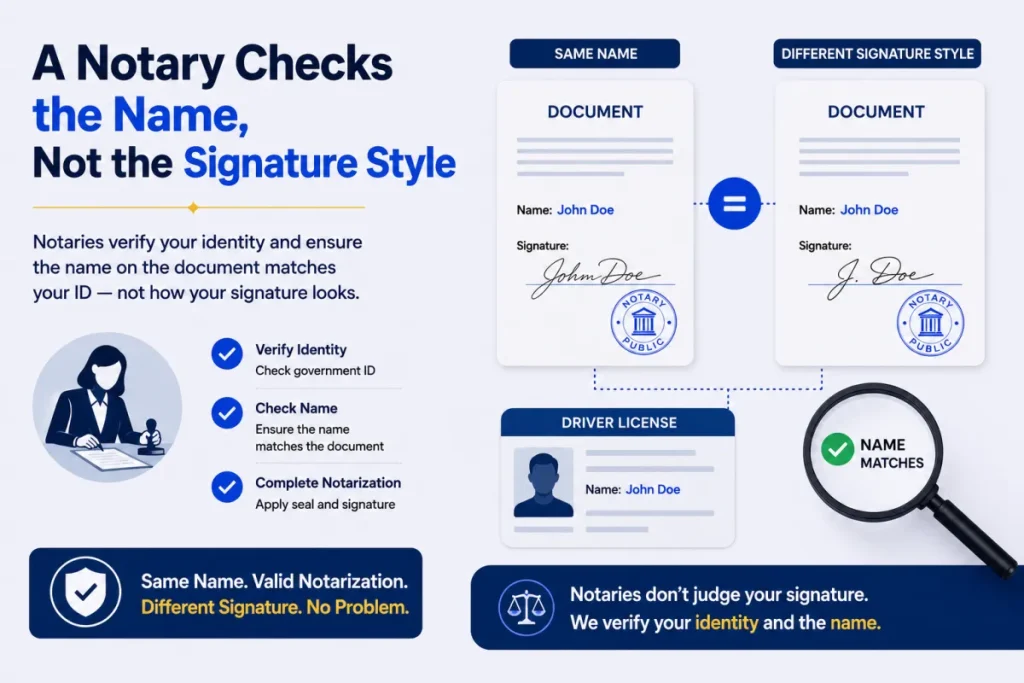
Your signature style doesn’t have to match
Let’s kill the myth directly: a notary is not a signature analyst. They don’t hold your document next to your ID to compare loops and slants. There’s no rule that your signature must look like the one on your license.
You can sign a notarized document in print or cursive, add a middle initial, or sign in a way that looks nothing like your ID signature and it’s still valid, as long as the notary verified your identity and the name is right. The signature is your mark of intent; the ID is what proves who you are. Those are two different things.
Your name does have to match your ID
Here’s the part that actually matters. The name you sign must be supported by your ID. The common professional standard is the “as much or more” rule: your ID should contain at least as much of your name as the document does, the same name or more, not less.
- ID = “John Michael Smith,” document = “John Smith” → usually fine (the ID has more than the document).
- ID = “John Smith,” document = “John Michael Smith” → problem (the ID has less; it can’t confirm the middle name).
The notary uses your ID to confirm the name being notarized. If the ID can’t support that name, they can’t verify you for it. This is a core part of the identity requirements and why the ID rules exist.
Name-change and nickname scenarios
Two situations cause most of the trouble:
- You changed your name (marriage, divorce, court order) but your ID still shows the old name. The notary can’t verify your new name from an old ID. You’ll either sign the name on your ID, update your ID first, or use a workaround below.
- You go by a nickname or middle name. Signing “Mike” when your ID says “Michael” can create a mismatch. Where it matters, sign the name your ID supports, or add documentation linking the two.
These aren’t the notary being difficult, verifying identity is exactly what protects everyone from fraud, the same principle behind notarization fraud red flags.
What to do if your name doesn’t match your ID
If your ID can’t support the name you need to sign, you have options:
- Sign the name on your ID: If the document can accept the name exactly as your ID shows it, that’s the simplest fix.
- Bring an ID that matches. A passport, updated license, or other government ID showing the needed name resolves it instantly.
- Use an AKA or “one and the same person” affidavit: Where a state allows it, this sworn statement links your names (e.g., maiden and married) so the document can be accepted.
- Use credible identifying witnesses: Some states let a witness who knows you vouch for your identity when your ID falls short.
Which options are available depends on your state, confirm with the notarization requirements by state guide before your appointment.
Conclusion
If you’re worried your signature won’t “match” your ID, relax. A notary doesn’t compare signature styles. You can sign in cursive, print, or with initials, and it’s valid as long as your identity was verified. The thing that actually has to line up is the name: your ID should show the same name or more than the name you’re signing. The usual snag is a name change with an old-name ID, and that’s fixable, sign the name on your ID, bring a matching one, or use an AKA affidavit or credible witnesses where your state allows.
Have a valid, current ID that matches the name you’ll sign? Notarize your document online with a commissioned notary on BlueNotary in about 15 minutes, 24/7. Not sure your ID qualifies? Check what you need to notarize first.
Frequently asked questions
Can a notary notarize if your signature doesn’t match your ID?
Usually yes. A notary verifies your identity through your ID, not by comparing signature styles. What matters is that the name you sign is supported by your ID, not how the signature looks.
Does a notary compare your signature to your ID?
No. Notaries are not handwriting analysts and do not compare your signature to the one on your ID. They confirm your identity using the ID and verify the name being notarized.
What if my name doesn’t match my ID?
Then the notary may not be able to verify you for that name. Your ID should show the same name or more than the document. If it shows less or a different name, you’ll need to fix the mismatch.
Can you sign a notarized document with a nickname or maiden name?
Only if your ID supports that name. If your ID shows a different or fuller name, sign the name on your ID, bring a matching ID, or use an AKA affidavit where allowed.
What if I got married and my ID has my old name?
The notary can’t verify your new name from an old ID. Sign the name on your ID, update your ID first, or use an AKA/”one and the same” affidavit or credible witnesses where your state permits.
Can you use an AKA affidavit for a name mismatch?
In many states, yes. An AKA or “one and the same person” affidavit is a sworn statement linking your names so a document can be accepted despite a name difference. Availability varies by state.