
Online notarization services have transformed how legal documents get authenticated in the digital age. Instead of driving to a notary’s office and waiting in line, you can now complete the entire notarization process from your computer or smartphone. This digital approach maintains all the legal protections of traditional notarization while eliminating the time and location constraints that often made document authentication a hassle.
Whether you’re a law firm handling client agreements, a real estate agent closing deals across state lines, or a title company managing property transfers, understanding how online notarization services work is essential for modern business operations. Credit Union Criteria Choosing The technology combines video conferencing, identity verification, and digital signatures to create a secure, legally binding process that’s recognized in most U.S. states.
This guide will walk you through everything you need to know about online notarization services, from the basic technology to real-world applications that can streamline your document workflow.
Understanding Online Notarization Services
Online notarization services represent a fundamental shift in how notarial acts are performed. At its core, Remote Online Notarization (RON) allows a notary public to perform notarial acts for remotely located signers using audio-visual technology and identity verification methods.

The concept builds on centuries-old notarial traditions while embracing modern technology. A notary public still serves as an impartial witness to document signing, but instead of meeting face-to-face, the interaction happens through a secure video connection. The notary verifies the signer’s identity using advanced authentication methods, witnesses the signature through live video, and applies their digital notarial seal to complete the process.
The Legal Foundation
Online notarization services operate under specific state laws that define how digital notarial acts can be performed. The Uniform Law Commission developed the Revised Uniform Law on Notarial Acts (RULONA) to provide states with a framework for authorizing remote notarization. As of recent counts, over 40 states have enacted legislation specifically permitting online notarization services.
The legal validity stems from several key principles. First, the notary must be commissioned in the state where the online notarization services are performed, not necessarily where the signer is located. Second, the technology must meet specific security standards, including tamper-evident recording and secure communication channels. Third, the notary must follow prescribed identity verification procedures that often exceed traditional in-person requirements.
Key Insight: Online notarization services don’t replace traditional notarization—they expand access while maintaining the same legal standards and protections.
Technology Requirements
The infrastructure supporting online notarization services involves multiple layers of security and verification technology. Audio-visual communication platforms must provide clear, real-time interaction between the notary and signer. These systems typically require high-definition video capabilities and secure, encrypted connections to prevent tampering or interception.
Identity verification technology forms another crucial component. Online notarization services employ credential analysis software that examines government-issued identification documents for security features, formatting, and authenticity markers. Knowledge-based authentication (KBA) systems generate questions based on public records that only the legitimate document holder should know. Biometric verification, including facial recognition technology, compares live images of the signer to their identification photo.
The digital signature and sealing process relies on Public Key Infrastructure (PKI) technology. When a notary applies their digital seal, cryptographic algorithms create a unique digital fingerprint that’s mathematically linked to the specific document and timestamp. This creates tamper-evident protection—any changes to the document after notarization become immediately detectable.
Recording and Audit Trail
Every online notarization session creates a comprehensive digital record. The audio-visual recording captures the entire interaction between notary and signer, providing evidence of proper procedures and signer consent. These recordings are typically stored for multiple years, as required by state law, creating a permanent audit trail that can be reviewed if questions arise about the notarization’s validity.
Digital certificates and timestamps provide additional layers of documentation. The notary’s digital certificate contains encrypted information about their commission status, jurisdiction, and commission expiration date. Timestamp services create independently verifiable records of when the notarization occurred, preventing backdating or other temporal manipulation.
How Online Notarization Services Work
The online notarization process follows a structured sequence designed to verify identity, confirm document integrity, and create legally binding notarial acts. Understanding this workflow helps legal professionals, real estate agents, and title companies integrate online notarization services into their existing document processes.
Initial Setup and Scheduling
The process begins when a signer needs a document notarized and chooses to use online notarization services. Most platforms allow scheduling appointments in advance or connecting with available notaries immediately for urgent needs. The signer uploads their document to the secure platform, where it’s reviewed for completeness and notarizability.
During upload, the system performs preliminary document analysis. The platform checks whether the document type is eligible for online notarization under applicable state laws. Some documents, such as wills or certain real estate deeds, may have restrictions in particular jurisdictions. The system also verifies that signature lines and notarial certificate areas are properly formatted.
The signer provides basic information including their name, contact details, and the state where they’re located. This information helps determine which notary can legally perform the notarization and which state’s laws will govern the process. The platform then either schedules the appointment or connects the signer with an available commissioned notary.
Identity Verification Process
Identity verification represents the most critical security component of online notarization services. The process typically involves three distinct verification methods that work together to confirm the signer’s identity with greater certainty than traditional in-person notarization.
Credential analysis forms the first verification layer. The signer photographs or scans their government-issued identification document using their device’s camera. Advanced optical character recognition (OCR) and security feature analysis software examines the ID for authenticity markers, proper formatting, and security elements like holograms, special inks, or embedded chips.
Knowledge-Based Authentication (KBA) provides the second verification layer. The system accesses public records and credit databases to generate questions that only the legitimate ID holder should know. These might include previous addresses, loan amounts, or family member names. The signer must answer a series of multiple-choice questions within a specified time limit.
Biometric verification completes the identity confirmation process. The signer takes a live photograph or video using their device’s camera. Facial recognition algorithms compare this live image to the photo on their identification document, analyzing facial geometry, feature placement, and other biometric markers to confirm identity.
Why It Matters: The multi-layered identity verification used in online notarization services often provides stronger identity confirmation than traditional in-person notarization, where notaries rely primarily on visual ID inspection.
Live Video Session
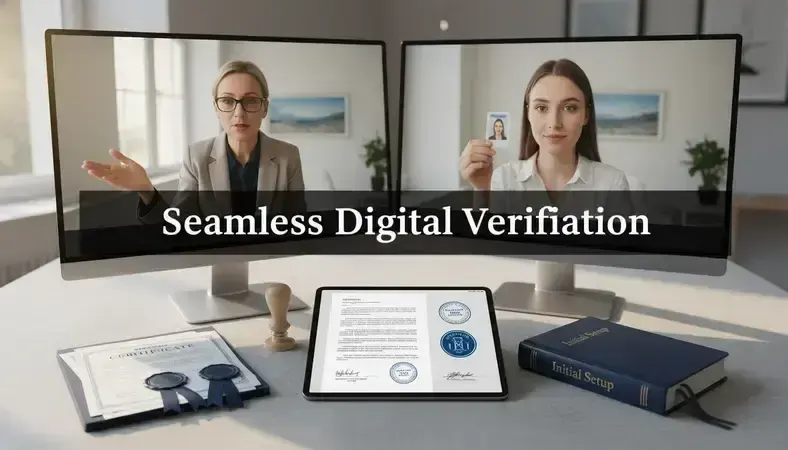
Once identity verification is complete, the signer enters a live video conference with the commissioned notary. This real-time interaction allows the notary to confirm the signer’s identity visually, ensure they understand the document they’re signing, and verify their willingness to sign without coercion.
The notary begins by introducing themselves and confirming their commission status and jurisdiction. They review the signer’s identity verification results and may ask additional questions to satisfy themselves about the signer’s identity. The notary explains the notarization process and confirms that the signer understands what they’re signing.
During the signing process, the notary watches as the signer applies their electronic signature to the document. The signer must be clearly visible on camera during signing, and the notary must be able to see the signing action in real-time. This visual confirmation serves the same witnessing function as traditional in-person notarization.
Digital Seal Application
After witnessing the signature, the notary applies their digital notarial seal to complete the notarization. This digital seal contains encrypted information about the notary’s commission, the date and time of notarization, and jurisdiction details. The seal is cryptographically bound to the specific document, creating tamper-evident protection.
The digital sealing process involves several automated steps. The notary’s digital certificate, issued by their commissioning state or an authorized certificate authority, provides the cryptographic foundation for the seal. The system generates a hash value—a unique digital fingerprint—of the document at the moment of sealing. This hash is then encrypted using the notary’s private key, creating a digital signature that can be verified using the notary’s public key.
Timestamp services add another layer of security by creating an independently verifiable record of when the notarization occurred. These timestamps are generated by trusted third-party services and cannot be altered or backdated, providing definitive proof of the notarization’s timing.
Key Components of Online Notarization Services
Online notarization services integrate multiple technological and procedural components to create a secure, legally compliant notarization process. Each component serves a specific function in maintaining the integrity and legal validity of the notarial act.
Audio-Visual Communication Platform
The communication platform serves as the foundation for remote interaction between notary and signer. These systems must provide high-definition video and clear audio to allow proper identification and communication. The platform needs to support real-time interaction without significant delays that could interfere with the notarization process.
Security features within the communication platform include end-to-end encryption to protect the privacy of the notarization session. The system must prevent unauthorized access or recording by third parties. Most platforms also include features like screen sharing, document annotation, and chat functionality to facilitate smooth communication during the notarization process.
Recording capabilities are built into the communication platform to create the required audit trail. The system automatically records the entire session, capturing both video and audio of the interaction. These recordings are stored securely and retained for the period required by state law, typically ranging from five to ten years.
Identity Verification Technology
The identity verification system combines multiple technologies to confirm signer identity with high confidence. Optical Character Recognition (OCR) technology reads and analyzes identification documents, extracting information like name, address, date of birth, and ID number. The system compares this extracted data against the information provided by the signer during registration.
Security feature analysis examines identification documents for authenticity markers that are difficult to counterfeit. This includes analyzing holograms, special inks, microprinting, and other security elements embedded in government-issued IDs. Advanced systems can detect common signs of tampering or forgery that might not be visible to the human eye.
Knowledge-Based Authentication (KBA) systems access public records and credit databases to generate verification questions. These questions are dynamically created based on the signer’s personal history and are designed to be answerable only by the legitimate ID holder. The questions typically cover previous addresses, loan amounts, employment history, or family member information.
Biometric verification technology uses facial recognition algorithms to compare live images of the signer to their identification photo. These systems analyze facial geometry, feature placement, and other biometric markers to confirm identity. Some advanced systems also include liveness detection to prevent the use of photographs or videos instead of live interaction.
Document Management System
The document management component handles the secure upload, storage, and processing of documents throughout the notarization process. Documents are encrypted during upload and storage to protect sensitive information. The system maintains version control to ensure that the document being signed is identical to the one originally uploaded.
Document preparation tools within the system help identify signature lines, notarial certificate areas, and other elements that require attention during notarization. Some platforms include document templates and automated certificate generation to streamline the process for common document types.
The system also manages document distribution after notarization is complete. Signers and other authorized parties receive copies of the notarized document, typically in PDF format with the digital notarial seal embedded. The system maintains secure storage of the original notarized document and provides access controls to ensure only authorized individuals can retrieve copies.
Compliance and Audit Features
Compliance management systems ensure that online notarization services meet all applicable state and federal requirements. These systems track notary commission status, monitor for expired commissions, and ensure that notaries only perform acts within their authorized jurisdiction.
Audit trail creation is automated throughout the notarization process. The system logs every action taken during the session, including login times, identity verification results, document access, signature application, and seal placement. These logs create a comprehensive record that can be reviewed by regulators, courts, or other authorized parties.
Quality assurance features monitor notarization sessions for compliance with established procedures. Some systems include automated alerts if required steps are skipped or if unusual activity is detected. Post-session review capabilities allow supervisors to evaluate notarization quality and identify areas for improvement.
Benefits and Use Cases for Online Notarization Services
Online notarization services offer compelling advantages across multiple industries and use cases. The technology addresses longstanding pain points in traditional notarization while opening new possibilities for document authentication and workflow efficiency.
Time and Location Flexibility
The most immediate benefit of online notarization services is the elimination of geographic and scheduling constraints. Signers can complete notarizations from any location with internet access, whether that’s their home office, a client site, or while traveling. This flexibility is particularly valuable for busy professionals who struggle to fit notary appointments into their schedules.
For law firms, online notarization services enable client document execution without requiring office visits. Clients can sign important agreements, affidavits, or other legal documents from their preferred location, improving client satisfaction and reducing scheduling conflicts. This capability is especially valuable when working with clients who have mobility limitations or live in remote areas.
Real estate agents benefit from the ability to handle document signing at any stage of the transaction process. Whether a buyer is relocating from another state or a seller is traveling during closing, online notarization services keep transactions moving forward without delays. The technology is particularly useful for investment property purchases where buyers and sellers may never be in the same geographic area.
Title companies can process closings more efficiently by eliminating the need to coordinate multiple parties’ schedules for in-person meetings. Online notarization services allow for sequential document signing, where different parties can complete their portions of the transaction at times that work for their individual schedules.
Pro Tip: Online notarization services can reduce document turnaround time from days to hours, making them invaluable for time-sensitive transactions or urgent legal matters.
Enhanced Security and Audit Trail
Online notarization services often provide stronger security than traditional notarization methods. The multi-factor identity verification process typically includes more rigorous identity confirmation than the visual ID inspection used in traditional notarization. The combination of credential analysis, knowledge-based authentication, and biometric verification creates multiple barriers against fraud.
The comprehensive digital audit trail created during online notarization provides detailed documentation of the entire process. This includes timestamps for each action, identity verification results, video recordings of the signing session, and cryptographic evidence of document integrity. This level of documentation can be invaluable in legal proceedings or regulatory reviews.
Document integrity protection through digital signatures and seals prevents post-notarization tampering. Any changes to a document after notarization are immediately detectable, providing stronger evidence of document authenticity than traditional paper-based methods where alterations might be difficult to detect.
Cost and Efficiency Improvements
Online notarization services can significantly reduce the total cost of document authentication when factoring in time, travel, and administrative overhead. While the per-notarization fee might be comparable to traditional services, the elimination of travel time and scheduling delays creates substantial cost savings for businesses and individuals.
For organizations that regularly require notarized documents, online notarization services can streamline workflows and reduce administrative burden. Legal assistants don’t need to coordinate notary appointments, clients don’t need to visit offices, and documents can be processed more quickly through the entire workflow.
The digital nature of online notarization services also reduces paper handling and storage requirements. Notarized documents are immediately available in digital format, eliminating the need for scanning and reducing the risk of document loss or damage.
Specific Industry Applications
Legal practice: Law firms use online notarization services for client affidavits, power of attorney documents, and contract execution. The technology is particularly valuable for estate planning, where elderly clients may have difficulty traveling to offices. Online notarization services also support litigation by enabling witness affidavits and expert declarations to be notarized remotely.
Real estate transactions: The real estate industry has embraced online notarization services for purchase agreements, disclosure documents, and closing paperwork. The technology enables transactions to proceed when parties are in different locations and reduces the complexity of coordinating closing meetings.
Financial services: Banks and credit unions use online notarization services for loan documents, account opening paperwork, and other financial instruments. The enhanced identity verification and audit trail features provide additional security for high-value financial transactions.
Healthcare and Elder Care: Healthcare providers use online notarization services for advance directives, healthcare power of attorney documents, and consent forms. This is particularly valuable for patients with mobility limitations or those in assisted living facilities.
Common Types of Online Notarization Services
Different types of online notarization services serve various document authentication needs. Understanding these distinctions helps organizations choose the appropriate service level for their specific requirements.
Remote Online Notarization (RON)
Remote Online Notarization represents the most comprehensive form of online notarization services. RON involves live, real-time interaction between the notary and signer through audio-visual technology. The notary performs all traditional notarial functions—identity verification, oath administration, and witnessing—through the digital platform.
RON requires the notary to be commissioned specifically for remote notarization in their state of commission. Not all states that permit traditional notarization automatically allow RON, and notaries must often complete additional training and certification to perform remote notarial acts.
The technology requirements for RON are more stringent than other online notarization services. The platform must provide tamper-evident recording, secure communication channels, and robust identity verification capabilities. The notary must maintain direct audio-visual contact with the signer throughout the signing process.
Electronic Notarization (eNotarization)
Electronic notarization involves notarizing electronic documents but still requires the notary and signer to be physically present in the same location. This hybrid approach maintains in-person interaction while using digital documents and electronic signatures.
eNotarization is often used when organizations want to eliminate paper handling while maintaining traditional in-person verification. The notary applies a digital seal to the electronic document, but the identity verification and witnessing occur through face-to-face interaction.
This approach is particularly common in high-volume environments like title companies or government offices where multiple documents require notarization and digital workflow provides efficiency benefits.
Hybrid Online Notarization Services
Some platforms offer hybrid models that combine elements of remote and in-person notarization. These services might allow initial document preparation and identity verification to occur online, with final signing and notarization completed through video conference or in-person meeting.
Hybrid approaches can be useful when dealing with complex documents that require detailed explanation or when signers need additional support navigating the technology. They provide flexibility for organizations transitioning from traditional to fully remote notarization processes.
The Technology Behind Online Notarization Services
The technical infrastructure supporting online notarization services involves sophisticated systems designed to replicate and enhance the security of traditional notarization. Understanding these technologies helps users appreciate the robust protections built into the process.
Public Key Infrastructure (PKI)
Public Key Infrastructure forms the cryptographic foundation of secure online notarization services. PKI uses mathematical algorithms to create pairs of related keys—a private key held securely by the notary and a public key that can be shared openly. When the notary signs a document, their private key creates a digital signature that can be verified using their public key.
The strength of PKI lies in its mathematical impossibility to forge. Even with massive computational resources, creating a fake digital signature that would pass verification is practically impossible. This provides stronger evidence of document authenticity than traditional ink signatures, which can be forged with sufficient skill and practice.
Digital certificates issued by trusted Certificate Authorities bind the notary’s identity to their public key. These certificates contain information about the notary’s commission, jurisdiction, and commission expiration date. The certificate authority verifies the notary’s credentials before issuing the certificate, creating a chain of trust that extends from the document back to the commissioning authority.
Tamper-Evident Technology
Online notarization services employ multiple methods to detect document tampering after notarization. Hash functions create unique digital fingerprints of documents that change if even a single character is modified. These hashes are encrypted and stored with the notarized document, allowing anyone to verify that the document hasn’t been altered since notarization.
Blockchain technology is increasingly used to create immutable records of notarization events. When a document is notarized, a record of the transaction is written to a blockchain, creating a permanent, unalterable timestamp and audit trail. This technology provides additional evidence of when notarization occurred and what the document contained at that moment.
Digital watermarking embeds invisible markers within notarized documents that can detect attempts at modification. These watermarks are integrated into the document structure in ways that make them difficult to remove without obvious signs of tampering.
Identity Verification Systems
Advanced identity verification systems use artificial intelligence and machine learning to analyze identification documents with greater accuracy than human inspection. These systems can detect subtle signs of forgery or alteration that might escape notice during visual inspection.
Liveness detection technology prevents the use of photographs or videos to spoof biometric verification. These systems require signers to perform specific actions like blinking, smiling, or moving their head to confirm that they’re interacting live with the system rather than presenting a static image.
Database verification cross-references information from multiple authoritative sources to confirm identity. This might include comparing ID information against voter registration records, property ownership databases, or other public records to ensure consistency across different data sources.
Regulatory Landscape and Legal Compliance
The regulatory environment for online notarization services continues to evolve as states update their laws to accommodate digital notarization while maintaining security standards. Understanding the current legal landscape is essential for organizations implementing online notarization services.
State Authorization and Reciprocity
Each state maintains its own laws governing notarial acts, including specific provisions for online notarization services. States that authorize Remote Online Notarization typically require notaries to complete additional training and certification beyond traditional notary requirements. These programs cover technology use, identity verification procedures, and record-keeping obligations specific to remote notarization.
Interstate recognition of online notarizations follows established legal principles governing notarial acts. Generally, a document notarized online in one state is legally valid in other states, provided the notarization complied with the laws of the state where the notary is commissioned. This reciprocity enables online notarization services to support transactions involving parties in multiple states.
However, some documents may have specific state requirements that limit where they can be notarized or require particular procedures. Real estate documents, for example, might need to comply with recording requirements in the state where the property is located. Organizations using online notarization services should verify that their specific document types and use cases comply with applicable state laws.
Federal Recognition and Standards
Federal agencies have generally recognized the validity of properly performed online notarizations. The Department of Veterans Affairs, for example, accepts online notarized documents for benefit applications and claims. The General Services Administration has updated federal acquisition regulations to accept electronic signatures and online notarizations for certain government contracts.
The SECURE Notarization Act, introduced in Congress, would establish minimum standards for online notarization services and require states to recognize remote notarizations performed in other states. While not yet enacted, this federal legislation indicates growing recognition of online notarization as a legitimate and necessary service.
Key Takeaway: Federal acceptance of online notarization services is expanding, but organizations should verify specific requirements for federal documents or programs they’re involved with.
Industry-Specific Regulations
Different industries may have additional requirements or restrictions on online notarization services. Healthcare organizations must ensure that online notarizations comply with HIPAA privacy requirements when handling medical documents. Financial institutions need to consider anti-money laundering (AML) and know-your-customer (KYC) regulations when using online notarization for account opening or loan documentation.
The real estate industry has specific considerations around recording requirements and title insurance policies. Some title insurance companies may require additional verification or documentation when online notarization services are used for property transactions. Real estate professionals should confirm that their title insurance providers accept online notarized documents.
Legal professional responsibility rules may also apply to attorneys using online notarization services. State bar associations have issued guidance on technology competence requirements and client confidentiality obligations when using digital platforms for legal document execution.
Implementation Best Practices
Successfully implementing online notarization services requires careful attention to technology selection, staff training, and process integration. Organizations that follow established best practices can maximize the benefits while minimizing potential complications.
Platform Selection Criteria
Choosing the right online notarization platform involves evaluating multiple factors beyond basic functionality. Security certifications should be a primary consideration—look for platforms that comply with industry standards like SOC 2 Type II, which demonstrates robust security controls and regular independent auditing.
Integration capabilities with existing document management systems can significantly impact workflow efficiency. Platforms that integrate with popular legal practice management software, real estate transaction platforms, or document management systems reduce the need for manual document handling and data entry.
User experience for both notaries and signers affects adoption success. Platforms with intuitive interfaces and clear instructions reduce training requirements and minimize user errors. Consider conducting pilot testing with a small group of users before full implementation to identify potential usability issues.
Training and Change Management
Staff training should cover both technical platform use and legal compliance requirements. Notaries need to understand how to verify identity through digital means, when to refuse notarization based on remote observations, and how to maintain proper records for online notarizations.
Support staff require training on scheduling, document preparation, and troubleshooting common technical issues. Having knowledgeable staff available to assist clients with platform access and technical problems improves the overall user experience and reduces abandonment rates.
Change management strategies should address potential resistance to new technology and workflows. Emphasizing the benefits for both staff efficiency and client convenience can help build buy-in. Providing adequate training time and ongoing support helps ensure successful adoption.
Expert Tip: Start with a pilot program using online notarization services for routine, low-risk documents before expanding to more complex or high-value transactions. This allows staff to gain confidence with the technology while minimizing potential complications.
Quality Assurance and Monitoring
Establishing quality assurance procedures helps ensure consistent compliance with online notarization requirements. Regular review of notarization recordings can identify areas where notaries might need additional training or where processes could be improved.
Monitoring key performance metrics like session completion rates, technical issue frequency, and client satisfaction scores provides insight into platform performance and user experience. This data helps identify trends and potential problems before they become significant issues.
Document audit procedures should verify that notarized documents meet all legal requirements and that proper records are maintained. Regular audits help ensure ongoing compliance and can identify process improvements that enhance efficiency or security.
Common Questions About Online Notarization Services
Are online notarizations legally valid everywhere?
Online notarizations are legally valid in states that have enacted Remote Online Notarization legislation, which currently includes over 40 states. The key requirement is that the notarization must be performed by a notary commissioned in a state that authorizes online notarization services. The notarized document is then generally recognized in other states under principles of interstate comity, similar to how traditional notarizations are recognized across state lines.
However, some document types may have specific state requirements that affect where they can be notarized or how they must be processed. Real estate documents, for example, might need to comply with recording requirements in the state where the property is located. Before using online notarization services for critical documents, verify that the specific document type and intended use comply with applicable state and local laws.
Federal agencies increasingly recognize online notarizations for their processes, but some programs may have specific requirements or restrictions. When in doubt, check with the receiving agency or organization to confirm their acceptance of online notarized documents.
How secure are online notarization services compared to traditional notarization?
Online notarization services often provide stronger security than traditional in-person notarization through multiple verification layers and comprehensive audit trails. Traditional notarization relies primarily on visual inspection of identification documents, which can miss sophisticated forgeries or altered IDs.
The identity verification process used in online notarization services combines credential analysis, knowledge-based authentication, and biometric verification to create higher confidence in signer identity. The knowledge-based questions, in particular, provide verification that goes beyond what’s possible with visual ID inspection alone.
The digital audit trail created during online notarization provides more comprehensive documentation than traditional notarization. Video recordings capture the entire interaction, digital timestamps provide precise timing information, and cryptographic seals create tamper-evident protection that’s stronger than ink signatures and embossed seals.
The main security considerations involve the technology platform itself and the need for secure internet connections. Reputable online notarization services use bank-level encryption and security measures to protect the process, but users should ensure they’re using secure, private internet connections for notarization sessions.
What types of documents can be notarized online?
Most document types that can be traditionally notarized are also eligible for online notarization services, but there are some exceptions and restrictions that vary by state. Common documents suitable for online notarization include contracts, affidavits, power of attorney forms, loan documents, real estate purchase agreements, and business formation paperwork.
Some states restrict online notarization for certain document types, particularly wills, trusts, and some real estate deeds. These restrictions often stem from additional witnessing requirements or specific statutory language that hasn’t been updated to accommodate remote notarization. Before proceeding with online notarization services, verify that your specific document type is eligible in the relevant jurisdiction.
International documents may have additional considerations, as some foreign governments or organizations may not recognize online notarizations. If documents will be used internationally, check with the receiving country’s requirements or consider using traditional notarization with apostille certification.
The document itself must be in electronic format for online notarization. Paper documents need to be scanned or converted to PDF format before the notarization session. The platform should maintain the document’s formatting and ensure that signature lines and notarial certificate areas are clearly visible during the video session.
How much do online notarization services cost?
Online notarization services typically cost between $25 and $50 per notarization, depending on the platform, document complexity, and urgency of service. This pricing is often competitive with traditional notarization when factoring in travel time, parking fees, and the opportunity cost of time spent traveling to a notary’s office.
Many platforms offer volume discounts for organizations that regularly use online notarization services. Law firms, real estate agencies, and title companies can often negotiate reduced per-notarization rates based on expected usage volumes. Some services also offer subscription models that include a certain number of notarizations per month for a flat fee.
Additional costs might include document preparation fees, expedited service charges, or premium features like extended recording retention or advanced integration capabilities. When evaluating costs, consider the total cost of ownership including staff time savings, improved client satisfaction, and reduced administrative overhead.
The cost-effectiveness of online notarization services becomes more apparent for organizations that previously struggled with notary availability or had to pay premium rates for mobile notary services. The convenience and time savings often justify the service fees, particularly for time-sensitive transactions or when serving clients in remote locations.
What happens if there are technical problems during notarization?
Reputable online notarization services have procedures in place to handle technical difficulties without compromising the notarization’s validity. If connection problems occur during the session, most platforms can pause and resume the notarization process once connectivity is restored, provided the notary can re-verify the signer’s identity and document integrity.
Platform providers typically offer technical support during notarization sessions to help resolve common issues like audio problems, video quality issues, or document display difficulties. Many services include backup communication methods or alternative access options to ensure sessions can be completed successfully.
If technical problems prevent completion of the notarization session, the process typically needs to be restarted from the beginning with a new session. However, the signer’s identity verification results may be retained for a short period to avoid repeating the entire verification process immediately.
Most platforms maintain detailed technical logs that can help diagnose and resolve recurring issues. This information helps improve platform reliability and can provide evidence of technical problems if questions arise about a notarization’s validity.
How long are online notarization records kept?
Record retention requirements for online notarization services vary by state but typically range from five to ten years. These requirements usually exceed traditional notary record-keeping obligations due to the digital nature of the process and the comprehensive audit trail created during online notarization.
The records maintained include audio-visual recordings of the entire notarization session, identity verification results, digital copies of notarized documents, and detailed logs of all actions taken during the process. Some platforms also retain backup copies in multiple geographic locations to ensure record availability even if primary systems experience problems.
Access to these records is typically restricted to the notary who performed the notarization, the document signers, and authorized legal representatives. Court orders or regulatory investigations may also trigger record disclosure requirements. The platform provider should have clear policies about who can access records and under what circumstances.
Organizations using online notarization services should understand their own record retention obligations and ensure that the platform’s retention policies meet their needs. Some industries or document types may require longer retention periods than the platform’s standard policy provides.
Final Thoughts
Online notarization services have revolutionized document authentication by combining legal validity with digital convenience. The technology provides enhanced security, comprehensive audit trails, and the flexibility to complete notarizations from anywhere with internet access. Get started with BlueNotary to experience how streamlined and secure online notarization can be for your organization. Ready to get started? Visit BlueNotary to learn more.