


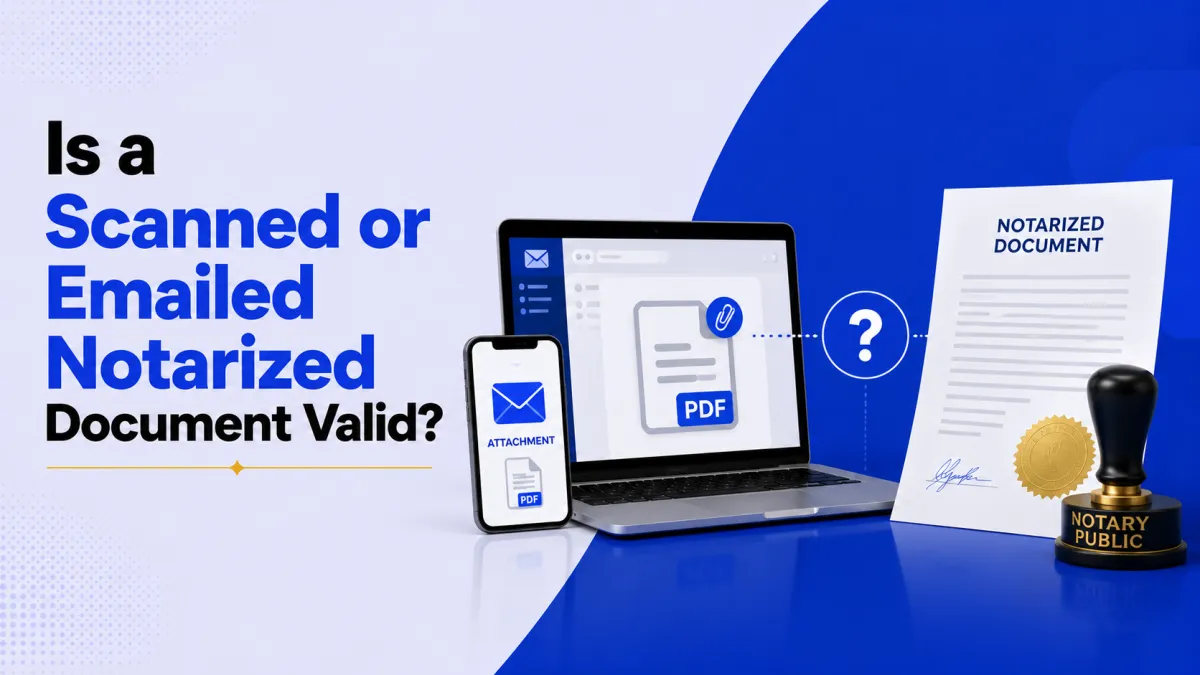

Quick answer: It depends on how it was notarized. An online (RON) notarized document is an electronic original, emailing or uploading the sealed file is completely valid. But a scan or emailed photo of a traditional wet-ink notarization is only a copy; courts, recorders, and some agencies require the original with the physical seal.
Is a scanned or emailed notarized document valid?
The honest answer is it depends on how the document was notarized, and that single distinction resolves most of the confusion.
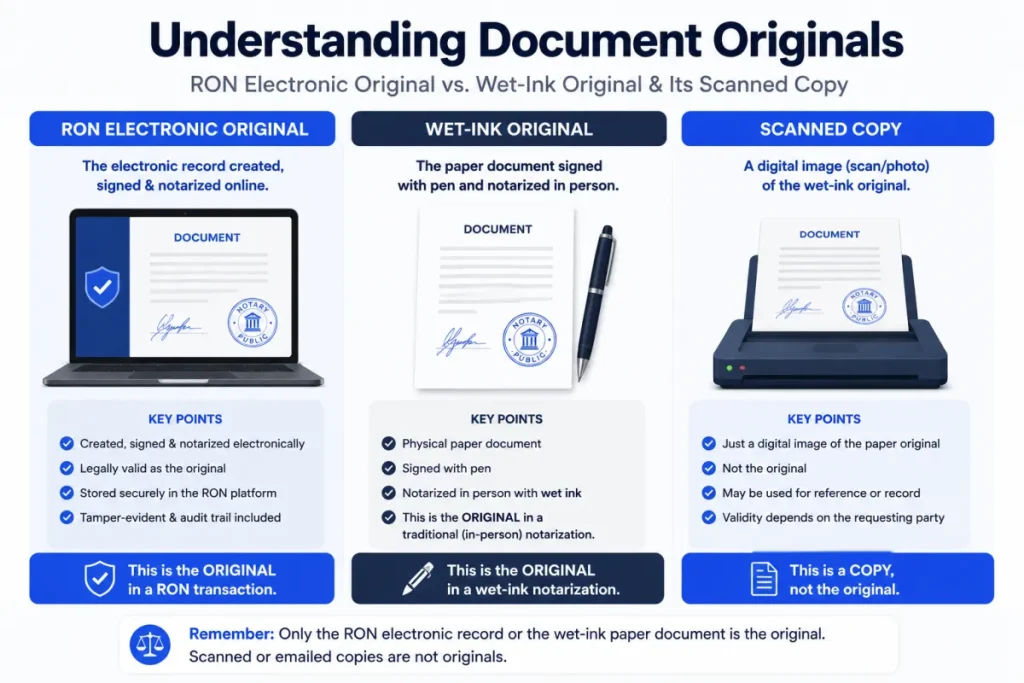
- If it was notarized online (remote online notarization), the document is an electronic original. The sealed digital file is the real thing, so emailing, uploading, or storing it is fully valid.
- If it was notarized in person with wet ink and a physical seal, the paper original is what carries legal weight. A scan or emailed photo of it is a copy, useful, but not a substitute for the original when an original is required.
So “is a scan valid?” really means “is it the original, or a copy of one?” The next sections break down both cases. If you want a document that’s valid as a digital file from the start, online notarization is the way.
Online (RON) notarizations: the electronic file is the original
When a document is notarized through remote online notarization, there is no paper “original” sitting in a drawer, the electronic document is the original, complete with the notary’s electronic seal, digital certificate, and a tamper-evident audit trail. Under the ESIGN Act and UETA, that electronic record has the same legal weight as a wet-ink one.
Because the file itself is the original, emailing or uploading it is exactly how you’re meant to deliver it. You’re not sending a “copy”, you’re sending the authentic document. In fact, the tamper-evident seal makes it easy for a recipient to confirm the file hasn’t been altered.
Wet-ink notarizations: the original vs. a scanned copy
Traditional, in-person notarization is different. The value lives in the physical document, the actual paper with the notary’s inked or embossed seal and signature. When you scan or photograph that document and email it, you’ve made a copy, not another original.
A scanned wet-ink notarization can be fine for informal or reference purposes, showing someone what was signed, or keeping a backup. But it does not replace the original where an original is required, and no scan can reproduce the legal status of the paper it came from. If the original is lost, a copy usually can’t stand in for it.
When you need the original (and a scan won’t do)
Certain recipients insist on the original wet-ink notarized document. A scan or email will typically be rejected by:
| Recipient | Why they want the original |
|---|---|
| County recorders | Deeds and mortgages must be recorded as originals (or properly e-recorded) |
| Courts | Filings often require original signatures and seals |
| Some banks / lenders | High-value transactions may require the physical document |
| Foreign authorities / apostille | Authentication usually starts from the original |
For everyday uses, many parties will accept a scanned copy, but never assume. Ask the recipient whether they accept a scan or require the original, and check any state-specific rules in the notarization requirements by state guide.
Need a valid copy? Get a certified copy
If you need a copy that carries weight, not the original, but something more than a plain scan, the answer is a certified copy, not an email attachment. A certified copy is an official reproduction verified as a true copy of the original by the issuing agency or, where allowed, a notary. It’s the recognized way to provide a valid duplicate.
So the hierarchy is: the original (or the RON electronic file) is best; a certified copy is the accepted stand-in when a copy is allowed; and a plain scan or email is the weakest, fine for reference, not for anything that demands authenticity. Learn the difference in what a certified copy is.
Conclusion
Whether a scanned or emailed notarized document is valid depends entirely on how it was notarized. An online (RON) notarization produces an electronic original, so emailing or uploading that sealed file is completely valid, that is the document. A wet-ink, in-person notarization lives in the paper original, so a scan or emailed photo is only a copy, often fine for reference, but not accepted where courts, recorders, or agencies require the original. When you need a legitimate duplicate of a wet-ink document, ask for a certified copy rather than relying on a scan.
Want a notarized document that’s valid as a digital file you can email? Notarize it online with a commissioned notary on BlueNotary in about 15 minutes, 24/7. The sealed electronic file is the original. Not sure your document needs a notary in the first place? Start with what documents require notarization.
Frequently asked questions
Is a scanned notarized document valid?
It depends. A scan of an online (RON) notarized file is valid because the electronic file is the original. A scan of a wet-ink notarization is only a copy and may not be accepted where an original is required.
Can you email a notarized document?
Yes, and for online (RON) notarizations the emailed file is the valid original. For wet-ink notarizations, you can email a scan, but it counts as a copy, not the original.
Is a photocopy of a notarized document legal?
A photocopy of a wet-ink notarized document is a copy, not the original. It may be accepted for informal use, but courts, recorders, and some agencies require the original or a certified copy.
Is an online (RON) notarized document valid as a digital file?
Yes. In remote online notarization, the electronic document with its digital seal and audit trail is the legal original, valid to email, upload, or store without printing.
Do you need the original notarized document?
For wet-ink notarizations, often yes. Especially for recording, court filings, and some financial transactions. For RON documents, the electronic file is the original, so there’s no separate paper original needed.
Will a court or recorder accept a scanned notarized document?
Usually not for wet-ink documents, courts and county recorders generally require the original or a properly e-recorded electronic version. Confirm the specific office’s rules before submitting.