


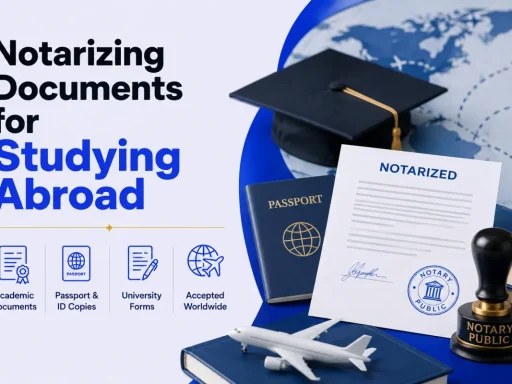

Quick answer: Studying abroad usually means notarizing a few documents, most often a financial support (sponsor) affidavit and sometimes a power of attorney. But academic records like transcripts and diplomas usually need an apostille or a certified copy from your school, not a notary. Many student documents can be notarized online.
What documents do you need to notarize for studying abroad?
Studying abroad generates a small stack of paperwork, but only a few pieces actually need a notary. The rest either need a different kind of authentication (an apostille) or nothing at all. Knowing which is which saves money and prevents a document from being rejected at a consulate or university.
The short version: sworn statements and authorizations, like a financial support affidavit or a power of attorney are what a notary handles. Official records like transcripts, diplomas, are certified by the issuing institution and authenticated by the state. This is the same distinction that trips people up with what documents require notarization in general.
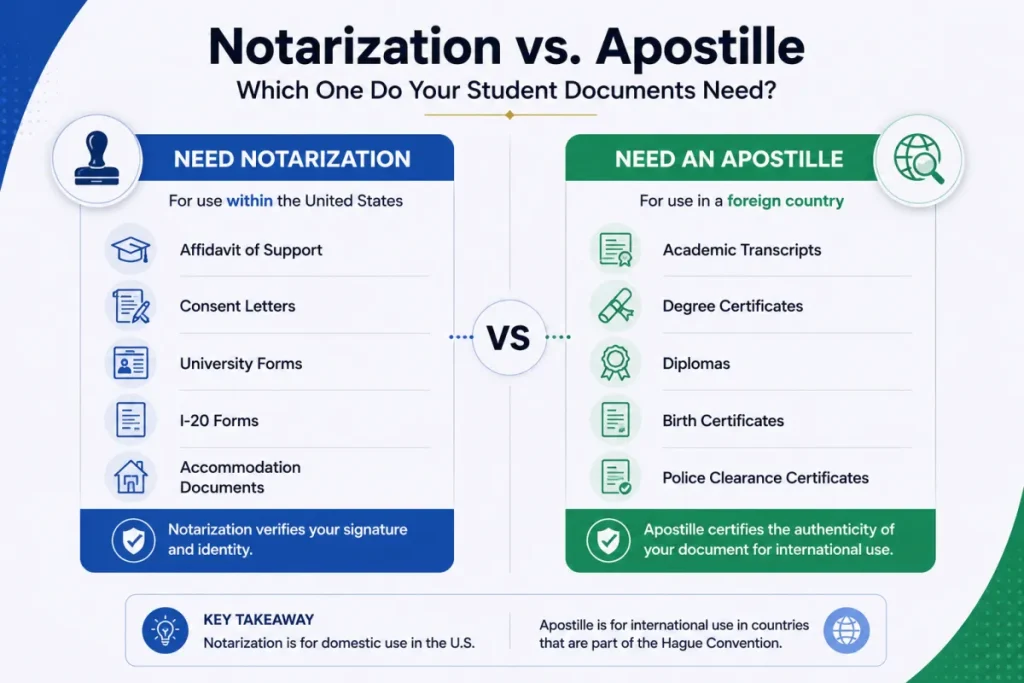
Student documents that DO need notarization
These are the documents where a notary is genuinely useful, usually sworn statements or authorizations:
- Affidavit of financial support / sponsor affidavit: For a student visa, you often must prove someone will fund your studies. A sponsor’s sworn affidavit is commonly notarized so the consulate or school trusts it.
- Power of attorney: Many students sign a POA authorizing a parent to manage their finances, mail, taxes, or property back home while they’re overseas.
- Parental/guardian consent: A minor studying abroad typically needs a notarized consent from both parents or guardians (more below).
- Proof-of-funds or bank affidavits: Some programs want a notarized statement confirming available funds.
Any of these can usually be handled through online notarization, which is ideal when you’re preparing to travel or already abroad.
Documents that need an apostille or certification instead
Here’s the myth that costs students time, transcripts and diplomas usually do NOT need a notary. A notary verifies a signature, but a foreign university or ministry of education wants proof the academic record itself is authentic and that comes from two different steps:
- Certification by your school: The registrar issues an official, sealed transcript or a certified copy.
- An apostille: The Secretary of State (or U.S. Department of State for federal documents) authenticates the record for use in Hague Convention countries.
So for transcripts, diplomas, and degree certificates, don’t reach for a notary, get the certified record + apostille. For documents that do get notarized but will be used abroad (like your affidavit), you may still need an apostille on top of the notarization. The apostille process guide walks through it, and the expat document requirements guide covers documents used internationally.
Notarize vs. apostille vs. certified copy: which does each student document need?
| Student document | What it needs |
|---|---|
| Financial support / sponsor affidavit | Notarize (often + apostille if used abroad) |
| Power of attorney | Notarize (+ apostille if used abroad) |
| Parental consent (minor) | Notarize (+ apostille for many countries) |
| Transcript | Certified by the school (+ apostille) not notarized |
| Diploma / degree certificate | Certified copy (+ apostille) not notarized |
| Bank statement / proof of funds | Often none, or a notarized affidavit if required |
Notarize the statements you sign; apostille or certify the records your school or a government issued.
How to notarize study abroad documents online
- Confirm what your school and destination require: Check whether the document needs notarization, an apostille, or both. Your university’s international office (DSO) is the authority here.
- Prepare the document but don’t sign it: Fill out the affidavit or POA completely; the notary must watch you sign.
- Upload it to an online notary platform: A service like BlueNotary connects you with a commissioned online notary in minutes, useful whether you’re at home or already overseas.
- Verify your identity: Complete ID checks with a government photo ID (a passport works well for students abroad).
- Sign on the live video call: The notary watches you sign and applies the tamper-evident electronic seal.
- Arrange an apostille if it’s headed abroad: For documents used at a foreign university or embassy, follow up with an apostille after notarization.
Studying abroad as a minor: parental consent
Students under 18 have an extra layer. A minor studying abroad, on an exchange, gap-year, or early-enrollment program, typically needs notarized parental or guardian consent, and often from both parents. Many destination countries also require that consent to be apostilled to be accepted at the border or school.
If custody is shared or contested, sort that out early. a notary can witness a consenting parent’s signature, but can’t resolve a custody disagreement. For anything complicated, involve a family-law attorney before you travel.
Conclusion
Getting your study-abroad paperwork right comes down to one rule: notarize the documents you sign, and apostille or certify the records an institution issued. A notary handles your financial support affidavit, power of attorney, and (for minors) parental consent, often with an apostille added when the document will be used at a foreign university or embassy. Your transcripts and diplomas don’t go to a notary at all; your school certifies them and the state apostilles them. Confirm the exact mix with your university’s international office and the destination country, and you’ll avoid the rejected-document scramble right before departure.
Preparing to study abroad? Notarize your financial support affidavit or power of attorney online with a commissioned notary on BlueNotary in about 15 minutes, 24/7. From home or overseas. Not sure a document needs a notary or an apostille? Start with what documents require notarization and the apostille process guide.
Frequently asked questions
What documents do you need to notarize for studying abroad?
Usually a financial support or sponsor affidavit, a power of attorney to manage affairs back home, and for minors, parental consent. Academic records like transcripts are certified and apostilled instead.
Do transcripts need to be notarized for studying abroad?
No. Transcripts are certified by your school’s registrar and, for international use, apostilled by the state. A notary verifies signatures, not academic records, so notarization isn’t the right step.
Does an affidavit of financial support need to be notarized?
Often yes. A sponsor’s affidavit proving they’ll fund your studies is commonly notarized so a consulate or university trusts it, and it may also need an apostille if used abroad.
Do you need an apostille for study abroad documents?
Frequently. Documents used at a foreign university or embassy in Hague Convention countries usually need an apostille, on transcripts and diplomas, and often on top of a notarized affidavit.
Can you notarize study abroad documents online?
Yes. Affidavits, powers of attorney, and consent forms can be notarized online through remote online notarization, which is convenient whether you’re still home or already overseas.
Do you need a power of attorney when studying abroad?
Many students do. A power of attorney lets a parent or trusted person manage your finances, mail, taxes, or property back home while you’re abroad, and it’s typically notarized.