


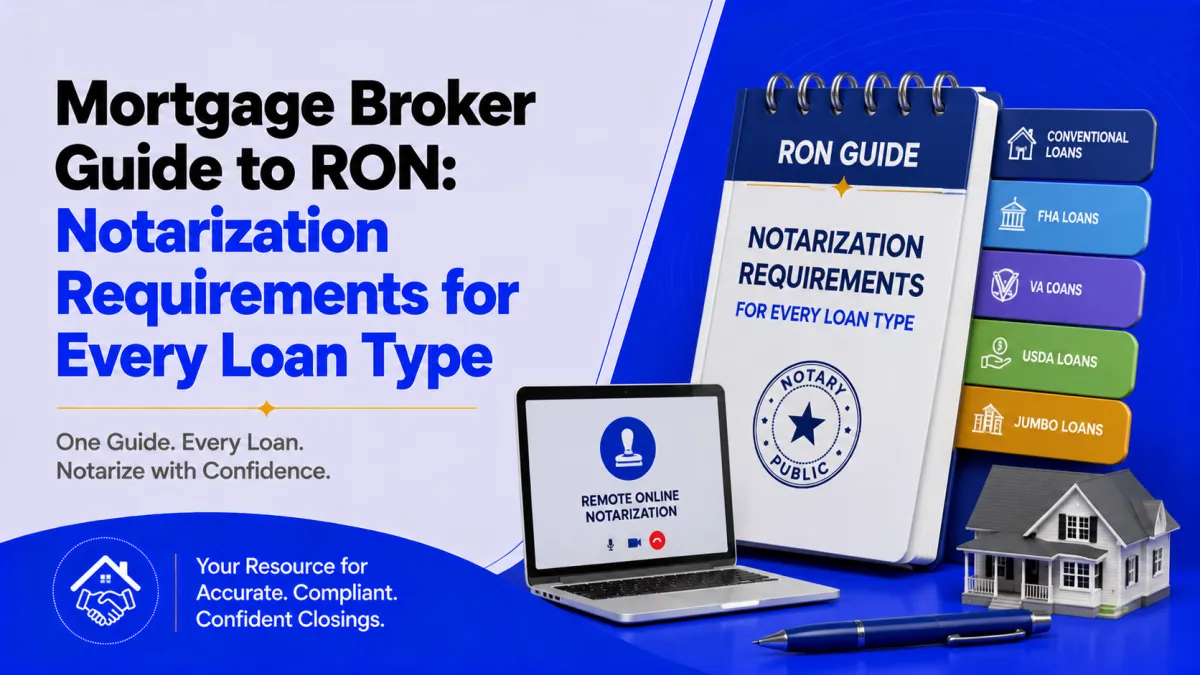

Quick answer: For a mortgage broker, remote online notarization (RON) is accepted on most loan types like conventional, FHA, VA, USDA, and many jumbo/portfolio loans but acceptance is conditional. The closing’s security instrument must still be notarized and recorded; RON only works where the property’s state permits it, the county recorder accepts the document, the platform meets MISMO standards, and the loan is delivered with the right RON indicator. California is the notable exception: its RON law is passed but not yet operational.
If you’re a broker weighing whether to move closings to RON, the real question isn’t “is RON legal?” it’s “for this loan, with this investor, in this county, will the notarization hold?” The answer is usually yes, but only when several conditions line up. This mortgage broker remote online notarization guide maps those conditions by loan type so you can route each file correctly instead of guessing.
It’s written for brokers, loan officers, and broker-owners building a digital-closing workflow, the people who get blamed when a deed bounces at the recorder.
What remote online notarization is, and what it actually notarizes
Remote online notarization (RON) is a notarial act performed over live audiovisual technology, where a commissioned notary verifies the signer’s identity remotely, witnesses the electronic signing, and applies an electronic seal, with the session recorded and logged. It replaces the in-person meeting, not the notarization itself. For the mechanics, see BlueNotary’s explainer on how remote online notarization works.
In a mortgage closing, RON’s job is narrow but critical, it notarizes the documents that must be notarized to be recordable and enforceable, chiefly the security instrument. Everything else in the package (disclosures, the note, the closing disclosure) is e-signed but not notarized. Knowing that line is the foundation of routing a file correctly.
Which mortgage documents actually need notarization
Not every page in a closing package needs a notary. The notarized documents are the ones that get recorded or sworn. Here’s the working breakdown:
| Closing document | Typically notarized? | Recorded? |
|---|---|---|
| Mortgage / Deed of Trust (security instrument) | Yes | Yes |
| Promissory note / eNote | No (usually) | No |
| Closing Disclosure | No | No |
| Signature/name affidavit | Often | No |
| Occupancy affidavit | Often | No |
| Power of attorney (if used) | Yes | Often |
| Deed (purchase, transferring title) | Yes | Yes |
The takeaway for routing: the security instrument and any deed or POA are the notarization-critical items. If those can’t be notarized and recorded electronically in the property’s jurisdiction, the file isn’t a full-RON candidate, it’s a hybrid. (More on that below.) Affidavits follow ordinary notarization rules; BlueNotary’s guide to notarized affidavits covers those.
RON acceptance by loan type: the broker’s matrix
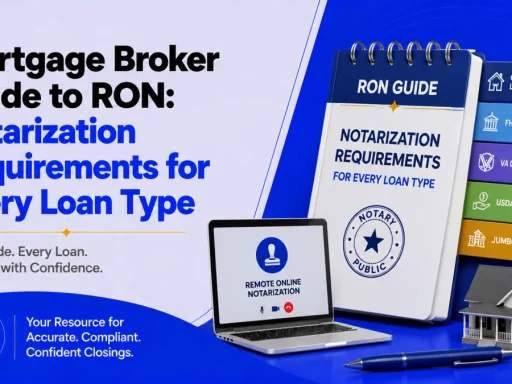
This is the section to bookmark. RON acceptance is driven less by the loan “type” than by the investor and agency behind it but it’s easiest to reason about by program. The constant across all of them: state law must permit RON and the county recorder must accept the e-document.
| Loan type / investor | RON accepted? | Key condition for the broker |
|---|---|---|
| Conventional (Fannie Mae / Freddie Mac) | Yes | Property state permits RON (or accepts out-of-state RON); MISMO-compliant platform; audit trail retained; deliver with the Remote Notarization Indicator |
| FHA | Expanding | FHA has broadened eClosing/eNote acceptance; confirm current program guidance and your investor’s overlays |
| VA | Yes | RON or IPEN eligible for guaranty if the notarization is valid under applicable law (per VA circular) |
| USDA (Rural Development) | Program-specific | Acceptance has grown; verify the current Single Family Guaranteed guidance and investor requirements |
| Jumbo / portfolio / non-QM | Varies | Driven entirely by the specific investor’s or warehouse line’s policy — get it in writing |
Conventional, Fannie Mae and Freddie Mac
Fannie Mae will accept loans whose security instruments were remotely notarized if the laws of the state where the property is located expressly permit RON or expressly accept out-of-state RON, per its notarization standards. On top of that, the RON platform must comply with MISMO RON standards, the lender must retain the RON audit trail in the electronic loan file, the county recorder must accept the document for recording, and the loan must be delivered with the Remote Notarization Indicator set to “Yes.” Freddie Mac’s requirements align closely. Fannie’s eClosing & eMortgage FAQs are the canonical reference.
VA, FHA, and USDA (government loans)
VA is explicit: loans closed using electronic notarization including IPEN and RON are eligible for guaranty provided the notarization is valid and effective under applicable law, per VA Circular 26-20-10. FHA and USDA have both expanded eClosing and eNote acceptance, but the details are program-specific and move over time, so treat their current agency guidance and any investor overlays as the controlling source for each file.
Jumbo, portfolio, and non-QM
Outside the agencies, there’s no universal rule. Acceptance depends on the specific investor, warehouse lender, or portfolio policy. The safe practice: confirm RON eligibility in writing for that product before you schedule the closing.
Hybrid eClosing vs. full RON eClosing
Brokers often conflate “eClosing” with “RON.” They’re not the same, and the difference decides how a given file closes:
- Hybrid eClosing: Most documents are e-signed, but the notarized items (often the security instrument) are printed and wet-signed and notarized in person. Used when the county recorder won’t accept e-recordings or the investor isn’t ready for full digital.
- Full RON eClosing: The entire package, including notarization of the security instrument via RON is digital. Requires RON-permissive state law, an e-recording-capable recorder, and an investor that accepts it.
- eNote layer: Whether hybrid or full, the promissory note can be an eNote but only if it’s a MISMO SMART Doc, stored in a MERS-compliant eVault, and registered in the MERS eRegistry, which the agencies require as the system of record for the authoritative copy.
The practical read: a file can be a hybrid even in a RON state if the local recorder lags. Route by the recorder and investor, not just the state.
Is RON legal in every state? (And the California catch)
Nearly every U.S. state now has permanent RON authority on the books but “nearly” is the operative word for a broker, because the exception is the largest mortgage market in the country. California’s RON law (SB 696) is enacted but not yet operational. Under the statute, California notaries may begin performing online notarizations only once the Secretary of State completes the required technology project, no later than January 1, 2030, per the official SB 696 text.
For brokers, that means California-property closings can’t rely on a California RON commission today, and you should plan those files as in-person or hybrid. Because rules and the recording landscape differ by jurisdiction, confirm the current status for each property state — BlueNotary’s guide to who regulates notaries by state shows where to check, and its overview of witness requirements for online notarization covers a detail that trips up real-estate signings.
A pre-closing RON checklist for brokers
A concrete example: a broker has a VA refinance on a property in Texas, sold to a RON-ready investor. Texas permits RON, the county e-records, the platform is MISMO-compliant, and VA allows RON guaranty, so it’s a clean full-RON file. Swap the property to California and the same loan becomes in-person/hybrid overnight. The variables, not the loan type, decide it.
Before you route any file to RON, confirm:
- Property state permits RON (or accepts out-of-state RON for that act).
- The county recorder accepts e-recorded documents in that jurisdiction.
- The investor/agency accepts RON for that specific loan product (get overlays in writing).
- The platform meets MISMO RON standards and retains a complete audit trail.
- eNote handling is set, eVault and MERS eRegistry registration if you’re delivering an eNote.
- Delivery flags are correct, e.g., Fannie’s Remote Notarization Indicator.
Miss one and a recordable document can be rejected after closing, the costliest place to discover a gap.
Choosing and using a RON platform (first-party note)
Disclosure: BlueNotary is a RON platform, so treat this section as vendor-aware. Independent of any provider, the platform requirements are the same: it must meet MISMO RON standards, perform compliant identity verification (credential analysis plus knowledge-based authentication, or a credible witness where allowed), record and store the session, and produce a retrievable audit trail your investor can examine. Compare options against those criteria first, BlueNotary’s overview of remote online notary platforms walks through what to evaluate.
And know when RON isn’t the answer: a California-property closing, a county that won’t e-record, or an investor without RON acceptance all point to in-person or hybrid, no platform changes that.
Building RON into your closing workflow? Run a test closing on BlueNotary to see how MISMO-standard identity checks, session recording, and a deliverable audit trail fit your pipeline, so your eligible conventional, VA, FHA, and USDA files close digitally without recorder surprises. Start with how to use an online notary service to map it to your process, then confirm investor acceptance per product.
The bottom line
For a mortgage broker, RON is a routing decision, not a yes/no. The security instrument still has to be notarized and recorded; RON simply lets that happen remotely when the state, the recorder, the investor, and the platform all align. Conventional, VA, and a growing share of FHA and USDA files qualify, California-property closings don’t yet. Build the six-point check into your intake, confirm investor overlays in writing, and you can move most of your pipeline to digital closings with confidence.
Frequently Asked Questions
Does Fannie Mae accept remote online notarization?
Yes. Fannie Mae accepts loans with remotely notarized security instruments when the property state permits RON (or accepts out-of-state RON), the platform meets MISMO RON standards, the lender retains the audit trail, the county recorder accepts the document, and the loan is delivered with the Remote Notarization Indicator set to “Yes.”
Can VA loans be closed with remote online notarization?
Yes. Per VA guidance, loans closed using electronic notarization, including IPEN and RON are eligible for guaranty as long as the notarization is valid and effective under the applicable law where it was performed.
Which mortgage documents need to be notarized?
The security instrument (mortgage or deed of trust) and any deed or power of attorney must be notarized and are typically recorded. Signature and occupancy affidavits are often notarized. The promissory note and the Closing Disclosure usually are not.
Is remote online notarization legal in every state?
Nearly. Most states have permanent RON authority, but California is the notable exception, its RON law is enacted but not operational, with services expected to begin no later than January 1, 2030. Always confirm the current status for the property’s state.
What’s the difference between a hybrid eClosing and a full RON eClosing?
In a hybrid eClosing, most documents are e-signed but the notarized items are wet-signed and notarized in person. In a full RON eClosing, the entire package, including notarization of the security instrument is completed remotely and digitally.
Do FHA and USDA loans allow RON?
Both have expanded acceptance of eClosing, eNotes, and electronic notarization, but the rules are program-specific and change over time. Confirm the current agency guidance and any investor overlays for each loan before closing.
What is an eNote and does it need to be in the MERS eRegistry?
An eNote is an electronic promissory note in MISMO SMART Doc format. To be investor-ready, it must be stored in a MERS-compliant eVault and registered in the MERS eRegistry, which serves as the system of record identifying the authoritative copy of the note.