


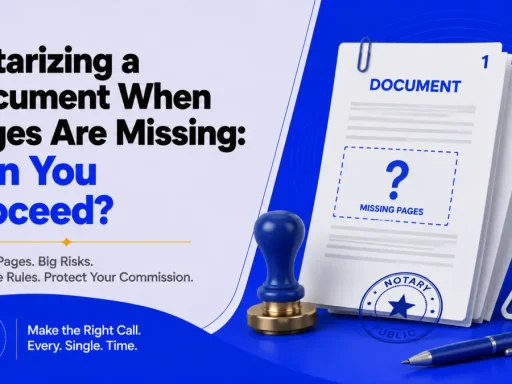

Quick answer: No, a notary should not notarize a document with missing pages. A document that’s missing pages is an incomplete document, and notaries are required by law or best practice to decline it. The fix is simple: get the complete, finalized document, then notarize. A handful of narrow exceptions exist (extra signature lines, “official use only” boxes), but a genuinely missing page is always a stop.
A signer slides a stack across the desk, you start your scan, and the page numbers jump from 3 to 5. Now you have to decide on the spot whether to notarize a document with missing pages or send the signer away. The short version: you decline. The longer version, why, the rare cases where blanks are fine, and how to handle it without losing the client is what this guide is for.
It’s written for notaries making the call in real time, and for signers who just got turned away and want to know what went wrong.
What counts as an “incomplete document”
An incomplete document is any document that is missing pages, has blank spaces in its body, or contains information that hasn’t been finalized. Notaries are required by state law in some places, by accepted best practice everywhere to decline notarizing one. The two most common forms are missing pages and blank spaces, and they’re not quite the same problem.
| Problem | What it looks like | Default action |
|---|---|---|
| Missing pages | Page numbers skip; only the signature page is presented; an exhibit or attachment referenced in the text isn’t there | Decline — get the complete document |
| Blank spaces in the body | Empty fields, dollar amounts, dates, or names left open in the text | Decline until filled or lined through (with narrow exceptions below) |
For a broader look at where notarizations go wrong, BlueNotary’s common notarization mistakes guide covers incomplete documents alongside ID, dating, and certificate errors.
Can you notarize a document with missing pages? No, here’s why
The rule is consistent across notary authorities: if pages are missing, the document is incomplete and you don’t notarize it. According to the National Notary Association, you should refuse to notarize an incomplete document and tell the signer you can’t proceed until you have the full document.
The reason isn’t bureaucratic, it’s liability. When you apply your seal, you’re certifying that a specific notarial act happened on a specific document. If pages are added or swapped afterward, the document the world sees is not the one you witnessed, and your seal is now attached to something you never reviewed. That’s the exact scenario notary law is built to prevent. The American Society of Notaries frames it the same way: open areas and missing pages leave the notary vulnerable to fraud committed after the fact.
The lone signature page: the most common version of this problem
The single most frequent way this comes up: a signer hands you only the signature page of a multi-page contract, deed, or agreement. It feels harmless, the signature is right there but it’s the textbook incomplete document.
You have no way to confirm the signature page actually belongs to the document the signer describes, and the body could be anything. The guidance is firm: never accept just the signature page. Ask for the complete document, scan it, confirm the signature page is genuinely part of it, then proceed.
Notaries scan, they don’t read but they do check for completeness
Here’s the nuance that trips people up. A notary is not required to read the document, and arguably shouldn’t, the contents are the signer’s private business, and verifying what a document means is outside a notary’s role. A notary confirms the signer’s identity and willingness and that the document is eligible for the act, not whether the terms are wise.
But “don’t read it” is not “don’t look at it.” You must visually scan the document to confirm it’s complete: pages are all present and in order, there are no open blanks in the body, and the notarial certificate itself is filled in. Scanning for completeness is part of the job; interpreting the contract is not.
When blanks are actually OK: The real exceptions
Not every blank makes a document incomplete. There are legitimate cases where you can proceed and knowing them keeps you from refusing valid notarizations:
- Blank signature lines for other signers:- If you’re notarizing one person’s signature on a document that includes additional, empty signature spaces for people who aren’t present, the document isn’t incomplete. You can notarize for any signer who is physically present and properly identified.
- “For Official Use Only” boxes?:- A boxed-off section labeled “For Official Use Only,” “Reserved for Recorder’s Use,” or similar is meant to be completed later by an agency. You may proceed without filling those in.
- Limited state-specific exceptions:- A few states carve out specific instruments, Florida, for example, has exceptions tied to certain negotiable instruments. These are narrow; confirm yours in your state handbook. BlueNotary’s guide to who regulates notaries by state shows where to find it.
One thing none of these covers: a missing page. Extra signature lines and official-use boxes are intentional blanks. A skipped page is a gap in the document itself, always a stop.
What to do instead (a clean script for the desk)
Declining doesn’t have to cost you the appointment. Here’s how to handle it without friction:
- Pause and name the issue:- “I can’t notarize this yet, pages 4 are missing / there’s a blank amount on page 2. Once it’s complete, I can finish right away.”
- Ask whether the blank is fillable now:- Sometimes a blank is just an oversight the signer can complete on the spot. If it’s information that genuinely won’t exist until after notarization, that’s usually a sign the document isn’t ready.
- Offer the line-through option for true non-applicable blanks:- Where a field doesn’t apply, the signer can draw a line through it or write “N/A” before you proceed, closing the gap so nothing can be added later.
- Reschedule if needed, and note it:- Record the declined act and the reason (missing pages, open blanks) in your journal. A notary journal entry protects you by documenting exactly what you saw and decided.
This is the same discipline that applies to any notarized affidavit or sworn statement: the document has to be whole and final before the seal goes on.
Does going online change any of this?
No. With remote online notarization, the completeness rule is identical and arguably easier to enforce, because the full document is uploaded and displayed on screen before signing. The notary still scans every page on camera, confirms nothing is missing, and declines an incomplete upload exactly as they would in person. If anything, RON removes the “I only brought the signature page” problem, since the platform handles the complete file. New to it? See how online notarization works.
The bottom line
When pages are missing, you don’t notarize, full stop. A missing page makes a document incomplete, and the whole point of notary law is to keep your seal off anything that can be altered after you’ve witnessed it. Scan every document for completeness, know the narrow exceptions (other signers’ lines, official-use boxes), and when something’s missing, give the signer a clear path to come back with the complete file.
Facing incomplete documents at the desk and want a faster, safer workflow? With BlueNotary’s online notarization platform, the full document is uploaded and displayed before signing, so you can scan every page on screen, confirm nothing’s missing, and complete the act in one session. Start a notarization at BlueNotary to handle complete documents end-to-end without the lone-signature-page surprise.
Frequently Asked Questions
Can a notary notarize a document with missing pages?
No. A document missing pages is incomplete, and notaries are required to decline incomplete documents. Tell the signer you can proceed once you have the complete, finalized document, then scan it and notarize.
Can a notary notarize just the signature page?
No. Notarizing a lone signature page is the most common incomplete-document error. You can’t confirm the page belongs to the document described, so you must ask for the full document before proceeding.
Can you notarize a document with blank spaces?
Generally no. Open blanks in the body can be filled in after notarization and change what was signed. Either the signer completes the blanks, or for fields that don’t apply, lines them through before you notarize.
Does a notary have to read the whole document?
No. A notary doesn’t read or interpret the contents and shouldn’t that’s the signer’s responsibility. But the notary must visually scan the document to confirm it’s complete and ready for the notarial act.
Can a notary notarize an incomplete document if the signer fills it in later?
No. The document must be complete before you apply your seal. If a signer promises to add pages or fill blanks afterward, decline until it’s finalized adding content after notarization is exactly the fraud risk the rule prevents.
What should a notary do with an incomplete document?
Decline the act, tell the signer specifically what’s missing, and offer to finish once it’s complete. Note the declined notarization and the reason in your journal to document what you observed.
Can you notarize a document with blank signature lines for other signers?
Yes. Extra, empty signature spaces for people who aren’t present don’t make a document incomplete. You may notarize for any signer who is present and properly identified, leaving the other lines blank.