


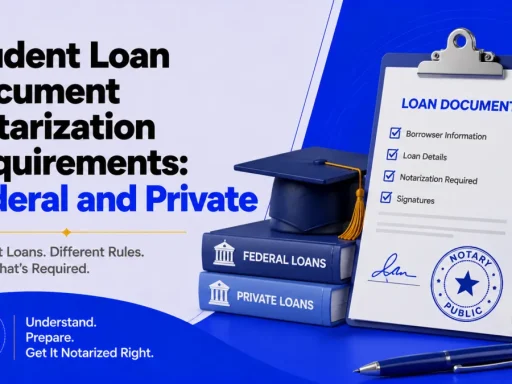

Quick answer: Most student loan documents do not need to be notarized. Federal loans use an electronic Master Promissory Note signed with your FSA ID, and most private lenders accept an electronic signature too. Student loan notarization requirements only come up in specific side cases, a power of attorney to manage someone’s loans, certain sworn affidavits, documents used internationally, or a particular lender’s request. Always confirm with your servicer before paying for a notary.
If you’re about to sign for a student loan or help a family member manage one you may be wondering whether you need to track down a notary first. For the vast majority of borrowers, the answer is no. Student loan notarization requirements are far lighter than people expect: the federal system and most private lenders run on electronic signatures, not notary stamps.
This guide gives you the straight federal-vs-private answer, clears up the myth about forgiveness forms, and lists the few real situations where a notary actually belongs in the process.
What “student loan notarization requirements” actually means
Student loan notarization requirements are the rules for when a notary public must witness a signature on a loan-related document. A notary confirms who signed and that they signed willingly, it doesn’t make a loan “more official” or change its terms. That’s a different act from an electronic signature (which authenticates you digitally) and from a certified copy (which verifies a photocopy matches an original).
Mixing these up is where confusion starts. If you’re fuzzy on the distinctions, BlueNotary’s guide to what notary certification means and its explainer on electronic notarization lay them out plainly.
Do federal student loans require notarization? No
Federal Direct Loans, Subsidized, Unsubsidized, and PLUS are not notarized. You complete a Master Promissory Note (MPN) online and sign it electronically using your FSA ID, which serves as your legal signature. According to Federal Student Aid, there is no in-person notary step anywhere in that flow.
A few details that surprise borrowers:
- Your FSA ID is your legal signature for federal loan documents, see how to sign the MPN.
- One MPN can stay valid for up to 10 years at the same school, so you typically don’t re-sign each year.
- The same e-signature approach applies to other federal forms, repayment plan requests, consolidation, and discharge applications are submitted and signed electronically, not before a notary.
So if a website or “helper” tells you a notary must witness your federal MPN, that’s incorrect.
Do private student loans require a notary? Usually not
Private student loans work differently from federal ones, but the notary answer is largely the same. Each lender uses its own promissory note, and most let you sign electronically print-and-mail is the older alternative. As Federal Student Aid’s federal-vs-private overview notes, private loans also run their own credit checks and cosigner process.
Where private loans differ:
- A cosigner completes a separate application and signs the note too but signing usually means an e-signature, not a notarized one.
- A small number of lenders, or specific high-value or estate-related agreements, may ask for a notarized signature. This isn’t standard; it’s lender-specific.
Because it varies, the safe move is to ask the lender directly: “Does any document in this loan need to be notarized, and if so, which one?” before you book a notary.
Federal vs. private: notarization at a glance
| Dimension | Federal student loans | Private student loans |
|---|---|---|
| Core document | Master Promissory Note (MPN) | Lender’s own promissory note |
| How it’s signed | Electronically, with your FSA ID | Usually electronically; sometimes print-and-sign |
| Notarization required? | No | Usually no, varies by lender |
| Cosigner | Not used | Common; signs the note (usually e-sign) |
| Where it’s signed | studentaid.gov | Lender’s portal or paper form |
| When a notary may appear | Power of attorney, affidavits, overseas use | Same, plus a specific lender’s request |
The pattern is clear: The loan note itself almost never needs a notary. Notarization shows up around the edges of student loans, not in the core signing.
The myth: “You need a notary for loan forgiveness or discharge”
This one circulates constantly, so it’s worth correcting directly. Federal forgiveness and discharge applications are not notarized. When reviewing the U.S. Department of Education’s current forgery loan discharge application, there is no notary block on the form at all, it asks for a signed application plus evidence, such as signature samples, a police report, or an identity theft report.
For identity-theft-based discharges, the supporting document people use is the FTC identity theft affidavit created free at IdentityTheft.gov — a sworn statement, not a notarized one. If you do choose to add a notarized affidavit of fact as extra evidence, that’s optional, not required. Be especially wary of anyone who charges you to “notarize your forgiveness paperwork”, that’s a red flag for a student loan scam. The official forgery discharge process is free.
When a notary IS genuinely part of student loans
Notarization does have a real place around student loans just not on the promissory note. Here are the situations where it legitimately comes up:
- Power of attorney to manage someone’s loans:- If you’ll handle a family member’s student loans, common when a borrower is deployed, ill, or studying abroad, you’ll use a financial power of attorney (POA). In most states, a POA must be signed in front of a notary to be valid. This is the single most common reason a notary touches student loan matters.
- Supporting affidavits:- A sworn written statement, explaining a hardship, identity theft, or a discrepancy is sometimes submitted with a loan request or dispute. When an affidavit is required to be sworn, a notary administers the oath. See BlueNotary’s guide to notarized affidavits and the related identity affidavit.
- Documents used internationally:- A borrower studying or living abroad may need a U.S. loan document, or a POA, notarized and then apostilled for use in another country. If that’s your case, start with apostille vs. notary public.
- A specific lender or estate scenario:- Occasionally a private lender, a cosigner-release agreement, or paperwork after a borrower’s death asks for a notarized signature. Treat these as one-offs and confirm in writing what’s required.
A quick checklist before you book a notary
A real-world example: Priya’s brother is deployed overseas and asked her to handle his private loan servicer. The loan note itself was e-signed years ago but to speak and act on his behalf, she needs a notarized power of attorney, not anything to do with the original loan. That’s the typical shape of a legitimate notary need here.
Before you spend time or money:
- Identify the exact document:- Is it the loan note (rarely notarized) or a POA/affidavit (often notarized)?
- Ask the lender, servicer, or agency in writing:- Whether notarization is required, and which signature.
- Confirm your state’s rule:- For POAs, BlueNotary’s guide to who regulates notaries by state shows where to check.
- Bring valid photo ID:- and the complete, unsigned document, never sign a notarized document in advance.
Can you notarize student loan–related documents online?
Yes, when notarization is required (a POA, an affidavit), you usually don’t need to find an office. With remote online notarization, a commissioned notary verifies your ID and witnesses your signature over secure video, which is convenient if you or the person you’re helping is far away or abroad. New to it? Here’s how online notarization works. Just remember: this is for the supporting document, not the loan note itself, which your lender handles electronically.
The bottom line
Student loan notarization requirements rarely apply to the loan itself. Federal MPNs are e-signed with your FSA ID, most private notes are e-signed too, and forgiveness and discharge applications aren’t notarized at all. A notary enters the picture only for the documents around the loan, a power of attorney, a sworn affidavit, or paperwork headed overseas. Pin down which document you actually have, confirm with the lender or agency, and you’ll avoid paying for a notarization you never needed.
Need a student loan power of attorney or affidavit notarized, without leaving home? Upload your document to BlueNotary and connect with a commissioned online notary in minutes to verify ID and sign on camera, even if the person you’re helping is overseas. Not sure your document needs a notary at all? Read how to use an online notary service first, then confirm with your servicer.
Frequently Asked Questions
Do student loans need to be notarized?
No, in nearly all cases. Federal loans are signed electronically with your FSA ID, and most private lenders accept electronic signatures too. Notarization only applies to certain side documents, like a power of attorney or a sworn affidavit.
Does a student loan promissory note need to be notarized?
No. The federal Master Promissory Note is e-signed online, and private lenders’ promissory notes are typically e-signed as well. A notary is not part of signing the note unless a specific lender unusually requires it.
Do federal student loans require notarization?
No. Federal Direct Loans use an electronic Master Promissory Note signed with your FSA ID, which serves as your legal signature. There is no notary step in the federal loan process.
Do private student loans require a notary?
Usually not. Most private lenders use electronic signatures for the promissory note and cosigner documents. A few lenders or special agreements may request notarization, so confirm directly with your lender.
Does a cosigner need to sign in front of a notary?
Generally no. A cosigner completes a separate application and signs the promissory note, but that signature is usually electronic. Only confirm notarization if the specific lender requires it.
Do you need a notary for student loan forgiveness or discharge?
No. Federal forgiveness and discharge applications are not notarized, the current federal forgery discharge form has no notary section. These applications need supporting evidence, like a police report or an FTC identity theft report, not a notarized signature.
Can you notarize student loan documents online?
Yes, when notarization is actually required, such as a power of attorney or affidavit. Remote online notarization lets a notary verify your ID and witness your signature over video, which helps when a borrower is far away or overseas.