

Quick answer: An audit trail in online notarization is a secure, tamper-evident record of everything that happened during your session, the audio-video recording, timestamps, identity-verification results, the notary’s digital certificate, and the sealed document. It’s stronger proof than a paper notary journal and helps defend the notarization if it’s ever challenged.
What is an audit trail in online notarization?
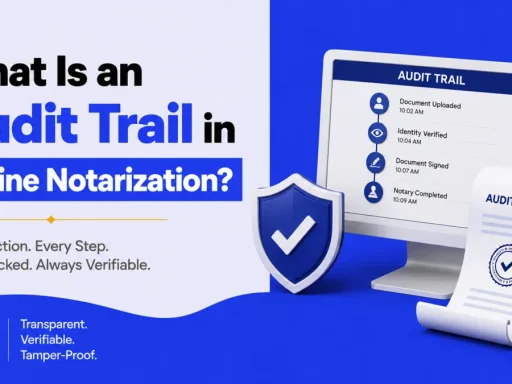
An audit trail (also called an audit log) is the complete, tamper-evident record a remote online notarization creates. Where a traditional notary keeps a paper journal entry, an online notarization automatically captures the entire session, who signed, when, how they were verified, and what was signed, in one secured, time-stamped record.
That record is a core reason online notarization is considered secure and provable. It doesn’t just show that a notarization happened; it documents exactly how it was done, step by step. If you want the bigger picture of the session itself, see how remote online notarization works.
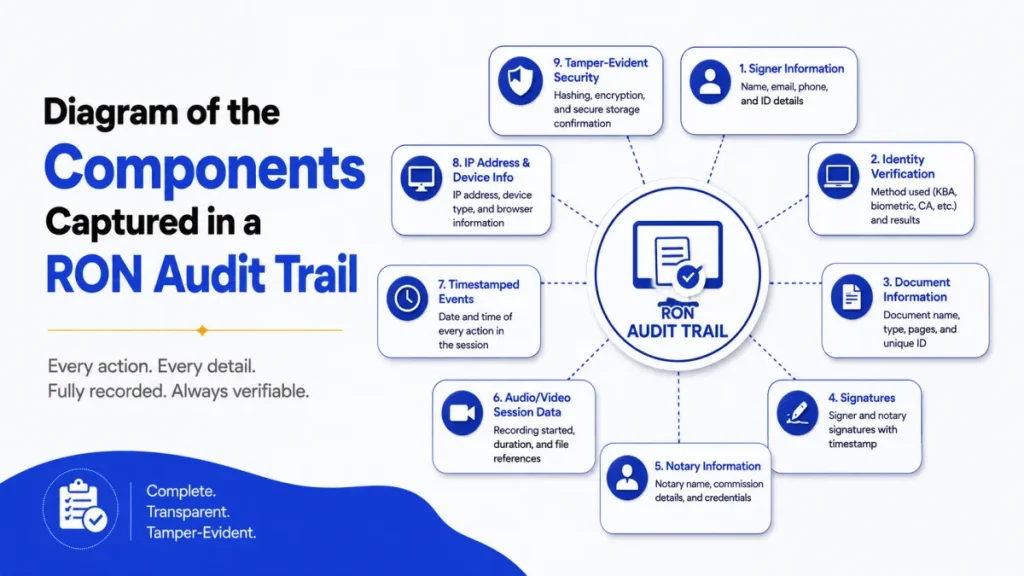
What a RON audit trail includes
A robust audit trail bundles several pieces of evidence into one record:
- Audio-video recording of the live session, required by most state RON laws.
- Timestamps for each step (upload, identity check, signing, sealing).
- Identity-verification results, the outcome of credential analysis and knowledge-based authentication (KBA).
- The notary’s digital certificate and commission details.
- The signed document with a tamper-evident seal, so any later change is detectable.
- Activity and access logs, IP address, actions taken, and who accessed the record.
Together these answer the “who, what, when, where, and how” of the notarization far more thoroughly than a paper entry. They’re also part of what makes a platform trustworthy, alongside the fraud protections in detecting notarization fraud.
Why the audit trail matters
Two big reasons, fraud prevention and legal defense.
- It deters and detects fraud: Because every step is recorded and the seal is tamper-evident, altering a notarized document or faking a session becomes far harder and any tampering is detectable.
- It defends the notarization in court: If someone later disputes a signature (“I never signed that” or “that wasn’t me”), the audit trail provides video proof, identity records, and timestamps evidence a paper journal simply can’t match.
For high-stakes documents like deeds and powers of attorney, that evidentiary strength is a real advantage.
Audit trail vs. paper notary journal
Traditional notaries keep a paper journal, an entry with the signer’s name, the document type, the date, and often a signature or thumbprint. It’s useful, but limited.
| Paper journal | RON audit trail | |
|---|---|---|
| Record of the signing | A written line entry | Full audio-video recording |
| Identity evidence | Notes about the ID shown | Credential analysis + KBA results |
| Tamper protection | Minimal | Tamper-evident digital seal |
| Timestamps | Handwritten date | Precise, automatic timestamps |
| Ease of retrieval | Manual lookup | Searchable digital record |
The audit trail is essentially a paper journal on steroids, more complete, harder to falsify, and easier to produce if it’s ever needed.
How long is an audit trail kept?
RON notaries and platforms are required to retain the audit trail, including the video recording for a period set by state law, commonly several years (many states specify five to ten). This ensures the evidence is available if a document is questioned long after signing.
Retention rules, and how the data must be secured, vary by state. Check the notarization requirements by state guide, and ask any platform how long it keeps your recording and how it protects it.
Conclusion
An audit trail is what turns an online notarization into a provable, defensible event. Instead of a single line in a paper journal, it captures the whole session, the audio-video recording, timestamps, identity-verification results, the notary’s digital certificate, and the tamper-evident sealed document, in one secure record. That makes it both a fraud deterrent and strong evidence in court, and state law requires it be retained for years so it’s there if you ever need it. When you notarize online, that protection comes standard.
Want a notarization backed by a complete audit trail? Every notarization on BlueNotary includes a recorded session, timestamps, and a tamper-evident seal, done in about 15 minutes, 24/7. Curious what documents you can notarize this way? See what documents require notarization.
Frequently asked questions
What is an audit trail in online notarization?
It’s a secure, tamper-evident record of the entire notarization session, including the audio-video recording, timestamps, identity-verification results, the notary’s digital certificate, and the sealed document.
What does a RON audit trail include?
Typically the recorded video, precise timestamps, credential analysis and KBA results, the notary’s digital certificate and commission info, the tamper-evident signed document, and access and activity logs.
Is the online notarization session recorded?
Yes. Most state RON laws require the live audio-video session to be recorded, and that recording is a central part of the audit trail retained after the notarization.
How long is a RON audit trail kept?
It’s retained for a period set by state law, commonly several years, many states require five to ten. Ask the platform how long it stores your recording and how it’s secured.
Is an audit trail better than a paper notary journal?
Generally yes. A paper journal is a written line entry, while an audit trail adds a full video recording, identity records, timestamps, and a tamper-evident seal, far stronger and harder to falsify.
Can an audit trail be used in court?
Yes. If a notarization is disputed, the audit trail provides video, identity verification, and timestamped evidence of exactly what happened, which can help defend the document’s validity.