


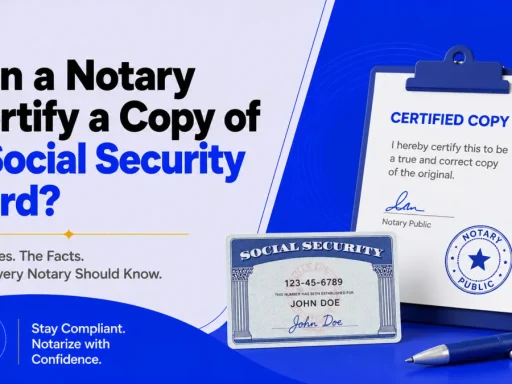

Quick answer: In most cases a notary cannot certify a copy of a Social Security card directly, many states forbid notaries from copy-certifying government records. The legal path is Copy Certification by Document Custodian: you sign a statement that your photocopy is true, and the notary notarizes your signature. Note: the Social Security Administration won’t accept either one, it only takes originals or agency-certified copies.
If someone told you to bring a “notarized copy of your Social Security card,” you’ve probably already hit a wall: most notaries say they can’t do it. They’re usually right. Whether you can notarize a copy of a Social Security card depends entirely on your state’s notary law and even where it’s allowed, the Social Security Administration itself won’t accept the result.
This guide explains exactly what a notary can and can’t do with your SS card, the one method that works in most states, and what to do when a notarized copy won’t actually get you what you need.
What “notarize a copy of a Social Security card” really means
There are two very different things people lump under this phrase, and confusing them is why so many requests get rejected:
- Copy certification — a notary compares your photocopy to the original and certifies the copy is a true, complete reproduction. The notary is vouching for the document.
- Notarizing a signature on a copy — you sign a statement swearing the copy is true, and the notary simply confirms your identity and signature. The notary vouches for you, not the document.
That distinction is the whole ballgame. Most state laws restrict
#1. for government records. Almost every state permits
#2. For a deeper primer on how certification works in general, see BlueNotary’s guide to what a certified copy is.
Why a Social Security card is a special case
A Social Security card isn’t an ordinary document. It’s a federal record issued and controlled by the Social Security Administration. Notary law treats records like this vital records, recordable documents, public records, differently from a personal letter or contract.
The logic: only the agency that issues a record can truly vouch for a copy of it. A notary has no way to know whether a card is genuine, current, or revoked. That’s why so many states draw a hard line around copies of government-issued records. The same reasoning applies to birth certificates and marriage licenses, which notaries generally also can’t copy-certify.
Can a notary certify a copy of a Social Security card? It depends on your state
Here’s the honest answer: there’s no single nationwide rule. Notary commissions are granted by states, so the power to certify copies is defined state by state.
According to the National Notary Association, some states give notaries copy-certification authority, some restrict it to non-recordable documents, and some ban it outright. Where your state lands changes everything.
| State group | Can a notary copy-certify an SS card directly? | What this means for you |
|---|---|---|
| No copy certification at all — e.g. New York, Illinois, Michigan, Nebraska, North Carolina, South Carolina, Ohio, Tennessee | No | Use the document custodian method below |
| No certification of vital/recordable/public records — e.g. Arizona, Arkansas, Colorado, Connecticut, Delaware, Florida, Kansas, Pennsylvania, Texas | No (SS card falls under restricted records) | Use the document custodian method below |
| Copy certification allowed for general documents — many other states | Sometimes — but notaries often still decline SS cards to be safe | Ask the notary; have the custodian method ready as a backup |
These lists are illustrative, not exhaustive, and notary statutes change. Confirm with your own commissioning authority, BlueNotary’s guide to who regulates notaries in each state shows where to check.
The method that works almost everywhere: Copy Certification by Document Custodian
When a notary can’t certify the copy, you can usually certify it yourself and have the notary notarize your signature. This is called Copy Certification by Document Custodian, you are the “custodian” of your own original card.
Here’s how it works, step by step:
- Make a clear copy of your Social Security card:- A color copy is best. Don’t sign or alter it yet.
- Write (or attach) a short true-copy statement:- Example: “I certify that the attached document is a true, correct, and complete copy of the original Social Security card in my possession.” This is a simple affidavit, a written statement you swear is true.
- Bring your unsigned statement, the copy, and your photo ID to a notary:- Do not sign in advance; the notary must witness it.
- Sign in front of the notary and take the oath or affirmation:- The notary verifies your identity, watches you sign, and completes a jurat (the wording used when you swear a statement is true).
- The notary stamps and seals your statement:- The result is your sworn certification, validated by a notary not the notary’s certification of the card.
This works in most states precisely because the notary is notarizing your signature, which is always within their authority — not making a legal judgment about a federal record. It’s the same mechanism used for passport copy notarization.
Limitation worth knowing: A few of the strictest states (New York is the clearest example) won’t even accept self-certified copies of government records for certain purposes, they want the issuing agency’s certified copy. Always check what the receiving party will take before you rely on this.
Notarized copy vs. certified copy vs. custodian affidavit
People use these terms interchangeably and then get rejected at the counter. Here’s the difference that matters:
| What it certifies | Who vouches for it | Will the SSA accept it? | |
|---|---|---|---|
| Notary copy certification | The copy matches the original | The notary | No |
| Document custodian affidavit | You swear the copy is true | You (notary confirms your signature) | No |
| Agency-certified copy | The copy is genuine, from the source | The Social Security Administration | Yes |
| The original card | n/a — it is the original | The SSA (issuer) | Yes |
The takeaway: a “notarized copy” and a “certified copy” are not the same thing. A notarized copy verifies a person or a sworn statement; an agency-certified copy comes straight from the issuer. For more on that line, see BlueNotary’s complete guide to notary certification.
Will Social Security accept a notarized copy of your card?
No. This is the part most articles bury. The SSA is explicit: it accepts only original documents or copies certified by the agency that issued them, and it cannot accept photocopies or notarized copies, see the official SSA evidence requirements.
In the SSA’s eyes, a notarized copy is still just a photocopy with a stamp on a separate page. So if your goal is anything with Social Security — replacing a lost card, proving your number for benefits, don’t bother notarizing a copy. Instead:
- Bring your original card to a local SSA office, or
- Request a replacement through your my Social Security account at ssa.gov, which is free.
So when IS a notarized copy of an SS card actually useful?
If the SSA rejects it, why would anyone notarize a copy? Because plenty of non-SSA parties accept one and they’re usually the ones asking. A notarized or custodian-certified copy of your Social Security card can be useful for:
- Employers and HR/onboarding that want a verified copy on file without holding your original.
- Private institutions — some banks, lenders, schools, or background-check firms that accept a notarized true-copy.
- International and immigration use, where a foreign agency wants a notarized copy, sometimes followed by an apostille for use abroad. If that’s your situation, start with apostille vs. notary public, what’s the difference.
The rule of thumb: ask the receiving party exactly what they need original, notarized copy, custodian affidavit, or agency-certified copy — before you visit a notary. Guessing is what causes the rejection loop.
How to get a copy of your Social Security card notarized online
If your state allows the document custodian method and the receiving party accepts a notarized copy, you don’t need to find an open office. With remote online notarization (RON), a commissioned notary verifies your identity and witnesses your signature over secure video.
The flow mirrors the in-person steps: you upload your true-copy statement and a scan of your card, the notary confirms your ID on camera, you sign electronically and take the oath, and the notary applies an electronic seal. New to it? Here’s how online notarization works and a plain-English breakdown of remote online notarization.
Common mistakes to avoid
- Signing the true-copy statement before you reach the notary:- The notary must witness the signature sign early and they’ll make you redo it.
- Assuming “notarized” equals “certified by SSA.”:- It doesn’t. For anything Social Security–related, only the original or an agency-certified copy works.
- Skipping the “what do you actually need?” question:- The single biggest time-waster. Confirm the format with the requester first.
- Forgetting your photo ID:- No valid ID, no notarization that rule has no exceptions.
The bottom line
A notary usually can’t certify a copy of your Social Security card directly, because most states restrict copy-certifying government records. What a notary can almost always do is notarize your sworn statement that a copy is true — the document custodian method. Just remember the ceiling on all of it: the Social Security Administration won’t accept any notarized copy, so reserve this route for employers, private institutions, and international filings that actually take one.
Need a copy of your Social Security card notarized today? If your state permits the document custodian method and the receiving party accepts a notarized copy, upload your document to BlueNotary and connect with a commissioned online notary in minutes verify your ID, sign on camera, and download a notarized copy without leaving home. Not sure it’s the right route? Read how to use an online notary service first, then decide.
Frequently Asked Questions
Can a notary notarize a Social Security card?
A notary can’t certify the card itself in most states, but they can notarize your signature on a statement swearing a copy is a true copy of your original. That’s the document custodian method. Whether direct copy certification is allowed depends entirely on your state’s notary law.
Will Social Security accept a notarized copy of a document?
No. The SSA accepts only original documents or copies certified by the issuing agency. It cannot accept photocopies or notarized copies, so a notarized copy of your card won’t work for any Social Security purpose.
What’s the difference between a notarized copy and a certified copy?
A notarized copy verifies a person’s identity and signature on a statement about the copy. A certified copy is issued or certified by the agency that holds the original record. They are not interchangeable — many agencies, including the SSA, require the certified version.
Can I get a certified copy of my Social Security card?
Not in the way you get a certified birth certificate. The SSA doesn’t issue “certified copies” of cards — it issues replacement cards. Use your my Social Security account at ssa.gov or a local SSA office to request a replacement, which is free.
Which states don’t allow notaries to certify copies?
States including New York, Illinois, Michigan, Nebraska, North Carolina, South Carolina, Ohio, and Tennessee generally don’t allow notaries to copy-certify documents, and many others restrict it for government or vital records. This list isn’t exhaustive — confirm with your state’s notary authority.
Can I notarize a copy of my Social Security card online?
Yes, where your state allows the document custodian method and the receiving party accepts a notarized copy. With remote online notarization, a notary verifies your ID and witnesses your signature over video.
Do I need my Social Security card notarized for an apostille?
Sometimes. For international use, an agency may ask for a notarized copy that’s then apostilled. Because a federal card can’t always be apostilled directly, start with apostille vs. notary public and confirm requirements with the receiving country.